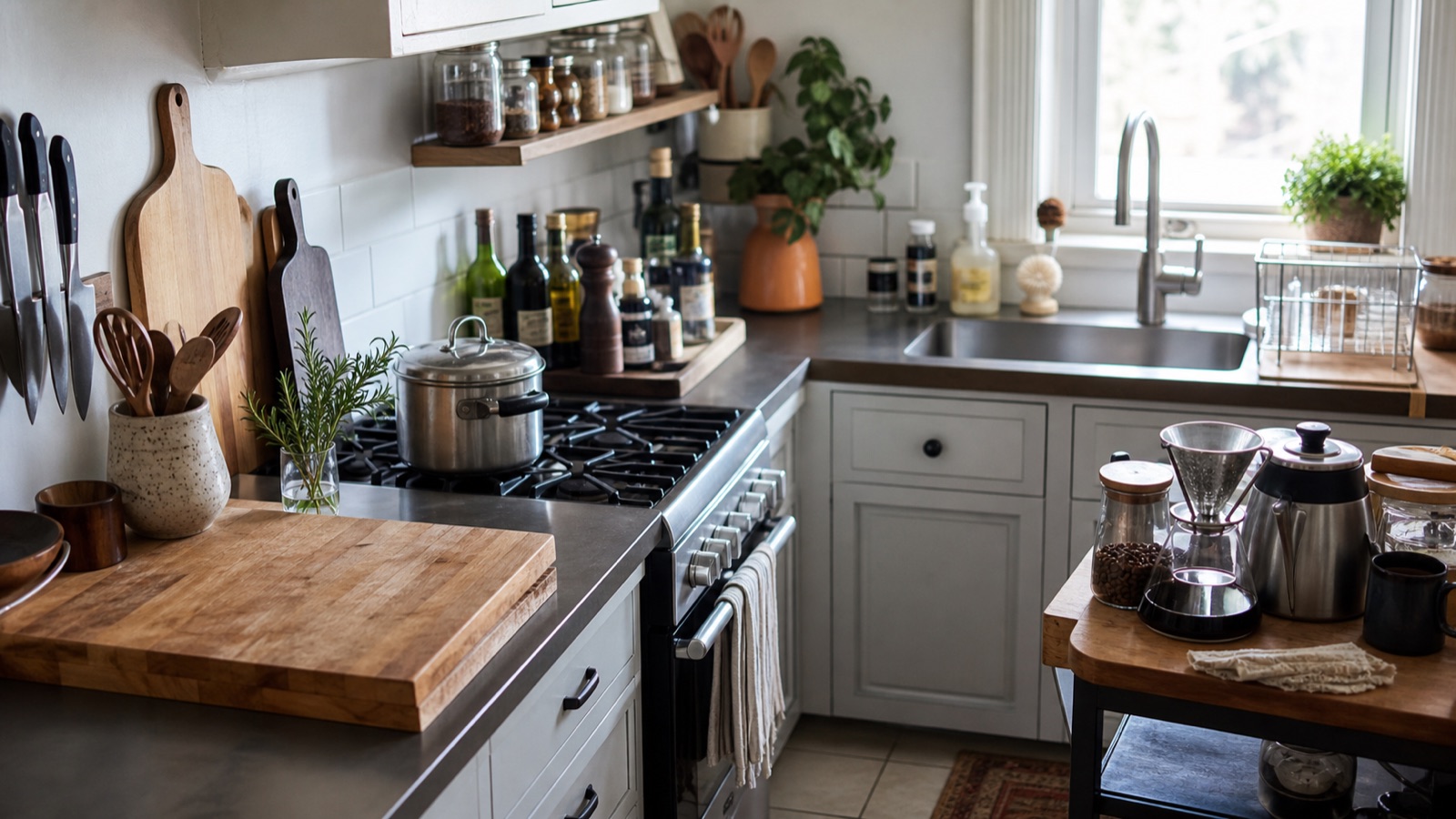
Your small kitchen probably isn't short on storage so much as short on logic. The pan you use every night lives across the room from the stove, the coffee mugs sit above the dishwasher instead of next to the coffee maker, and every "organizing hack" you try adds another bin without changing where things actually go. Most zone-organization guides are written for kitchens with a walk-in pantry and an island; they tell you to "create a baking zone" as if you had a spare cabinet to give it.
The zone system in this guide is the same one that anchors our step-by-step small kitchen organizing system, scaled down for kitchens where one cabinet may have to do two jobs. You'll map five zones, decide what earns first-reach storage in each, and see exactly where the system needs bending in a galley, one-wall, or no-drawer layout.
What a kitchen zone actually is
A zone is a stretch of counter plus the storage within arm's reach of it, dedicated to one type of task. The test is simple: can you do the whole task without taking a step? If you have to cross the kitchen to grab a cutting board while prepping, the prep zone isn't set up yet.
Zones are not categories. "All the plastic in one cabinet" is a category; "everything you need to pack lunch, next to the fridge" is a zone. Categories look tidy on a shelf but send you walking; zones cut the trips. That difference is why a zoned kitchen feels bigger even when nothing has been thrown away.
The five zones for a small kitchen
Bigger kitchens can carve out six or seven zones. In a kitchen under about 100 square feet, five is the realistic ceiling, and two of them will usually overlap.
- Prep zone: the longest clear stretch of counter, ideally between sink and stove. Holds knives, cutting boards, mixing bowls, measuring tools, and the trash bin.
- Cooking zone: the stove and the cabinet or drawer directly beside it. Holds pots, pans, lids, spatulas, oils, salt, and the spices you cook with weekly.
- Cleaning zone: the sink, dishwasher (if any), and under-sink cabinet. Holds dish soap, sponges, towels, trash bags, and cleaning sprays.
- Food storage zone: the fridge plus whatever cabinet is closest to it. Holds dry goods, containers, snacks, and lunch-packing supplies.
- Serving and drinks zone: dishes, glasses, mugs, and the coffee or tea setup. In a small kitchen this is often the cabinet nearest the dining table or the doorway, not the one nearest the sink.
If your layout only allows four, merge serving into food storage and keep the other three separate. Prep, cooking, and cleaning are the zones you use every single day, and they should never share a cabinet.
Map your zones in 20 minutes
You don't need to empty a single cabinet to plan this. Grab painter's tape or sticky notes and give yourself 20 minutes.
- Stand at the stove and note every cabinet and drawer you can reach without moving your feet. That's your cooking zone's storage, full stop.
- Do the same at the sink. Anything reachable from there is cleaning-zone storage, including the under-sink cabinet.
- Find the longest clear counter run. Label it prep and claim the drawer and cabinet beneath it.
- Whatever sits nearest the fridge becomes food storage. Whatever sits nearest the exit or table becomes serving.
- Label each door with a sticky note. Leave the notes up for a week before you move anything so you can catch conflicts.
The most common conflict is the sink-stove shared cabinet, where one cabinet is reachable from both. Give it to cooking; cleaning supplies come out once or twice a day, pans several times.
Decide what earns first-reach storage
Inside every zone there are three tiers, and most small-kitchen frustration comes from ignoring them. First-reach is the eye-level shelf and the top drawer: items used daily. Second-reach is the lower shelf, bottom drawer, and the door back: items used weekly. Dead storage is above the fridge, the highest shelf, and the back of deep corners: items used monthly or less.
Move through each zone and sort against those tiers. A slow cooker used twice a winter has no business in a first-reach cooking cabinet, no matter how heavy it is. Drawer dividers turn one top drawer into a genuine first-reach tier for the prep zone; the best drawer dividers for narrow drawers are the adjustable spring-loaded kind, which work in drawers from roughly 12 to 22 inches deep but slip in shallow drawers under about 2.5 inches tall.
Under the sink, the cleaning zone's first-reach tier is the front six inches of the cabinet. A two-tier pull-out or a tension rod for spray bottles keeps daily items forward; our under-sink organization guide walks through layouts that clear the garbage disposal and plumbing, and the best under-sink organizers roundup compares the ones that adjust around pipes.
When the zone system breaks, and how to bend it
One-wall and galley kitchens: the sink and stove often sit two feet apart with a single cabinet between them. Split that cabinet by shelf rather than by door: pans on the lower shelf (cooking), dish soap refills and towels on the upper (cleaning). A cabinet-door rack adds a fourth surface.
Kitchens with no drawers: the prep zone loses its top-drawer tier. Replace it with a countertop utensil crock and a wall-mounted knife strip, then use a shelf riser to create an upper and lower tier inside the prep cabinet. The countertop organization guide covers keeping that setup from creeping across your counter.
Not enough cabinets for five zones: put the overflow on wheels. A rolling cart parked at the end of the counter can hold the entire serving zone, or the food storage zone's containers, and roll out of the way when you need floor space. The best rolling carts for small kitchens guide compares three-tier carts, which fit gaps as narrow as about 12 inches but tip if you load the top shelf with heavy appliances.
Shared kitchens (roommates, dorms): zones work poorly per person and well per task. Zone the kitchen by task, then give each person one first-reach shelf inside the food storage zone.
Keep the zones alive
Zones drift. Guests unload the dishwasher into the wrong cabinet, and a month later the cooking zone has a stack of mugs in it. People who stick with a short weekly kitchen reset report that ten minutes of putting things back by zone is enough to hold the layout; the ones who skip it tend to rebuild the system every few months from scratch.
Two rules help more than any product. Store things at the point of first use, not the point of washing, and never let a zone borrow space from another zone "just for now." When you outgrow a zone, that's a signal to declutter it, not to spill into the next cabinet.
Where products earn their place
You can zone a kitchen without buying anything. Where products genuinely help is in creating tiers inside a zone that only has one shelf. Matching, stackable containers make the food storage zone's first-reach shelf hold twice as much; our best stackable containers comparison covers sets that nest when empty, which matters most in kitchens with a single food cabinet. For the cleaning zone, start with the under-sink organizer roundup above, and for prep, drawer dividers or a knife strip will do more than any decorative canister.