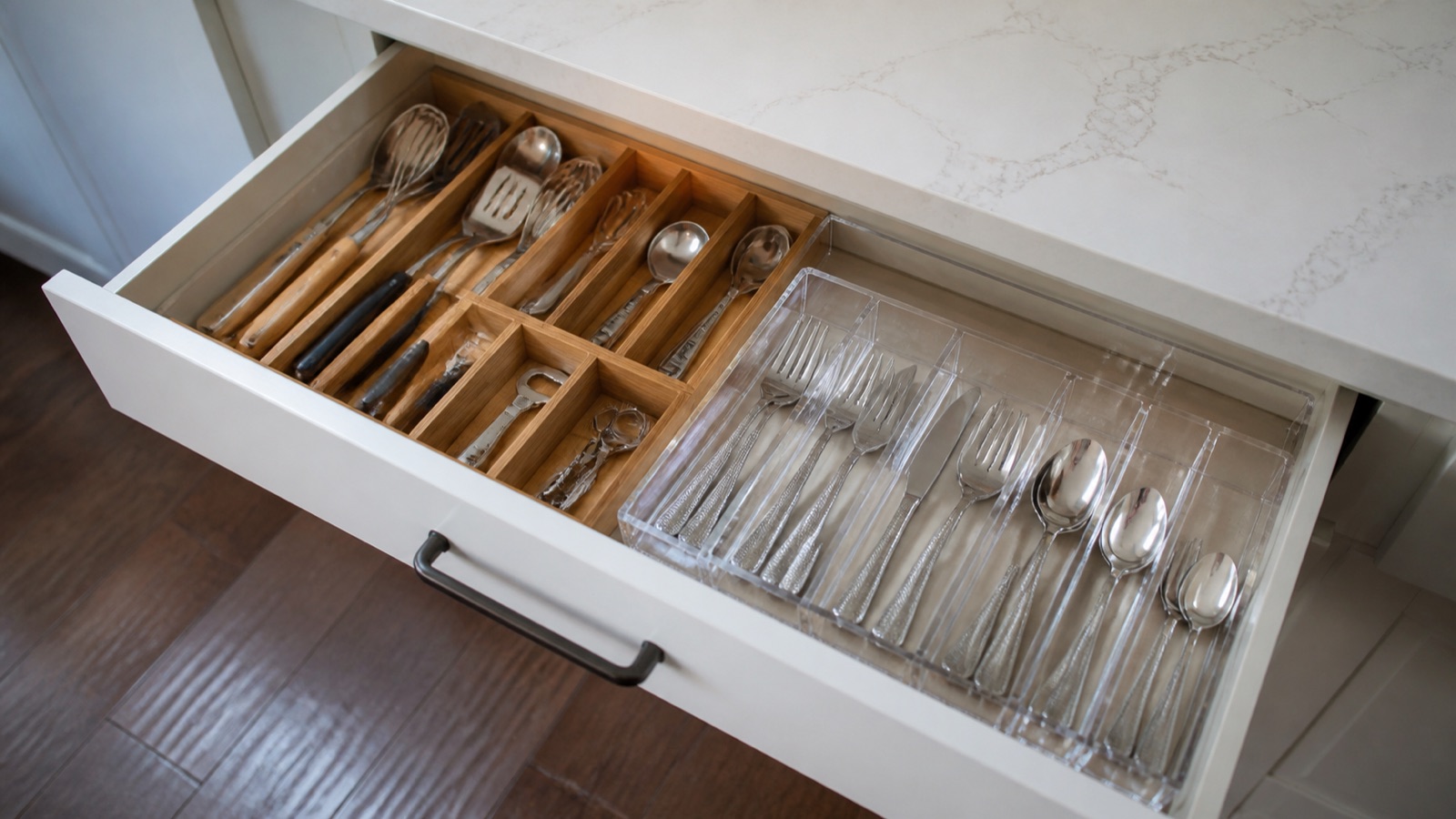
Small kitchens rarely have more than two or three drawers, so each one ends up holding utensils, knives, foil, and the junk that has no other home. Drawer dividers turn that pile into lanes, but they come in several very different mechanisms, and a divider that is perfect for a deep pot drawer is useless in a shallow utensil drawer. This guide is part of our small kitchen organizer buying guide and sorts dividers by how they work so you can match one to the drawer you have.
Buy spring-loaded dividers if your drawers are odd sizes and you want lanes without buying a tray that never quite fits. Buy an expandable tray if the drawer is the everyday utensil drawer. Buy modular bins if you want to reconfigure as your needs change, and buy an in-drawer knife insert if the counter block has to go. Skip dividers for any drawer shallower than a stacked spoon, since nothing will stay in its lane there.
| Product | Width | Depth | Height | Material | Price |
|---|---|---|---|---|---|
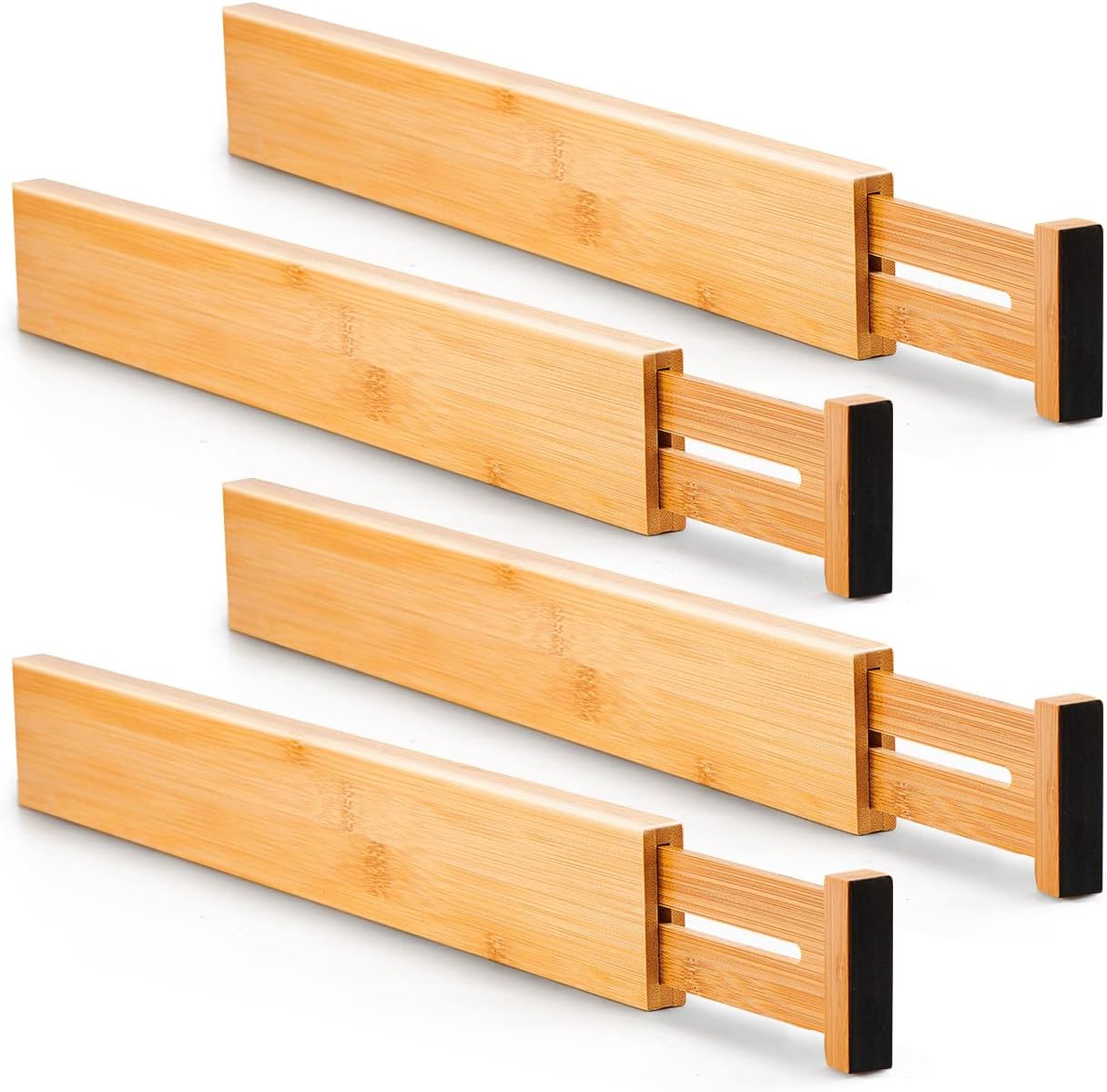 UtoplikeUtoplike 4 Pcs Bamboo Kitchen Drawer Dividers, A... UtoplikeUtoplike 4 Pcs Bamboo Kitchen Drawer Dividers, A... | 0.6 in | 21.7 in | 2.4 in | Bamboo | $27.20 as of Aug 27Check price |
 PipishellPipishell Bamboo Expandable Silverware Drawer Or... PipishellPipishell Bamboo Expandable Silverware Drawer Or... | 19.68 in | 16.92 in | 1.92 in | Bamboo Wood | $25.99 as of Aug 27Check price |
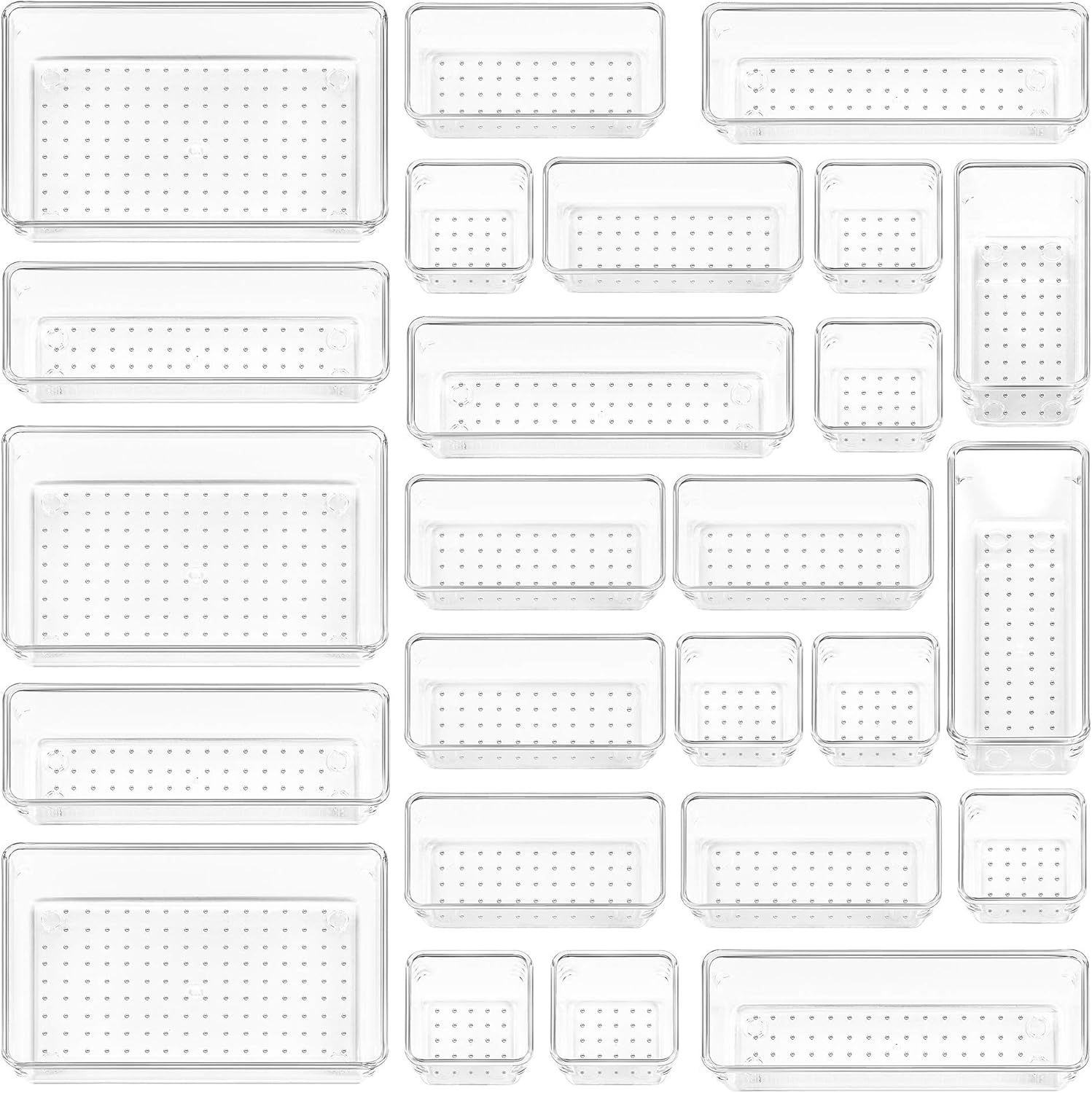 VtopmartVtopmart 25 PCS Clear Plastic Drawer Organizers... VtopmartVtopmart 25 PCS Clear Plastic Drawer Organizers... | 5.91 in | 9.25 in | 6.5 in | Plastic | $18.99 as of Aug 27Check price |
 UtoplikeUtoplike In-Drawer Knife Block, Bamboo, Large (u... UtoplikeUtoplike In-Drawer Knife Block, Bamboo, Large (u... | 12.2 in | 16.6 in | 1.8 in | Bamboo | $34.95 as of Aug 27Check price |
 Rev-A-ShelfRev-A-Shelf Trimmable Pegboard Drawer Divider Or... Rev-A-ShelfRev-A-Shelf Trimmable Pegboard Drawer Divider Or... | 24.25 in | — | 24.25 in | — | $116.99 as of Aug 27Check price |
Dimensions as listed; dividers show their extended length.
Take the first one that fits
- Are the drawers odd sizes, and you want lanes without a tray that never quite fits?Spring-loaded adjustable dividers
- Is it the everyday utensil drawer?Expandable utensil tray
- Do you want to reconfigure as your needs change?Modular interlocking bins
- Does the counter knife block have to go?In-drawer knife insert
- OtherwiseDeep-drawer dividers or a peg system
SkipDividers for any drawer shallower than a stacked spoon; nothing stays in its lane there
Spring-loaded adjustable dividers
Spring-loaded dividers are single bars with a tension mechanism that presses against the front and back of the drawer, so they hold in place without screws or adhesive. They are the most flexible option because each bar goes wherever you want it, which makes them ideal for renters and for drawers that are not a standard width. Bamboo and plastic versions are both common.
Fit and limits: they rely on friction, so a drawer with a slick laminate interior lets them slide when you toss in a heavy utensil. Bars only run one direction, front to back or side to side, so you cannot make a grid without a second set. The most common complaint in reviews is bars popping loose when the drawer is slammed.
What to check in the listing: the minimum and maximum length range, the height of the bar against your drawer's interior height, and whether the ends have rubber pads. A set of four usually runs $15–30.
Pros
- Fits any drawer within the length range
- No tools, no adhesive
- Move bars as your needs change
Cons
- Slides in slick drawers
- Pops loose when the drawer is slammed
- Bars run in one direction only
Expandable utensil trays
Expandable trays are a fixed set of compartments with a sliding section that widens to fill the drawer. They are the classic choice for the main utensil drawer and suit anyone who wants forks, knives, spoons, and serving tools sorted without thinking about it. Most are plastic or bamboo, and many have a removable insert for the widened section.
Fit and limits: the compartments are sized for standard flatware, so long serving spoons and whisks end up diagonal across the top. Fully extended, the sliding section flexes and can leave a gap that collects crumbs. The tray still slides in the drawer unless the base has grip feet or you add a non-slip liner.
What to check in the listing: the width range, the compartment length against your longest everyday utensil, and whether the tray is dishwasher-safe. Expect to pay usually $15–35. If the drawer holds more than flatware, our kitchen drawer organization guide shows how to combine a tray with a divider bar for the tools that do not fit.
Pros
- Sorted flatware with no setup
- One tray fits a range of widths
- Easy to lift out and wash
Cons
- Long utensils do not fit the slots
- Extended section flexes and gaps
- Slides without a liner
Modular interlocking bins
Modular bins are individual open boxes in a few standard sizes that snap or nest together, so you build a custom layout for each drawer. They are for the drawer that holds a mix of odd things: measuring cups, twist ties, bag clips, tea, the bottle opener. Because each bin lifts out on its own, you can carry one to the counter and put it back.
Fit and limits: bins that do not interlock slide as a group, and even interlocking sets shift if they do not fill the drawer edge to edge. Buying enough bins to fill a drawer often costs more than a tray. Tall bins block the view of what is behind them in a shallow drawer.
What to check in the listing: the bin heights against your drawer's interior height, whether the bins connect, and if the set includes non-slip pads. A starter set usually runs $12–25, and a full drawer often needs two sets. For cabinets and pantry shelves, the same bins are covered in our inside-cabinet organization ideas.
Pros
- Custom layout for odd items
- Lift one bin out at a time
- Reuse the bins in another drawer later
Cons
- Slides unless the drawer is filled edge to edge
- Costs more than a tray to fill a drawer
- Tall bins hide what is behind them
In-drawer knife blocks and blade inserts
In-drawer knife inserts are slotted bamboo or plastic blocks that lie flat in a drawer, holding each knife blade-down in its own groove. They free the counter from a knife block and keep blades from clanking against each other, which is the safer setup with kids in the house. They come in fixed-width blocks and in expandable versions for wider drawers.
Fit and limits: the drawer needs enough interior height for the handles to clear the drawer above, so shallow drawers push the knives up where the drawer catches. Slots are cut for standard chef and paring knives, and cleavers or wide santokus may not fit. The block takes a large share of a small drawer, so it usually displaces the utensil tray.
What to check in the listing: the interior height it needs, the number of slots, and whether the slots are angled for easy grip. Prices usually land at $20–45. If drawer space is too tight for a block, a wall strip is the other counter-free option; see the best magnetic knife strips and the wider knife storage without a countertop block guide.
Pros
- Frees the counter of a knife block
- Blades protected and out of reach
- Expandable versions fit wider drawers
Cons
- Needs a drawer with enough height
- Slots miss wide or unusual blades
- Takes most of a small drawer
Deep-drawer dividers and peg systems
Deep pot drawers and plate drawers need tall dividers, either long bamboo or acrylic panels with brackets, or a pegboard base with movable pegs that box in each stack. They are for kitchens where the drawers are deep enough to hold pans, plates, or containers upright, and they stop the plate stack from sliding into the pots every time the drawer closes. Peg systems are the most adjustable; panel dividers are the sturdiest.
Fit and limits: these are useless in a standard shallow drawer, and the peg boards have to be trimmed to fit unless the drawer is close to the board's size. Plates stored upright between pegs need enough height, and tall dividers can catch on the drawer above if the drawer is not truly full height. Panel dividers often mount with brackets that need adhesive or screws.
What to check in the listing: the divider height, whether it is trim-to-fit, and how it attaches to the drawer base. Sets usually run $20–50. If your kitchen has no drawers at all, none of this applies, and our kitchen with no drawers guide covers the cabinet and cart substitutes.
Pros
- Keeps plates and pots from sliding
- Pegs adjust for any stack size
- Panel dividers handle heavy loads
Cons
- Only for deep drawers
- Pegboards need trimming to fit
- Brackets may need screws or adhesive
How to choose drawer dividers
Measure the drawer's interior length, width, and height with the drawer pulled out, since the front face is wider than the inside and the interior height is less than the drawer front. Compare those to the listing's minimum and maximum range rather than a single stated size; the most common complaint in reviews is a divider that is an inch too long or too tall.
Then match the mechanism to the drawer. Utensil drawers take a tray plus one spring bar for the long tools; junk drawers take modular bins; deep drawers take pegs or panels. Add a non-slip liner under anything that does not lock to the drawer, and prefer bamboo or rigid plastic over thin plastic that bows. If you plan to reorganize often, spring bars and bins move with you; trays and blocks are more of a commitment.
Keeping the drawer sorted
Dividers set the lanes, but the drawer only stays sorted if each lane has a category and the extras leave. Pull everything out, keep what you used this month, give each group a lane, and put a liner underneath so nothing drifts. Our kitchen drawer organization guide walks through that process drawer by drawer, and if spices share the drawer, the spice storage ideas for small kitchens guide shows the tiered inserts that keep jars readable.