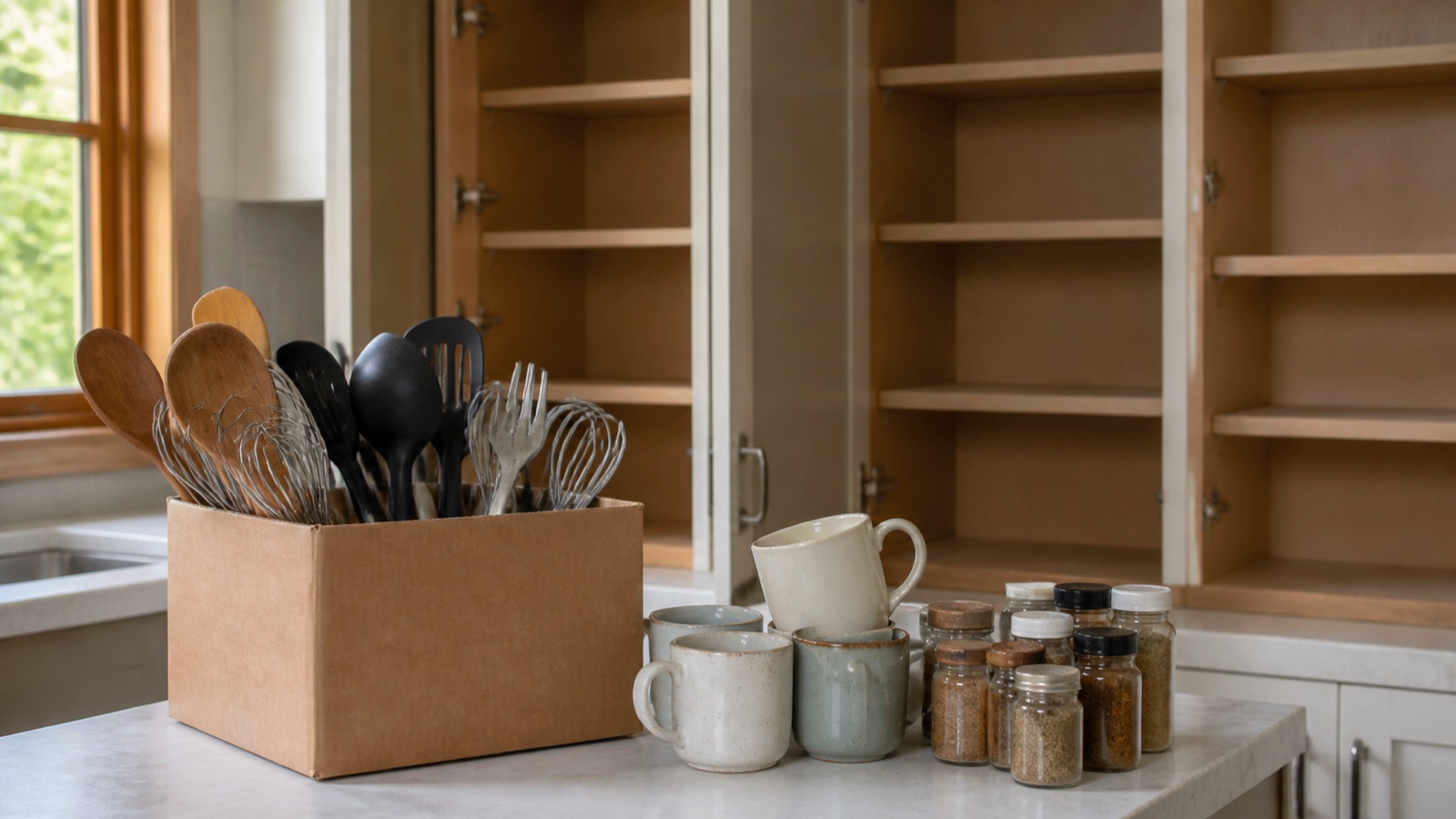
You open the cabinet, three lids fall out, and you close it again. That's the moment most people go looking for a kitchen declutter checklist, and most of what they find is either a forty-item list with no order to it or a "declutter your whole kitchen in a weekend" plan that assumes you have a spare weekend and a dining table to spread everything across. In a small kitchen you need to work one cabinet at a time, with a clear rule for what leaves, because there's nowhere to stage a pile.
This checklist is the first step of our step-by-step small kitchen organizing system: declutter before you buy a single bin. It's split into six zones of about 15 minutes each, so you can do one tonight and the next one tomorrow. Print this page or copy the lists into your notes app and check items off as you go.
Set up before you start (5 minutes)
Every zone below uses the same three destinations, so set them up once. You'll need a trash bag, a donate box, and a "decide later" box with today's date written on it.
- Work on one zone per session; don't open a second cabinet until the first is closed.
- Put a timer on. When 15 minutes are up, stop, even mid-shelf. Momentum matters more than finishing.
- The decide-later box gets sealed and stored out of the kitchen. Anything you haven't gone back for in 30 days leaves unopened.
- Wipe the shelf while it's empty. It takes 30 seconds and you won't do it later.
This works when you have a closet or car trunk to park the box in. It doesn't work if the box stays on the counter; it will quietly become storage again.
Zone 1: Countertops (15 minutes)
Counters are the fastest win and the one that changes how the kitchen feels. The rule for a small kitchen: only things used daily stay out.
- Small appliances used less than three times a week: move to a cabinet or the top of the fridge.
- Decorative items, extra utensil crocks, fruit bowls with no fruit in them: donate or relocate.
- Mail, chargers, keys, and anything that isn't kitchen-related: out of the kitchen entirely.
- Dish rack: keep only if you use it every day; otherwise, switch to a foldable one that stores under the sink.
- Spice racks and oil bottles: keep the three you reach for while cooking, move the rest inside.
Deciding where the displaced appliances go is its own problem in a tiny kitchen; the guide to where to put small appliances covers the options by appliance size. Once the counter is clear, the countertop organization guide helps keep it that way.
Zone 2: Food containers and lids (15 minutes)
This is where the lid avalanche lives, and it's the zone where most people find they own twice what they need.
- Match every container to a lid. Anything unmatched goes: recycling for plastic, donate for glass.
- Stained, warped, cracked, or smelly plastic: toss.
- Count what's left. For one or two people, 8 to 12 containers in two or three sizes is plenty; a family rarely needs more than 20.
- Takeout containers and deli tubs: keep at most five for sending leftovers home with guests, recycle the rest.
- Lids that don't stack or nest: consider replacing the whole set with one system.
If you replace the set, this is the one purchase worth making before you organize, because a matching set changes how much cabinet space you need. The best stackable containers roundup compares sets whose lids nest and whose bases stack, and the Tupperware lid storage guide shows how to store the survivors so they stay matched.
Zone 3: Cookware and bakeware (15 minutes)
- Pans with flaking nonstick, warped bottoms, or loose handles: toss, they won't get better.
- Duplicate sizes: keep the one you reach for, donate the other.
- Specialty pans used once a year (bundt, springform, paella): decide-later box.
- Lids with no pot, pots with no lid: pair them or let them go.
- Sheet pans and cooling racks: keep two sheet pans and one rack unless you bake weekly.
For most small kitchens, the target is one skillet, one saucepan, one large pot, one sheet pan, and one baking dish. If your set is bigger than that and you're short on cabinet space, a nesting set is the honest fix; the best nesting cookware sets comparison covers sets that stack into a single cabinet footprint, and notes that detachable-handle sets frustrate people who cook with two pans at once.
Zone 4: Utensils and gadgets (15 minutes)
Empty the utensil drawer and the crock onto a towel. Then sort with one question: have you used it in the last three months?
- Duplicates (three spatulas, four wooden spoons): keep two of each at most.
- Single-purpose gadgets (avocado slicer, corn stripper, egg separator): decide-later box.
- Broken, melted, or rusted tools: toss.
- Dull knives you never sharpen: donate or sharpen this week; don't put them back dull.
- Measuring cups and spoons: one full set, plus a second set only if you bake often.
Zone 5: Pantry food and dry goods (15 minutes)
- Expired spices, stale crackers, opened bags with two servings left: toss.
- Duplicates you bought because you couldn't see the first one: consolidate into one container.
- "Aspirational" ingredients bought for one recipe over a year ago: donate unopened, toss opened.
- Decant only what you buy repeatedly (rice, oats, flour, pasta); leave occasional items in their packaging.
- Group what remains by meal, not by category: breakfast, baking, dinner staples, snacks.
Zone 6: Under the sink and cleaning supplies (15 minutes)
- Nearly empty bottles: combine or finish this week.
- Products you tried once and disliked: give away.
- More than two of the same sponge, brush, or cloth type in use: keep a backup, store the rest elsewhere.
- Plastic bags: keep what fits in one dispenser, recycle the rest.
- Check for leaks and water damage while the cabinet is empty; it's the only time you'll see the back corner.
What to do the day after
Decluttering without a system for putting things back creates the same mess in six weeks. Once the six zones are done, assign each cabinet a job using the kitchen zone system, then hold the line with a short weekly kitchen reset. People who stick with this order, declutter first, zone second, buy third, report that they end up purchasing far fewer organizers, because the emptied cabinets already have room.
When you do buy, buy for the zone that gave you the most trouble. For most small kitchens that's the container cabinet, which is why the stackable container roundup above is the place to start.