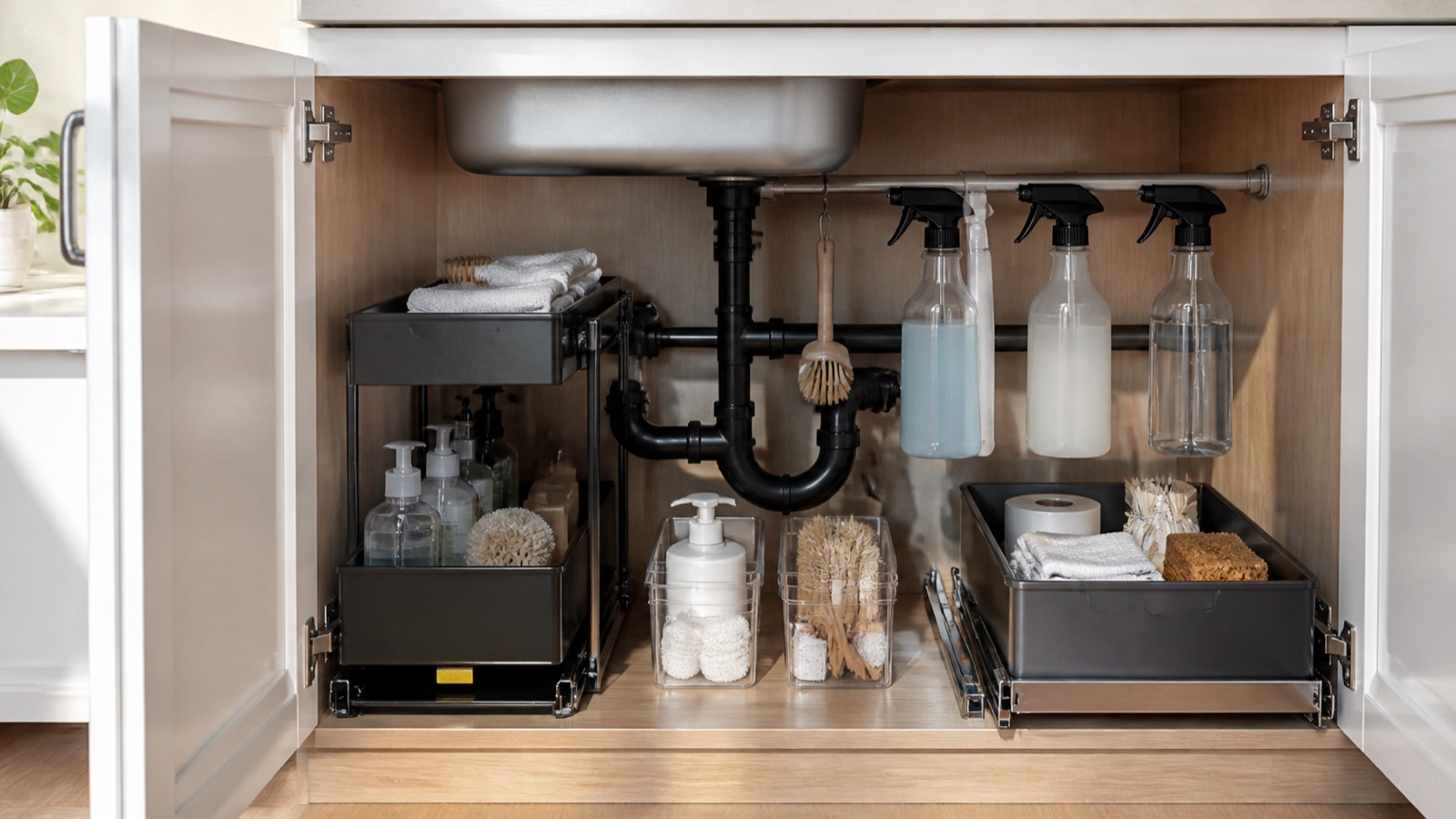
The cabinet under your kitchen sink is probably the least useful 30 inches of storage you own. A P-trap drops right through the middle, a garbage disposal eats the left third, and the water shutoffs sit exactly where a bin would go. Most under sink organization ideas online are photographed in a cabinet with no plumbing at all, which is why the organizer you ordered did not fit.
This guide is one zone in our small kitchen storage by zone series, and it treats the pipes as the starting point rather than an afterthought. Every setup below comes with the cabinet width, depth and clearance it needs, and the situations where it simply will not work. Measure first, and you will only buy once.
Measure around the plumbing before you buy anything
Open the doors and write down four numbers: the clear opening width between the door hinges, the interior depth from the back wall to the cabinet face, the height from the cabinet floor to the underside of the sink basin, and the position of the P-trap and disposal. In a small kitchen the opening is often only 24 to 30 inches wide, and a disposal can take 8 to 10 inches of that on one side. Note whether the drain comes down in the center or is offset, because that decides whether a two-sided organizer or a one-sided one is the right shape.
Also check the height. A shallow stainless sink leaves 18 to 20 inches of clearance, while a deep farmhouse basin can cut that to 12 or 13 inches, which rules out most two-tier organizers. If you have a face-frame cabinet, the frame edge will narrow the usable opening by another inch or two on each side.
- AClear height from the cabinet floor to the underside of the basin — a deep farmhouse sink cuts it
- BClear opening width between the door hinges; a disposal and a face frame both narrow it
- CInterior depth from the cabinet face to the back wall
Expandable two-tier organizers for the wide, offset-drain cabinet
The most popular fix is an expandable two-tier shelf with a removable center panel, so the top tier can be split into two short sections that straddle the pipe. These usually adjust from about 18 to 30 inches wide and stand 10 to 14 inches tall, and they cost under $30 in most listings. They work well when your drain is offset to one side and the disposal, if you have one, is against a wall.
They do not work when the P-trap drops in the center and the disposal sits right next to it, because both tiers end up fighting the same 10 inches of space. Reviewers with deep basins also report that the top tier has only 3 or 4 inches of headroom, enough for a sponge box but not a bottle of dish soap. Check the listing for current dimensions and hold a tape measure at that height in your cabinet before ordering.
Sliding pull-out baskets for the deep back corner
The back 8 to 10 inches of an under-sink cabinet is where extra sponges and the backup dish soap go to be forgotten. A pull-out basket on rails turns that dead depth into reachable storage, and the narrow single-column versions, roughly 5 to 7 inches wide, fit beside a disposal where nothing else will. Freestanding pull-outs sit on the cabinet floor and need no screws, which makes them the renter-safe choice.
The limit is the cabinet floor itself. Many sink bases have a slightly raised or warped floor from a past leak, and freestanding rails will rock or jam on it. Screw-in pull-outs need a flat 3/4-inch plywood or particleboard floor to bite into, and you must leave 1 to 2 inches of side clearance for the drawer slides. If your shutoff valves sit low on the back wall, a full-depth pull-out will hit them, so measure to the valves rather than the wall.
A tension rod for spray bottles
A single spring tension rod set 8 to 10 inches below the sink basin lets you hang spray bottles by their trigger heads, which lifts them off the floor and out of the way of a bin. Rods rated for a 24 to 36 inch span typically hold 10 to 15 pounds, which is plenty for four or five bottles. This is the cheapest fix on the list, usually under $15.
It does not work in a cabinet with thin or damaged side walls, because the rod needs solid pressure on both ends to stay put, and reviewers who use them in older particleboard cabinets consistently report the rod sliding down after a few weeks. It also fails when the disposal or a water filter sits in the path of the rod. If you like this approach, our guide to the best tension rod shelves for renters covers the stronger models that hold under load.
Use the inside of the cabinet doors
A cabinet door is a vertical surface about 15 by 24 inches that most people leave empty. An over-the-door caddy that hooks over the top edge can hold a scrub brush, gloves and a small trash bag roll, and adhesive hooks handle a dish brush or a folded microfiber cloth. This works best on flat slab doors that are the standard 3/4-inch thickness.
The limits are the hinges and the pipes. On a face-frame cabinet, a caddy that sticks out more than 3 inches can hit the frame or the P-trap when the door closes, and on doors with a raised panel the hooks may not sit flush. Our full guide to over-the-door storage in a small kitchen walks through the door types where these caddies fit and the ones where they do not.
Sort what belongs under the sink and what does not
Water is the reason under-sink storage fails over time. Keep only cleaning supplies, trash bags and sponges in this zone, and move paper products, spare dish towels and any food out entirely, because a slow drip from the supply line will ruin them before you notice. A waterproof liner or a 2-inch-deep drip tray on the cabinet floor costs under $20 and gives you one wipe-down instead of a warped shelf.
Renters should also think about what a maintenance visit looks like. Bins that lift out in one motion are easier than a fixed rack when the plumber needs to reach the trap. For a broader system for this category, see our guide to storing cleaning supplies in a small kitchen, which covers the items that do not need to live under the sink at all.
Pick an organizer that matches your cabinet, not the photo
If your drain is offset and you have 18 inches of height, a two-tier expandable shelf is the best value. If the disposal takes a third of the cabinet, go with narrow pull-outs and a tension rod instead. Either way, our roundup of the best under-sink organizers compares the shapes by cabinet width and drain position, so you can match one to the numbers you just measured. For the rest of the kitchen, the storage by zone hub covers every other cabinet, drawer and wall.