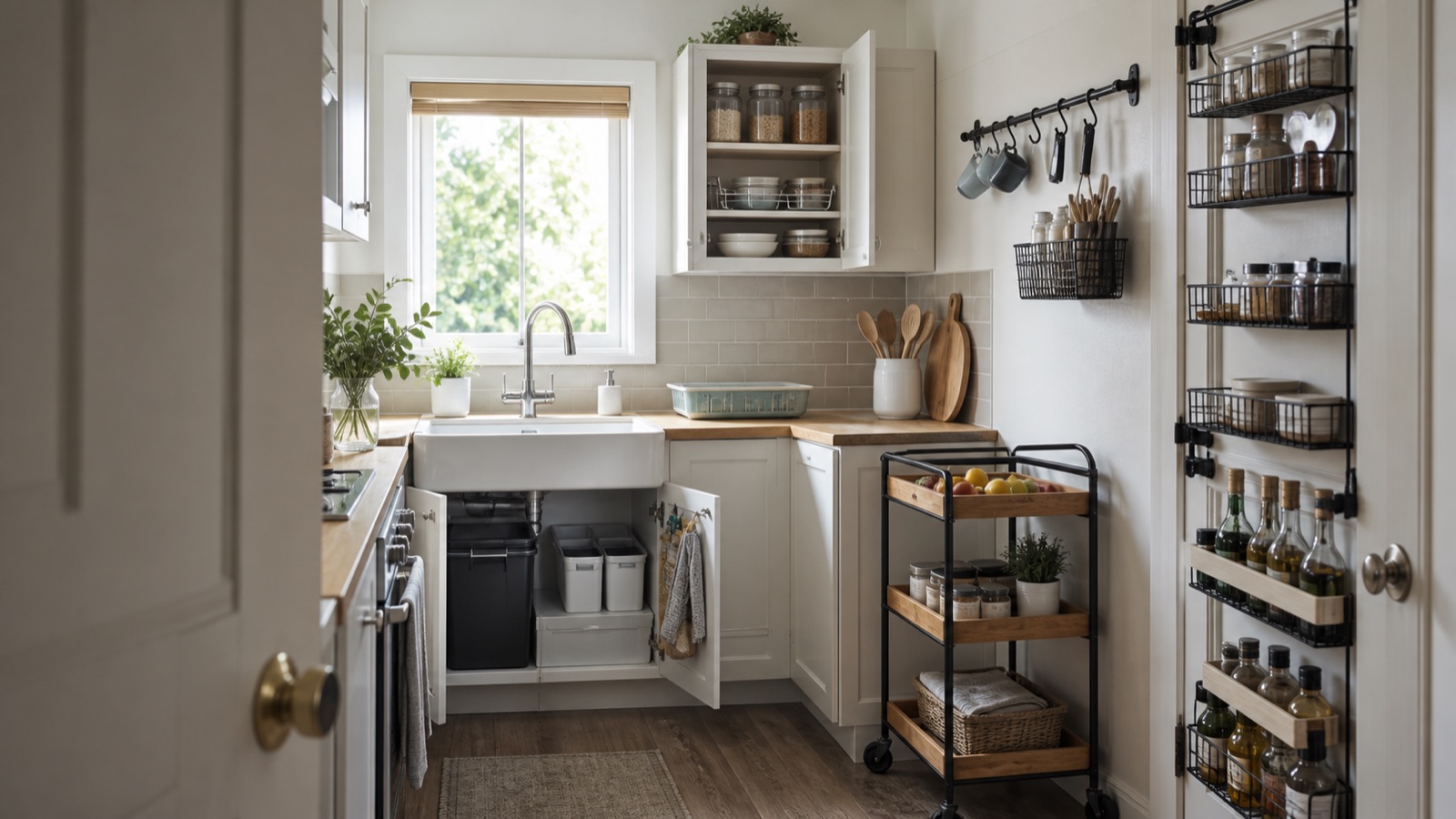
You have already scrolled a "26 small kitchen storage ideas" list and still have nowhere to put the air fryer. The problem is not a shortage of ideas; it is that those lists are sorted by novelty, not by where the empty space in your kitchen actually is. This guide is organized by zone instead: the counter, the inside of cabinets and drawers, the dead zones nobody uses, the doors and walls, and the mobile zone a cart creates. Each zone gets its own guide with specific organizers, the measurements to take first, and the situations where each idea stops working.
Read it as a walk-through. Stand in your kitchen, start at the counter, and work outward through the zones in order. In a kitchen under 100 square feet, you will usually find two or three zones doing nothing at all, and that is where the storage comes from.
Take the first one that fits
- Is the counter the problem: appliances and jars eating your prep space?Zone 1: the counter
- Are the cabinets full but the space inside them badly used?Zone 2: inside cabinets and drawers
- Is there dead space you never touch: under the sink, above the fridge, the corner, under the cabinets?Zone 3: the dead zones
- Are the doors, walls, and windowsill still bare?Zone 4: doors, walls, and windowsills
- OtherwiseZone 5: the mobile zone, a cart
Zone 1: The counter
The counter is the only zone you look at every time you walk in, so it sets how the whole kitchen feels. It is also where small kitchens lose the most: a coffee maker, a toaster, a knife block, and a dish rack can eat 4 feet of a 6-foot counter before you cook anything. The rule that holds up is one appliance per daily use, with everything else stored inside or above.
Countertop organization for a tiny kitchen covers how to decide what earns counter space, tiered corner shelves that use the height above the backsplash, an over-the-sink dish rack that gives the drying area back, and a plain tray that makes the appliances you do keep look deliberate. The limit is honest: counter organizers still take counter. Add three of them and you have replaced clutter with organized clutter.
Zone 2: Inside cabinets and drawers
Most upper cabinets are about 12 inches deep and 30 or more inches tall, with a single fixed shelf, which leaves a foot of dead air above every stack of plates. Inside-cabinet organization ideas is about reclaiming that air with shelf risers, stackable bins in the lower cabinets, and under-shelf baskets that hang from an existing shelf. It also explains when a riser is a mistake, such as a cabinet with adjustable shelves you could simply move.
Drawers are the other half. A small kitchen may have only two, so each one has to do the job of three. Kitchen drawer organization covers expandable dividers, stacking flatware trays, and storing utensils on edge in a deep drawer, with notes on the drawer depths where each option stops working.
Then there is the corner cabinet, the one where a blender went in years ago and never came out. Corner cabinet storage solutions compares lazy susans, pull-out corner units, and the low-cost option of a two-tier turntable, with the diameters that fit standard corner openings and the ones that get stuck.
Zone 3: The dead zones
Every small kitchen has three areas that hold almost nothing: under the sink, on top of the fridge, and the strip beneath the upper cabinets. Together they can add up to the storage of a full cabinet, which is why each one gets its own guide.
Under the sink is blocked by a drain pipe and often a garbage disposal, so a normal shelf does not fit. Under-sink organization for small kitchens shows the expandable two-tier organizers that build around the pipe, the stackable bins that keep cleaning supplies from leaking onto each other, and the tension rod trick for hanging spray bottles, with the widths to measure between the pipe and the cabinet wall.
Above the fridge is 12 to 18 inches of height that usually collects a cereal box and dust. Above-the-fridge storage ideas covers clear bins with handles, a small wire shelf, and what not to put up there, which is anything heavy or anything you reach for weekly.
The underside of the upper cabinets is the most overlooked. Under-cabinet storage walks through under-shelf baskets, stemware racks, and slide-in paper towel holders, and it separates the ones that need screws from the ones that hang on the shelf edge, which is what renters should use.
Zone 4: Doors, walls, and windowsills
When the horizontal surfaces are full, the vertical ones are what is left. Every cabinet door, every strip of open wall, and the windowsill over the sink can carry storage, as long as you match the organizer to the surface and its weight limit.
Over-the-door storage ideas for small kitchens covers cabinet-door racks for spices, lids, and foil, plus full-height racks for a pantry door, with the door thicknesses and interior clearances that make or break them. Vertical and wall storage for small kitchens handles the wall itself: pegboards, rail systems, magnetic strips, and floating shelves, along with the no-drill versions renters should use instead. Windowsill and ledge storage is the smallest zone but a real one, good for herbs, dish soap, and a narrow riser, as long as the sill is at least 3 inches deep and the window still opens.
Zone 5: The mobile zone
A rolling cart is the one zone you create instead of find. Parked beside the fridge or in the gap where a dishwasher would go, a 3-tier cart adds roughly 3 square feet of shelf that you can roll to the stove while cooking and back out of the way after. Using a rolling cart as a mobile kitchen zone explains how to give it a single job, whether coffee station, baking station, or the pantry you do not have, and why a cart with no job becomes a junk drawer on wheels within a month.
Renting? Read this first
If you cannot drill, the wall and under-cabinet zones change. The organizers still exist; they just attach differently, with tension rods, over-the-door hooks, and freestanding units instead of screws and anchors. Renter-friendly kitchen storage covers the whole kitchen through that lens, and no-drill kitchen storage ideas gives the specific swap for each zone above, with the wall types where adhesive products fail.
Organizers that earn their space
Each zone has one or two organizers that come up again and again in what renters and small-kitchen owners report actually working. For inside cabinets, start with the best shelf risers and cabinet shelves; measure cabinet depth first, because a riser that overhangs the shelf front gets knocked off. For the dead zone below the sink, the best under-sink organizers compares the expandable models that fit around plumbing and lists the clear width each one needs.
For corners, the best lazy susans for cabinets and corners sorts by the diameters that fit common corner openings. For drawers, the best drawer dividers and organizers focuses on the adjustable models that fit shallow rental drawers. For doors, the best over-the-door organizers and racks sorts by door thickness. For the mobile zone, the best rolling carts for small kitchens compares widths, since a cart that is an inch too wide for the gap is just furniture in the way.
All of these are collected in the small kitchen organizer buying guide, sorted by the same zones as this page, so you can go straight to the category you need.
Where to start
Start with the counter, because clearing it makes everything else feel possible. Then take the dead zones, since under the sink and above the fridge are storage you already own and are not using, and they cost under $30 to fix in most kitchens. Leave the walls and doors for last; they are the most work to install and the most visible when you get them wrong. One zone per weekend is a pace that renters consistently report they actually finish.