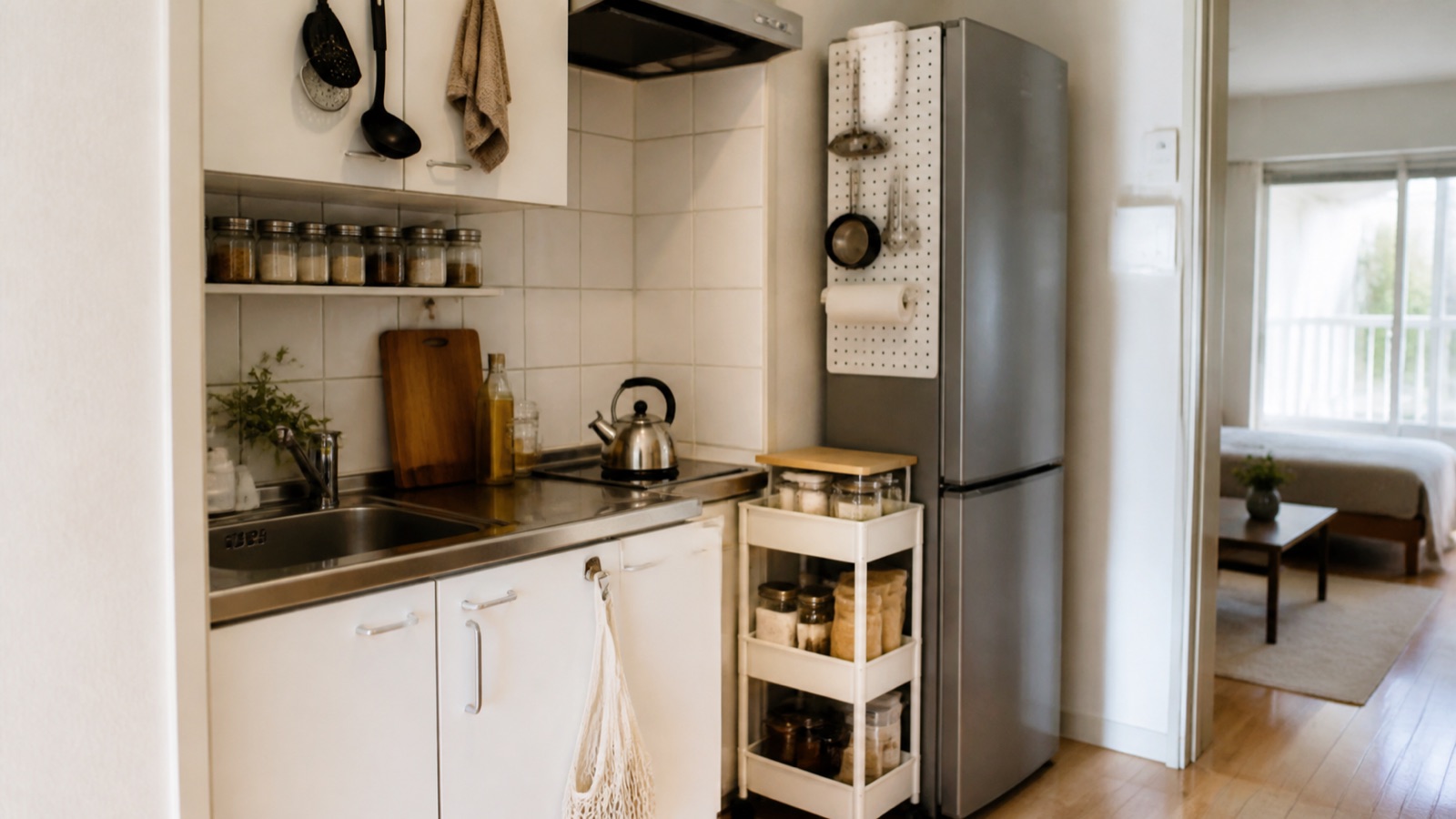
Your lease says no holes in the walls, your kitchen has about six feet of counter, and every "small kitchen storage ideas" article you open assumes you can screw a pot rack into a stud. That is the gap this guide fills. Every idea here can be installed and removed without a drill, and every guide linked below is sorted by the constraint you actually have: a rental with no pantry, a studio kitchenette, a dorm with a mini fridge, or an RV galley that has to survive a highway.
Read it in this order. Start with the no-drill toolkit, because tension rods, over-the-door racks, and freestanding shelving are the building blocks every other section relies on. Then jump to the one section that matches your living situation. Finish with the buying guides, so you spend money once on organizers that fit your cabinet depth and your landlord's rules.
Take the first one that fits
- Is the kitchen on wheels: an RV, a van, or a tiny house?Kitchens that move: RVs, vans, and tiny houses
- Is it a dorm room or a basement suite with a mini kitchen?Dorm rooms and basement suites
- Is the kitchen missing a pantry, drawers, or cabinets entirely?When the kitchen is missing something
- Is it a galley: two runs and a narrow aisle?Galley kitchens
- OtherwiseApartments, studios, and kitchenettes, then the buying guides
The no-drill toolkit every renter needs first
The four workhorses of renter-friendly kitchen storage are tension rods, over-the-door organizers, freestanding shelving, and adhesive hooks rated for the weight you will actually hang. None of them touch a stud, and all of them come out in minutes at move-out. The trade-off is capacity: a tension rod shelf holds a row of spice jars or a few cans, not a stack of cast iron, and adhesive hooks lose grip on textured, glossy, or freshly painted walls.
No-drill kitchen storage ideas that won't cost you your deposit walks through all four, with the weight limits and wall types where each one fails. Read it before you buy anything, because renters consistently report that the most common waste is an organizer that arrived and did not fit the cabinet.
Then read how to organize a rental kitchen without losing your deposit. It covers the lease-side questions that come up most: which adhesive products leave residue, whether shelf liner counts as an alteration, and how to photograph the kitchen the day you move in so the deposit is not a debate a year later.
Apartments, studios, and kitchenettes
A typical small apartment kitchen has 8 to 12 linear feet of upper cabinets and one or two drawers, and the counter is usually shorter than a bath towel. The winning move is vertical: shelf risers that double the usable height inside each cabinet, a rolling cart parked where a dishwasher would go, and the space above the cabinets reserved for things you touch twice a year. Small apartment kitchen storage ideas goes through these one surface at a time, starting with the counter you actually cook on.
A studio kitchenette is a different problem. You may have a two-burner cooktop, a mini fridge, and roughly 30 inches of counter, with your bed in the same sightline. Studio apartment kitchenette storage focuses on keeping the kitchen visually quiet: closed storage over open shelving, one cart that can roll out of the room, and a hard cap on how many appliances live on the counter.
When the kitchen is missing something
Some rental kitchens are not just small; they are missing a whole category of storage. Renters consistently report this is the most frustrating version, because generic advice assumes the pantry, the drawer, or the cabinet exists and just needs organizing.
If you have no pantry, dry goods end up in grocery bags on the floor within a week. No pantry? Where to put food in a small kitchen shows how to build a pantry out of a freestanding shelf, a reassigned cabinet, or an over-the-door rack, and how to keep it from turning into a snack avalanche.
If you have no drawers, utensils and dish towels have no obvious home. Kitchen with no drawers: storage that works covers countertop crocks, a utensil rail hung from a tension rod, and stackable bins inside a lower cabinet that behave like drawers without any hardware.
If you have almost no cabinets, everything has to live in the open. Kitchen storage without cabinets explains which freestanding pieces replace cabinets best, whether a baker's rack, a 4- or 5-tier wire shelf, or a microwave cart, and how to keep an open kitchen from looking like a storage unit.
Dorm rooms and basement suites
A dorm kitchen is often a mini fridge, a microwave, and whatever fits under the bed. Dorm kitchen storage ideas is built around that footprint: a 3-tier cart that slides in beside the fridge, stackable containers that pack into one box in May, and a short list of what not to bring in the first place.
Basement suites have their own quirks: lower ceilings, more moisture, and a kitchen that was often added after the house was built, with odd cabinet sizes. Basement suite kitchen storage addresses damp-safe food storage, low-clearance shelving, and making an awkward layout feel intentional instead of improvised.
Kitchens that move: RVs, vans, and tiny houses
Everything on the road has to survive being shaken. The renter playbook still applies, with one extra rule: if it is not latched, nested, or wedged, it will be on the floor at the first hard stop. That rule changes what you buy, since a cart that is perfect in an apartment is a hazard in a moving vehicle.
RV kitchen storage ideas that survive the road covers nesting cookware, non-slip liners, tension rods across cabinet fronts, and the weight limits that matter when your whole kitchen rides on axles. Camper van kitchen storage goes smaller still, for builds where the entire kitchen is a 2-foot counter and a single pull-out drawer. Tiny house kitchen storage sits in between: a stationary home, but with ladder-access lofts and fewer cabinets than almost any apartment.
Galley kitchens
A galley kitchen has two parallel walls, a narrow aisle, and no room for anything freestanding in the middle. It is one of the most common layouts in older rental buildings, and it punishes clutter fast because there is nowhere to step around it. Galley kitchen storage and organization focuses on the walls themselves: over-the-door racks on the cabinet doors, tension rod shelves inside the uppers, and keeping the aisle clear enough that two people can pass without turning sideways.
What to buy, and what to skip
Once you know your situation, the buying decisions get simple. For most renters, the first purchase is a set of renter-friendly tension rod shelves, because they add a shelf inside an upper cabinet, under the sink, or across a window without touching a wall. The limit is width and load: most adjustable rods span roughly 16 to 28 inches and are happiest under about 10 pounds, so measure the cabinet interior and weigh what you plan to put there before you order.
The second purchase is no-drill over-the-door storage for cabinet doors and the pantry door if you have one. Check door thickness first, because many hooks are sized for standard cabinet doors and will keep a thicker door from closing cleanly. Also confirm there is clearance behind the door, since a rack that hits the shelf inside is worse than no rack.
After that, it depends on your section above. Renters with no cabinets should look at the best rolling carts for small kitchens, which do the work of a lower cabinet for under $50 in most cases. Anyone on the road should compare nesting cookware sets before buying another pan. The complete set of comparisons lives in the small kitchen organizer buying guide, which is organized around the same constraints as this page, so you can go straight to the category you need.
Skip anything that promises heavy-duty holding power from adhesive alone. Adhesive hooks are fine for a dish towel or a light utensil, but renters consistently report that adhesive shelves and rails loaded with jars fail within weeks, usually taking paint with them. If something needs to hold real weight in a rental, put it on the floor, on a tension rod, or over a door.
Where to start
If you only read one more page, make it the no-drill guide. Then pick the single section above that describes your kitchen, fix that one gap, and stop. Renters consistently report that buying six organizers at once just creates a new pile of clutter; buying one that solves the worst problem is what sticks. When that one is working, come back here and take the next section.