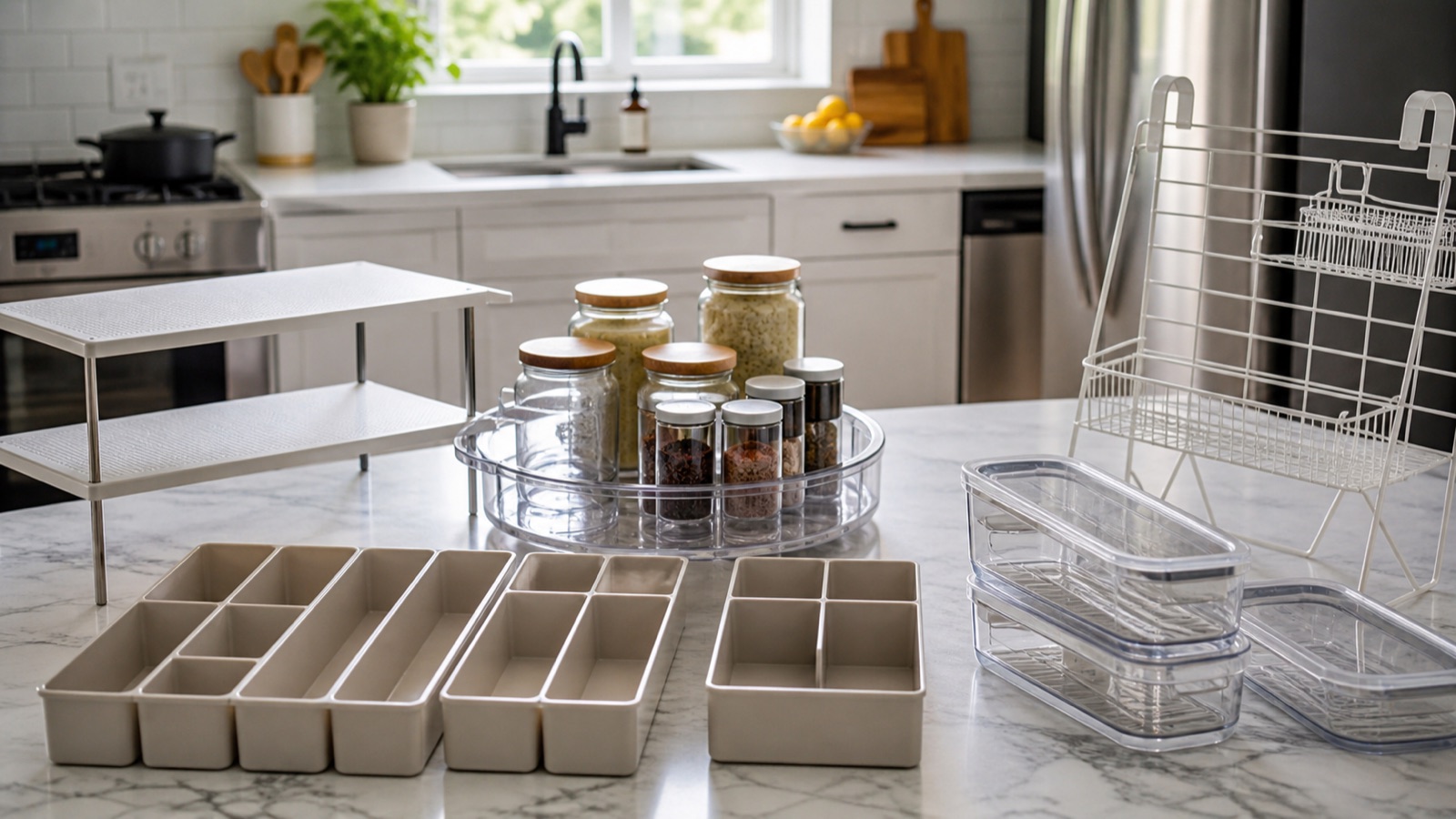
Most "best kitchen organizers" lists run 25 products long, sorted by star rating, and are written for a kitchen with a pantry and 30 feet of cabinet. If your kitchen is small, or rented, or both, the question is not which organizer is best overall. It is which category of organizer solves your specific problem, and what to measure before you order so it actually fits.
This guide answers that. It is organized by the problem you are trying to solve, and each section points to a dedicated comparison for that category, built around the criteria that matter in a small space: footprint, whether it needs a drill, how much it holds, and whether it comes out clean at move-out.
Read the measuring section first, even if you already know what you want. The most common complaint in organizer reviews is not quality; it is "did not fit," and nearly every one of those was avoidable with a tape measure and two minutes.
Take the first one that fits
- Do you rent, or can you not drill?No-drill organizers for renters
- Is the problem inside the cabinets: stacked plates, lost cans, wasted height?Inside the cabinet
- Is it the drawers: utensils, knives, and foil in one pile?Drawers
- Is it the counter, or the lack of one?Counter and mobile storage
- OtherwiseCookware and food storage sets
Before you buy: measure these three things
Cabinet interior depth and height. Most upper cabinets are about 11 to 12 inches deep inside; most lower cabinets are about 22 to 24 inches. Shelf risers, lazy susans, and pull-out organizers all list a footprint, and if you do not compare it to the inside of your cabinet, you are guessing. Height matters too, since a two-tier riser under a fixed shelf can leave no room for the plates it was meant to hold.
Door thickness and clearance. Over-the-door racks hook over the door edge, and the hook gap has to match the door. Then the rack has to clear whatever sits on the shelf behind it when the door closes, so measure from the inside of the door to the front edge of the shelf.
Wall type, and whether you can drill at all. Drywall with studs, tile, plaster, and brick each take different anchors, and a lease usually rules out drilling entirely. If you rent, read renter-friendly kitchen storage first, because it changes which categories below are even options for you.
No-drill organizers for renters
These are the categories that add storage without touching a wall. They are the first stop for anyone with a lease, and a sensible second stop for owners who do not want to patch and repaint later.
Tension rod shelves add a shelf inside a cabinet, under the sink, or across a window using nothing but pressure. Most span roughly 16 to 28 inches and are built for light loads, so they are for spice jars, cans, and spray bottles, not cast iron. The comparison sorts by span, by load rating, and by how well the end caps grip painted wood versus laminate, which is where the cheapest ones slip.
Over-the-door organizers and racks use the cabinet door or pantry door you already have. That comparison is sorted by door thickness and by basket depth, because a deep basket on a shallow cabinet blocks the shelf behind it. Magnetic knife strips and racks get the knife block off the counter; the guide covers screw-mount strips for owners and adhesive or fridge-side options for renters, with the honest limit that an adhesive strip should not be trusted with a heavy cleaver.
For the how-to side of all three, no-drill kitchen storage ideas walks through installation and the walls and doors where each one fails.
Inside the cabinet
This is where most small kitchens have the most unused space, usually a foot of air above every stack of dishes. Shelf risers and cabinet shelves are the cheapest fix, typically under $20 for a pair, and the comparison covers expandable models, stackable models, and the depth to match to your shelf. Lazy susans for cabinets and corners solve the corner cabinet and the spice cabinet; that guide sorts by diameter, since a turntable that is too large for the opening cannot be lifted out to clean.
Under the sink is its own problem because of the plumbing. Under-sink organizers compares the expandable two-tier models that build around the drain, the stackable bins, and the pull-out drawers, and lists the minimum clear width each one needs beside the pipe. Pair it with under-sink organization for small kitchens for how to lay out the cabinet once the organizer is in place.
Drawers
A small kitchen might have two drawers, so each one has to be perfect. Drawer dividers and organizers compares spring-loaded adjustable dividers, stacking flatware trays, and bamboo inserts, with a focus on the shallow drawers, often around 3 inches deep, that rental kitchens tend to have. The limit to know before buying: adjustable dividers rely on friction, and they slip in drawers with slick plastic or laminate interiors unless you add a liner.
Counter and mobile storage
When the cabinets are full, a cart is the only way to add a whole new storage zone. Rolling carts for small kitchens compares 3-tier carts by width, since the most useful ones are narrow enough, often under 18 inches, to fit beside a fridge or in the gap where a dishwasher would be. The guide covers wheel locks, shelf lips that keep jars from sliding off, and realistic weight capacities, and it is honest that a cart in a kitchen with no gap is just an obstacle you paid for.
For how to give the cart a job so it does not become a junk drawer on wheels, read using a rolling cart as a mobile kitchen zone.
Cookware and food storage
Two categories of purchase reduce what you need to store rather than storing it better. Nesting cookware sets replace five pans that do not stack with a set that does, which can free most of a lower cabinet; the guide covers detachable handles, induction compatibility, and the trade-off that a set is a bigger purchase than one pan. Stackable food storage containers end the lid avalanche by design, with lids that nest or clip to the base; that guide compares glass and plastic, and which sets fit a 12-inch-deep cabinet shelf.
Both pair with the item-by-item guides in what goes where in a small kitchen, which cover how to store the things you keep after the purchase.
How these comparisons are built
Every category guide on this site uses the same four criteria, in this order.
- Fit: does it match common small-kitchen cabinet, door, and drawer dimensions, and does the listing give measurements you can check.
- Hold: what renters and small-kitchen owners consistently report it carrying without sagging, slipping, or pulling paint.
- Removability: whether it comes out clean, which matters for a lease and for changing your mind.
- Price range: where it sits between "under $15" and "worth spending more," since a $40 organizer that fits beats three $12 ones that do not.
None of the guides rely on first-hand product testing. They lean on patterns in owner reviews, the manufacturer's stated dimensions and load ratings, and where those two disagree, the reviews win.
What to skip in a small kitchen
Some organizers are popular in big kitchens and a mistake in small ones. Countertop organizers that hold more than one category of thing turn into a second junk drawer. Adhesive shelves and rails that promise to hold jars fail in reviews far more often than adhesive hooks holding a towel.
Anything that needs 24 inches of clear cabinet depth will not fit an upper cabinet, whatever the listing photo shows. And a second cart is almost never the answer to a first cart that has no job.
Where to start
Measure first, then pick one category. If you rent, start with tension rod shelves or an over-the-door rack, since both come out clean. If you own, start with shelf risers, because they are cheap, fit almost every cabinet, and give the most space per dollar. Then walk your kitchen with small kitchen storage ideas by zone to see which zone should get the next purchase, and stop after one.