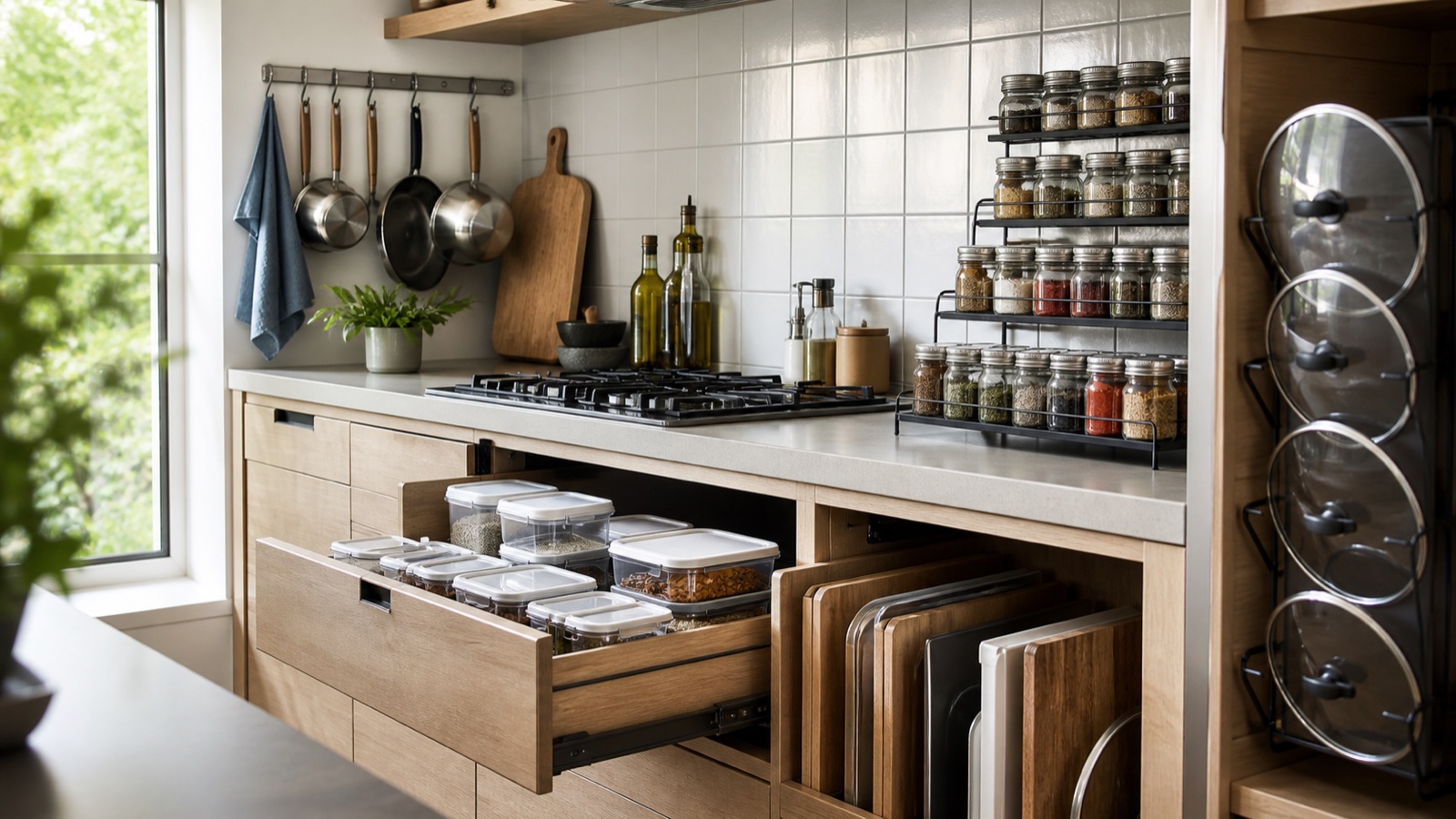
The frustration in a small kitchen is rarely the total amount of space. It is that specific things have nowhere to go: the pot lids that will not stack, the container lids that outnumber the containers, the air fryer that lives on the counter because no cabinet is deep enough to take it. Generic storage lists skip this, because they are organized by product, not by the item in your hand.
This guide is organized by item. Every guide below answers one question, where does this go in a kitchen with no room, and gives the two or three answers that actually hold up, with the limits of each.
Read it by walking through what is on your counter and in your most crowded cabinet right now. Start with the awkward shapes, since cookware and lids take the most space and have the fewest good options. Then move to food, prep tools, appliances, drinkware, and finally the utility items nobody wants to look at.
Take the first one that fits
- Is it cookware: pots, pans, lids, or sheet pans?Cookware section
- Is it food: containers, lids, produce, or snacks?Food storage section
- Is it a prep tool: knives, cutting boards, or spices?Prep tools section
- Is it a small appliance living on the counter?Small appliances section
- OtherwiseDrinkware, cleaning supplies, trash, and recycling
Cookware: pots, pans, lids, and sheet pans
Cookware is the biggest space problem in any small kitchen because it does not stack well and you use it daily. A basic set of five pots and pans with lids takes most of a lower cabinet if nothing nests. How to store pots and pans in a small kitchen covers nesting with felt pan protectors, a pull-out organizer that stands pans on edge, hanging them from a tension rod rail, and when a nesting cookware set is the honest answer for a kitchen with a single lower cabinet.
Lids are worse than the pots. Pot lid storage ideas that actually work compares a lid rack mounted inside the cabinet door, a file-style rack standing on the shelf, and adhesive hooks for lids under about 2 pounds, with the door clearance each one needs before the door will close.
Sheet pans, cooling racks, and muffin tins are flat, which means they get stored flat and then buried. How to store baking sheets and trays shows vertical storage in a narrow cabinet, a tension rod divider that turns one cabinet into slots, and an above-the-fridge rack for the pans you use once a month.
Food storage: containers, lids, produce, and snacks
Food storage containers multiply and their lids scatter. How to store Tupperware and food container lids is about the lid problem specifically: a lid organizer that stands them on edge, sticking to one brand so the lids nest, and the rule of keeping only as many as fit in one bin. It also covers when to give up and switch to a stackable set with lids that clip to the base.
Produce that should not be refrigerated needs air and dark, which a small kitchen rarely offers. How to store onions and potatoes in a small kitchen covers a hanging mesh basket, a tiered wire basket on the counter, and a ventilated bin in a lower cabinet, along with why onions and potatoes should never share a container.
Snacks are the category most likely to end up in a bag on top of the fridge. Snack storage and organization ideas covers clear labeled bins, a dedicated cart shelf, and an over-the-door rack for a kitchen with no pantry, with a note on portioning so the bins do not refill themselves.
Prep tools: knives, cutting boards, and spices
A knife block takes about 6 by 9 inches of counter, which in a small kitchen is a real cost. Knife storage without a countertop block compares a magnetic strip on the wall, a no-drill magnetic strip for renters, an in-drawer knife tray, and a slim block that stores inside a cabinet, with the wall types where a magnetic strip is not safe to mount.
Cutting boards need to stand upright to dry. Cutting board storage ideas covers a slot organizer inside a cabinet, an over-the-door holder, and the gap between the fridge and the wall, which fits a board perfectly if it is at least 2 inches wide.
Spices are the smallest items and the most likely to be scattered across three cabinets. Spice storage ideas for small kitchens compares a tiered riser inside the cabinet, a door-mounted rack, a drawer insert, and a magnetic option on the side of the fridge, with the jar heights each one accepts.
Small appliances: the counter hogs
The air fryer, the Instant Pot, the blender, and the stand mixer take more counter than everything else combined. Where to put small appliances in a tiny kitchen is a decision guide: which appliances earn a permanent counter spot, which go on a rolling cart, which go above the fridge, and how to store the rest so that using them is not a chore. It includes the cabinet depth a typical air fryer needs, which is why most upper cabinets will not take one.
Drinkware: mugs and water bottles
Mugs are the item most people own too many of, and they do not stack. Mug storage ideas when cabinet space is gone covers under-shelf mug hooks, a mug tree that fits in a corner, a rail hung from a tension rod, and a cap on the collection, which is the only fix that works every time.
Water bottles roll, tip, and do not fit standard shelf heights. How to store water bottles compares a wine rack repurposed for bottles, a stacking bottle organizer in a cabinet, and a bin in a lower cabinet, with the heights that fit tall insulated bottles.
Utility items: cleaning supplies, trash, and recycling
Cleaning supplies belong under the sink, but the sink cabinet is half plumbing. Cleaning supplies storage in a small kitchen covers an expandable under-sink shelf that builds around the pipes, a caddy you can carry to the bathroom, and a tension rod for spray bottles, with the widths to measure beside the pipe before buying.
Trash and recycling take floor space a small kitchen does not have. Trash and recycling in a small kitchen compares a slim can that fits between the counter and the fridge, a pull-out can inside a lower cabinet, an over-the-door bin for recycling, and the capacities that make sense for one or two people.
The organizers that solve the most item problems
A few products come up in almost every guide above, and they are worth knowing before you buy anything one-off. The best nesting cookware sets solve pots, pans, and lids at once for a kitchen with one lower cabinet, though a set costs more up front than a single pan. The best stackable food storage containers end the lid problem by design, and the best magnetic knife strips and racks get the knife block off the counter, with no-drill versions for renters.
For the utility items, the best under-sink organizers compares the expandable models that fit around plumbing, and the best lazy susans handle spices and oils in a corner cabinet. The full comparison set is in the small kitchen organizer buying guide, sorted by the problem each one solves.
Where to start
Start with cookware and lids. They are the biggest, the hardest to store, and the fastest win when they finally have a home. Then take the counter, which means appliances and the knife block.
Save the small stuff, spices and snacks, for last. Small-kitchen owners consistently report that solving one item category completely beats half-solving five, so pick one guide above and finish it before opening the next.