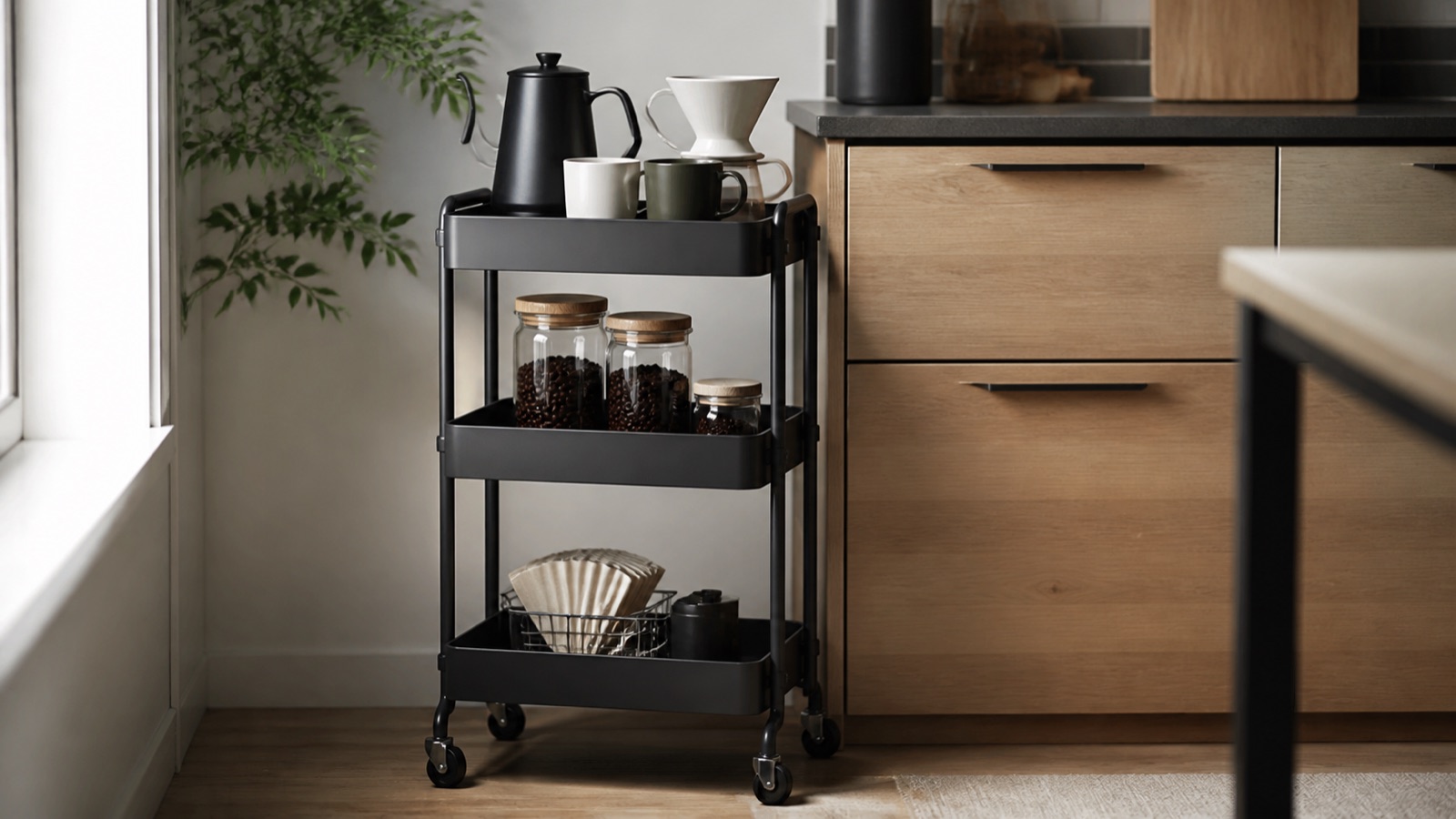
If your kitchen has one run of cabinets and less counter space than a desk, you have probably already looked at a three-tier rolling cart, because one shows up in nearly every small kitchen photo online. What those photos do not show is the same cart six months later, holding a blender, a bag of onions, a stack of mail, two phone chargers, and nothing you can find. People searching for kitchen cart storage ideas have usually hit that wall: the cart was supposed to add storage, and instead it added a rolling junk drawer that is also in the way.
The fix is not a better cart, it is a narrower job. This guide, part of our small kitchen storage ideas by zone series, treats the cart as a mobile zone that replaces one thing your kitchen is missing: a coffee station, a pantry, a place for the air fryer, or a prep surface. For each job you will find what goes on which shelf, what the cart needs to have (a solid top, locking casters, a weight rating), and where the idea breaks down.
Give the cart one zone, not everything
Decide what your kitchen lacks most before you decide what to buy. If the coffee maker eats the only counter, the cart is a coffee station. If dry goods are stacked on the floor of a cabinet, it is a pantry.
If the air fryer lives in a closet because there is nowhere to run it, it is appliance parking. If you chop on a cutting board balanced over the sink, it is a prep island.
Then hold the line: if something does not belong to that zone, it does not go on the cart. This is the same logic behind organizing a whole kitchen by task, and our guide to the kitchen zone system explains how to sort everything else the same way. A cart with one job stays usable; a cart that catches overflow from every other zone is the one you end up stepping around.
Coffee or breakfast station
A coffee cart puts the machine, mugs, and supplies on one rolling unit that parks against a wall and rolls to the outlet in the morning. The top shelf holds the coffee maker or kettle, the middle shelf holds mugs and a bin of pods or filters, and the bottom shelf holds beans in an airtight canister along with sugar and the toaster if you have one. Three-tier carts sized around 17 by 14 inches fit this job and often cost under $40.
The two things that make or break it are the top surface and the outlet. Wire mesh tops flex and let a kettle wobble, so pick a cart with a solid wood or bamboo top or lay a small cutting board across the mesh. The cart also has to park within reach of an outlet, since most appliance cords run 24–36 inches, and high-wattage kettles and coffee makers should plug straight into the wall rather than through an extension cord. Lock the casters before you pour; the most common complaint in reviews of light carts is that they roll away when you lean on them.
Overflow pantry
If you have no pantry, a cart is the closest thing to one that does not require a wall. Group food into bins by category, one bin per shelf section: cans and jars on the bottom shelf where the weight is stable, bottles and boxes in the middle, and snacks and bread on top where you can see them. Use opaque or labeled bins rather than open mesh baskets so the cart reads as a pantry instead of as clutter, and park it out of direct sun.
Weight is the limit that catches people. Lightweight three-tier mesh carts are built for light loads, and a case of canned goods weighs more than 20 pounds on its own, so check the listing for the per-shelf weight rating before you load it, and choose a heavier steel utility cart if cans are most of what you store. For the full plan on splitting dry goods between a cart, the fridge top, and cabinets, see where to put food when you have no pantry. Decanting flour, rice, cereal, and pasta into square containers makes the cart hold noticeably more than the original bags do; our roundup of the best stackable food storage containers covers sizes that fit a 14-inch-deep shelf.
Appliance parking
An air fryer, toaster oven, or multicooker that has no permanent counter spot can live on a cart, roll to the outlet when you cook, and roll back to a corner or a closet afterward. This needs a solid top at least 16 by 12 inches, because most air fryers and countertop ovens are 12–15 inches on a side, and a cart rated to carry the appliance plus a bit more, since many of these weigh 10–15 pounds. Store the accessories, liners, and cookbook on the shelves below so the whole zone moves as one piece.
Heat is the constraint people overlook. Air fryers exhaust hot air from the back and need 4–5 inches of clearance behind them, so do not park the cart against the wall while it runs, and never run a toaster oven on a lower shelf under a wooden top. Casters need to lock so the appliance does not drift while you open a hot drawer. Our guide to where to put small appliances in a tiny kitchen covers the cabinet and closet options for appliances that are too heavy for a cart.
Prep island
If what you lack is a place to chop, a cart with a butcher-block top becomes a small island. Look for a top 20–30 inches wide at counter height, around 36 inches, so you can work at it standing up, and for a shelf or drawer underneath for cutting boards and a mixing bowl. These are heavier and pricier than mesh carts, generally in the $100–250 range, and they usually arrive flat-packed with an hour of assembly.
The limits are floor space and stability. A prep cart needs about 6 square feet for itself plus room to stand at it, which in a galley kitchen may mean it only works parked at the end of the run. Cheap models sway when you chop, so locking casters are mandatory and a cart with a lower shelf that stiffens the frame is worth the extra cost. It does not roll on carpet, and an unfinished butcher-block top needs an occasional coat of mineral oil to keep from cracking.
Where it parks: the spot, the path, and the floor
A cart is only mobile if it has somewhere to park and a path to get there, so measure both before buying. Typical three-tier carts are 13–18 inches wide, 15–18 inches deep, and 30–32 inches tall, and many fit the gap beside a refrigerator or at the end of a cabinet run; check the listing for current dimensions and compare against the gap with a few inches to spare. Then confirm the path: a cart in front of the dishwasher blocks the door, a cart in a swing path gets hit by the oven door, and a threshold between kitchen and hallway stops small casters cold.
Floors matter more than people expect. Hard floors take any caster, but low-pile carpet needs casters of 2 inches or more and high-pile carpet defeats most carts entirely. If the kitchen has no parking spot at all, the cart can live in an adjacent room and roll in when needed; our guide to small apartment kitchen storage covers the layouts where that works.
- AHeight under whatever is above the gap — the cart plus anything stacked on top
- BWidth of the gap beside the fridge or at the end of the run, with a few inches to spare
- CDepth from the wall to the front of the fridge — a deeper cart sticks out into the path
Closing
Match the cart to the zone's weight: a light mesh cart with a solid top for coffee or a small pantry, a steel utility cart for cans and appliances, and a butcher-block cart when the job is chopping. Our roundup of the best rolling carts for small kitchens sorts models by those three jobs, with width and weight ratings for each, so you can pick the one that fits the gap you measured.