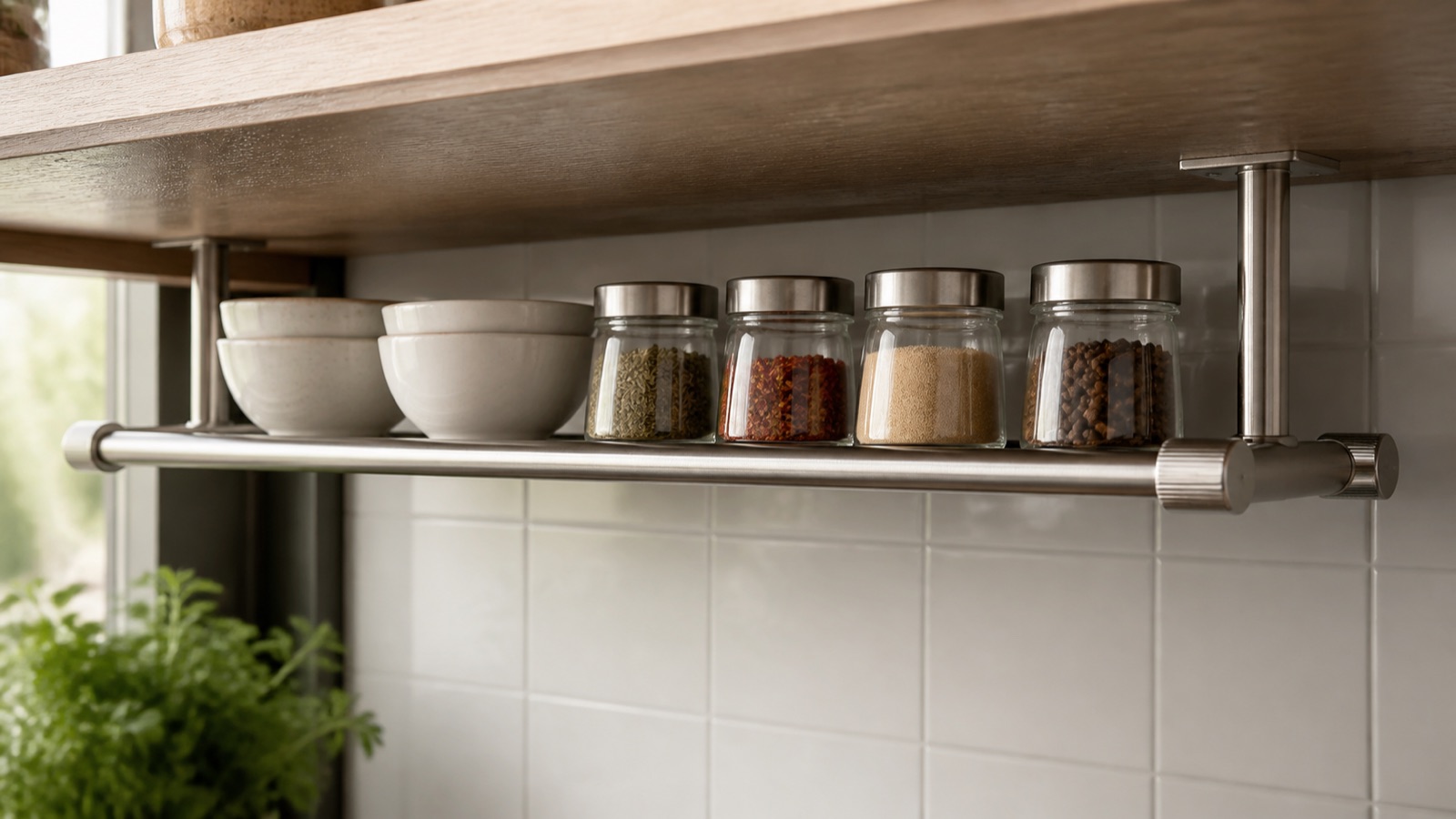
A tension rod shelf is the closest thing to a free wall shelf a renter can get: a spring-loaded or twist-lock pole that braces itself between two surfaces and holds a shelf, a basket, or a row of hooks without a single screw. It comes out with a quarter turn and leaves nothing behind but a faint rubber mark, which is why it shows up in almost every deposit-safe kitchen. The catch is that tension only works when the surfaces are solid, flat, and parallel, and most disappointing reviews come from ignoring that.
Buy a floor-to-ceiling tension pole unit if you have a blank corner and need real shelving. Buy a horizontal tension shelf if you have a window recess or a gap between a cabinet and a wall. Buy plain heavy-duty rods if what you need is hanging space for mugs, utensils, or spray bottles. Skip tension products entirely on drop ceilings, textured plaster, glossy tile, or any wall you can push and feel flex.
This guide is part of our small kitchen organizer buying guide, and it builds on the no-drill kitchen storage ideas our renter readers use most.
| Product | Width | Length | Height | Material | Pieces | Price |
|---|---|---|---|---|---|---|
 ALLZONEALLZONE Adjustable Tall Narrow Bookshelf, 4-Tier... ALLZONEALLZONE Adjustable Tall Narrow Bookshelf, 4-Tier... | 20.28 in | — | 113 in | Metal Poles & MDF Shelves | — | $79.99 as of Aug 27Check price |
 HershiiHershii Closet Tension Shelf & Rod Expandable, A... HershiiHershii Closet Tension Shelf & Rod Expandable, A... | 15.74–23.62 in | — | — | Stainless steel composite pipe / ABS | — | $25.90 as of Aug 27Check price |
 IvilonIvilon Tension Curtain Rod - Spring Tension Rod... IvilonIvilon Tension Curtain Rod - Spring Tension Rod... | 1 in | 24–36 in | — | Metal | — | $25.99 as of Aug 27Check price |
 SIQUKSIQUK Cupboard Bars Adjustable Spring Tension Ro... SIQUKSIQUK Cupboard Bars Adjustable Spring Tension Ro... | 0.51 in | 28 in | — | Plastic, Stainless Steel | 6 | $12.99 as of Aug 27Check price |
 FoukusFoukus Adjustable Tension Pole Corner Organizer,... FoukusFoukus Adjustable Tension Pole Corner Organizer,... | 9.27 in | — | 31–124 in | Stainless Steel | — | $31.99 as of Aug 27Check price |
Ranges are the min–max the rod or shelf extends to; fixed numbers are single sizes.
Take the first one that fits
- Do you have a blank corner and need real shelving?Floor-to-ceiling tension pole unit
- Is there a window recess, or a gap between a cabinet and a wall?Horizontal tension rod shelf
- Do you just need hanging space for mugs, utensils, or spray bottles?Heavy-duty rods with S-hooks
- OtherwiseShort rods as cabinet dividers
SkipAny tension product on drop ceilings, textured plaster, glossy tile, or a wall that flexes when you push it
Floor-to-ceiling tension pole shelving
This is a vertical pole that braces between floor and ceiling and carries three to five shelves or baskets on adjustable clamps. It fits a corner or a strip of blank wall in a kitchen with a solid ceiling, and it gives you a small pantry column where there was nothing. Usually $40–90 depending on shelf count and material.
The limit is the ceiling. Buyers consistently report that these units are rock solid against drywall or plaster over joists and useless against drop-ceiling tiles or popcorn texture, which crumbles under the top cap. Shelves also have a low load rating each, so it is a place for spices, jars, and dishes rather than a stack of cast iron.
Check the stated height range against your ceiling height, the per-shelf load rating, and whether the shelves are wire, glass, or solid. Solid shelves are easier to clean; wire lets you see what is on top without a step stool.
Pros
- Real shelving without a single hole
- Shelf height is adjustable after install
- Fits corners that no cabinet can use
Cons
- Useless under drop ceilings or crumbling texture
- Low load rating per shelf
- Taller units wobble if the pole is not perfectly plumb
Horizontal tension rod shelf
A horizontal tension shelf is a flat shelf, often wire or slatted, with a tension mechanism built into the ends so it braces between two vertical surfaces. It fits inside a window recess, between the side of a cabinet and the wall, or across the top of a stacked washer nook. It turns a gap into a shelf for plants, jars, or a row of mugs. Usually $20–45.
The limit is span. The longer the shelf, the lower the load rating, and buyers consistently report sag on anything near the top of the stated width range. It also needs both surfaces to be solid, so a shelf that braces between a cabinet side and hollow drywall will slowly walk out of position.
Check the width range at both ends, the load rating at the widest setting rather than the narrowest, and the end cap material. Rubber caps hold on paint; hard plastic slides on it. Our guide to windowsill and ledge storage has more on what actually belongs on a kitchen window shelf.
Pros
- Turns a window recess or cabinet gap into a shelf
- Installs in under a minute
- Adjustable width covers most small nooks
Cons
- Sags near maximum width
- Needs two solid parallel surfaces
- Nothing heavy or bouncy, like a mixer, belongs on it
- Width
- 15.74–23.62 in
- Tiers
- 1
- Material
- Stainless steel composite pipe / ABS
- Mounting
- Wall Mount (tension)
Heavy-duty tension rod with S-hooks
The simplest version is a strong single rod, mounted horizontally at eye level or above the sink, with S-hooks hung from it for mugs, utensils, oven mitts, and small pans. It fits any space between two solid walls, including under the sink for spray bottles and inside a tall cabinet for hanging tools. Usually $10–25 for a rod, plus a few dollars for hooks.
The limit is that everything hangs, so it only helps with items that have a handle or a loop. Cheap rods are also the most common complaint in reviews: thin spring-loaded models bend and slip once a few mugs are on them, while thicker twist-lock rods with a screw mechanism hold much better.
Check the rod diameter and the mechanism type, and look for a load rating rather than a generic claim of heavy duty. Match the S-hook size to the rod so hooks do not rattle off when you pull a mug down.
Pros
- Cheapest way to hang mugs and tools
- Works above sinks and inside cabinets
- Removable in seconds for cleaning
Cons
- Only holds things that hang
- Thin spring rods bend under mugs
- Hooks fall off if sized wrong for the rod
Short tension rods as cabinet dividers
A pack of short tension rods installed vertically inside a cabinet turns one shelf into a row of upright slots for baking sheets, cutting boards, muffin tins, and pot lids. It fits any cabinet with a solid shelf above and below, and it beats a dedicated divider rack because you can space the slots to your own pans. Usually $10–20 for a set of several.
The limit is that the rods are only as strong as the shelves they push against. Buyers consistently report that adjustable cabinet shelves on plastic pegs can pop off their pegs when a rod is cranked tight. It also does nothing for round or bulky items; this is a flat-items trick.
Check the minimum length against your cabinet shelf spacing and the diameter of the rods, since very thin ones bow under a stack of sheet pans leaning on them. Our guide to baking sheet storage shows the layout most people end up with.
Pros
- Custom slot spacing for your own pans
- Cheapest divider system available
- No hardware and reversible
Cons
- Can lift adjustable shelves off their pegs
- Only for flat items
- Thin rods bow under heavy pans
- Width
- 0.51 in
- Length
- 28 in
- Pieces
- 6
- Material
- Plastic, Stainless Steel
Tension pole with adjustable baskets
A cross between the floor-to-ceiling unit and a shower caddy, this is a slim pole with several wire baskets that clamp on at any height. It fits the dead strip beside a fridge, the corner behind a door, or the narrow wall beside the stove where nothing else is thin enough. Usually $25–50.
The limit is basket depth. The baskets are shallow to keep the unit slim, so it holds spice jars, oils, sponges, and small produce rather than boxes of cereal. Like the shelving unit, it needs a solid ceiling and floor, and the most common complaint in reviews is baskets sliding down the pole when overloaded.
Check the height range, the basket dimensions against the jars you plan to store, and the clamp type. Screw-tightened clamps hold better than push-on clips.
Pros
- Slim enough for gaps beside a fridge or stove
- Baskets move to any height
- Cheaper than a full shelving unit
Cons
- Shallow baskets limit what fits
- Clip-on baskets slide under load
- Needs solid ceiling and floor
How to choose
Start with the surfaces, not the product. Press on the wall or ceiling where the rod would sit: if it flexes, is textured, or is glossy tile, tension is the wrong approach and you should look at adhesive and over-the-door options instead. Then measure the exact span, because every tension product is sold by a range and the load rating drops sharply toward the maximum.
Then match the mechanism to the load. Spring-loaded rods are quick and fine for a few mugs or spray bottles. Twist-lock rods and pole units with a screw-tightened top cap are what you want for a shelf that holds anything heavier than a row of jars. Rubber end caps are non-negotiable on painted drywall; they are the difference between a rod that stays and one that creeps.
Finally, be honest about weight. Tension holds by friction, and friction has a limit that no listing photo shows. Put dishes, spices, and small tools on tension shelves and leave cookware and appliances on the floor or a rolling cart.
Rod length (in)
Where tension rods fit in the plan
Tension products are one piece of a no-drill kitchen, not the whole thing. Our renter-friendly kitchen storage guide lays out how rods, door racks, and adhesive hooks fit together room by room. For the door side of that plan, see the best over-the-door organizers, and for the cabinet under the sink, where a single rod does the most work, read our under-sink organization guide.