Your lease says no holes in the walls. Your kitchen says good luck fitting a month of groceries, a drying rack, and an air fryer into two cabinets. Most storage advice online quietly assumes you can mount a pot rail or screw a shelf wherever you like — which is exactly the advice that costs renters their deposit.
This guide is different: every idea below installs with tension, gravity, magnets, or adhesive, and comes back off the wall without a trace. It's part of our full renter-friendly kitchen storage guide, which covers the whole apartment-kitchen playbook. Here we focus on one thing: adding real storage without touching a drill.
Tension Rods: The Renter's Power Tool
A spring-loaded tension rod costs less than lunch and installs in ten seconds, and almost nobody uses them in the kitchen. Three placements do the most work:
Vertical dividers in a cabinet. Run two or three short rods front-to-back in a lower cabinet and you've built slots that hold sheet pans, cutting boards, and pot lids upright. No more excavating the whole stack to get the one pan on the bottom.
Under the sink. Mount one rod high across the cabinet and hang spray bottles by their trigger heads. The floor of the cabinet stays free for a bin of dish soap and sponges.
Across dead gaps. The space between the fridge and the wall, or inside a too-tall cabinet, becomes a shelf the moment a rod (or a pair) spans it.
The honest limits: a rod needs two solid, parallel surfaces to press against, and a basic spring rod holds a few pounds — spray bottles yes, a cast-iron skillet no. For actual shelving weight, flat spring-tension shelves are built for the job; our roundup of the best tension rod shelves covers which ones hold groceries and which ones slide down the wall.
Over-the-Door and Over-the-Cabinet Storage
Every door in your kitchen is unused vertical storage. A full-height rack hung over a pantry or closet door adds five or six baskets of capacity — spices, snacks, foil and bags, cleaning supplies — without a single screw. If your kitchen has no pantry at all, a door rack on a nearby closet is the single fastest fix, and our no-pantry storage guide builds a whole system around that move.
Smaller over-cabinet-door hooks matter too: hang a dish towel, a cutting board, or measuring cups on the inside of a cabinet door and you've stolen storage from air.
Check three things before buying. Door thickness — most hooks fit standard 1 3/8-inch interior doors, but older buildings vary, so measure. Clearance — the door still has to open with a loaded rack on it, and the top bracket needs a little headroom above the door. And rattle — a strip of felt or a couple of adhesive pads between metal and door keeps the whole thing silent. Weight ratings vary widely between racks, which is exactly what separates the good ones in our best over-the-door organizers roundup from the ones that bend.
Adhesive Hooks and Strips (Used Right)
Damage-free adhesive hooks are the most abused tool in the renter kit — renters consistently report ripped paint, and it's almost always a prep or removal problem, not a product problem. Used correctly, they're genuinely deposit-safe: clean the spot with rubbing alcohol, press the strip on for 30 seconds, wait an hour before loading it, and at move-out pull the release tab straight down — slowly — instead of yanking the hook off the wall.
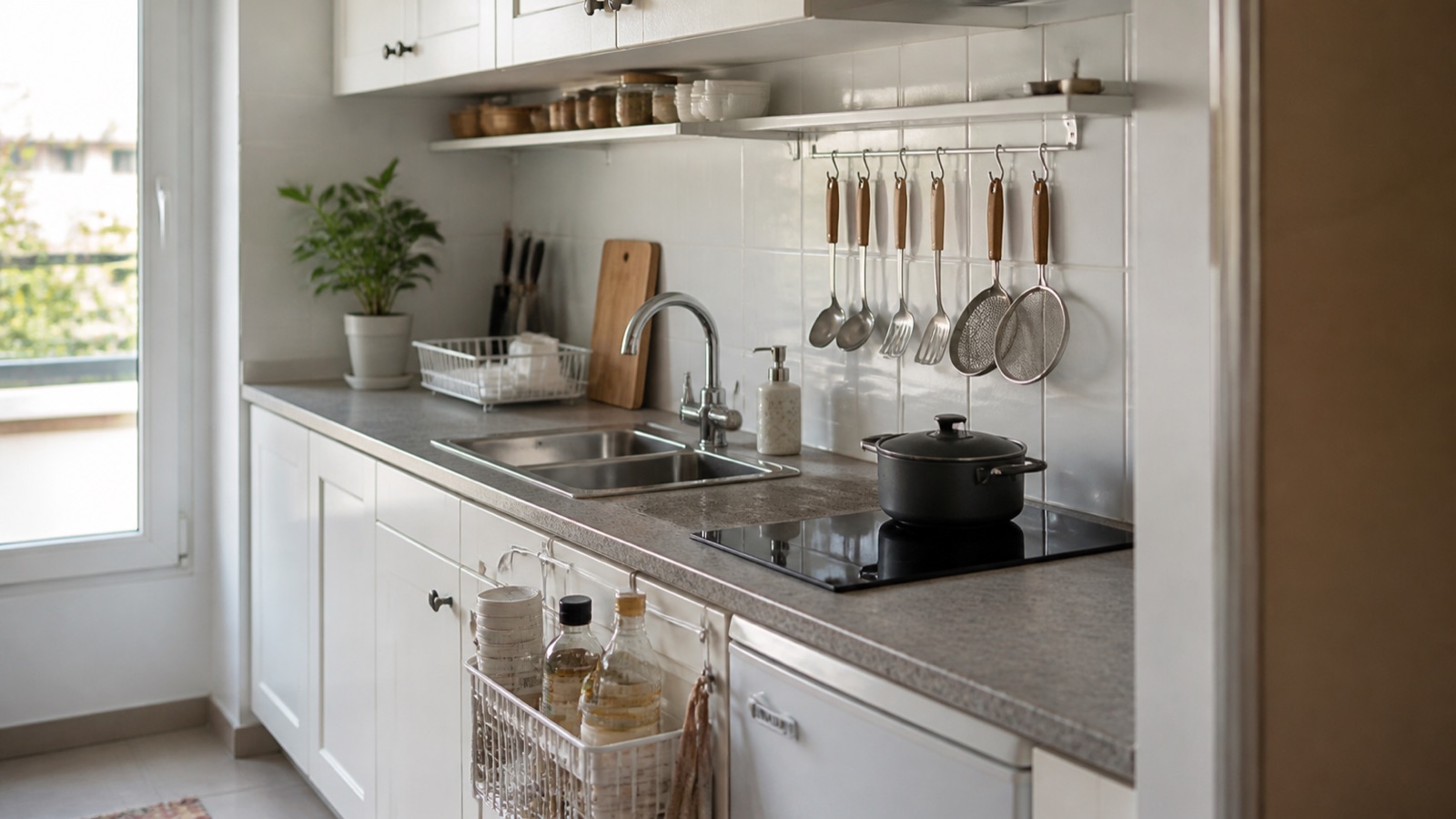
What they're actually for: utensils and oven mitts on a backsplash, measuring spoons inside a cabinet door, a dish towel by the sink, lightweight wire baskets for packets and pouches.
Pros
- Truly damage-free when prepped and removed correctly
- Cheap — hook packs typically run $5–$15
- Stick to tile, glass, metal, and painted drywall
Cons
- Real weight limits — most hooks max out around 3–5 lb
- Unreliable on textured walls, brick, and freshly painted surfaces
- Steam and heat near the stove weaken adhesive over time
Magnetic Storage: Use the Side of Your Fridge
The side of your refrigerator is a free wall that happens to be perfectly magnetic — no adhesive, no tension, nothing to remove later. Magnetic spice tins get an entire cluttered cabinet shelf back. A magnetic shelf or basket holds oils and the salt jar at arm's reach from the stove. A magnetic paper towel holder frees the counter spot the upright one was hogging.
Two caveats. Many stainless fridge fronts aren't magnetic even when the sides are — test with a fridge magnet before ordering anything. And match the load to the magnet: a strong magnetic shelf is rated for real weight, but a cheap one sliding down mid-boil ends with paprika on the floor.
Freestanding Pieces That Move Out When You Do
Here's the reframe that makes renting easier: money spent on freestanding storage isn't a compromise — it's furniture you keep. A landlord-approved renovation walks away from you; a rolling cart moves to the next apartment.
A three-tier cart is the workhorse. Load it as a mobile pantry, a coffee station, or overflow prep space, and roll it against the wall when you're done. A narrow 5-inch version slides into the gap beside the fridge and stores cans and bottles in space that was doing nothing. We compare sturdiness, wheel quality, and shelf height in our best rolling carts guide. One tier up in commitment, a baker's rack or a microwave stand adds a full column of shelves — still zero wall contact.
Fix the Counters and Drawers You're Stuck With
No-drill tools solve the walls, but rentals usually ship with two other problems: countertops the size of a cutting board and a mysterious shortage of drawers. Both have the same constraint-first fixes — risers, sorters, and vertical stands that sit in place rather than screw in. We cover them zone by zone in countertop organization and storage for kitchens with no drawers.
The Deposit Math: Why No-Drill Wins
A patched-and-repainted wall is one of the most common move-out charges there is, and repainting a single wall can eat $100–$300 of your deposit — more if the whole room needs color-matching. Against that, the entire toolkit above — a handful of tension rods, a door rack, a pack of adhesive hooks, magnetic tins — typically lands under $100, and most of it packs into the moving box.
Before you hand back the keys: pull adhesive strips slowly by their release tabs, warm soapy water dissolves any stubborn residue, and give magnet spots a quick wipe. Tension rods and door racks leave nothing behind at all. Your kitchen worked harder, your walls stayed untouched, and the deposit check comes back whole.