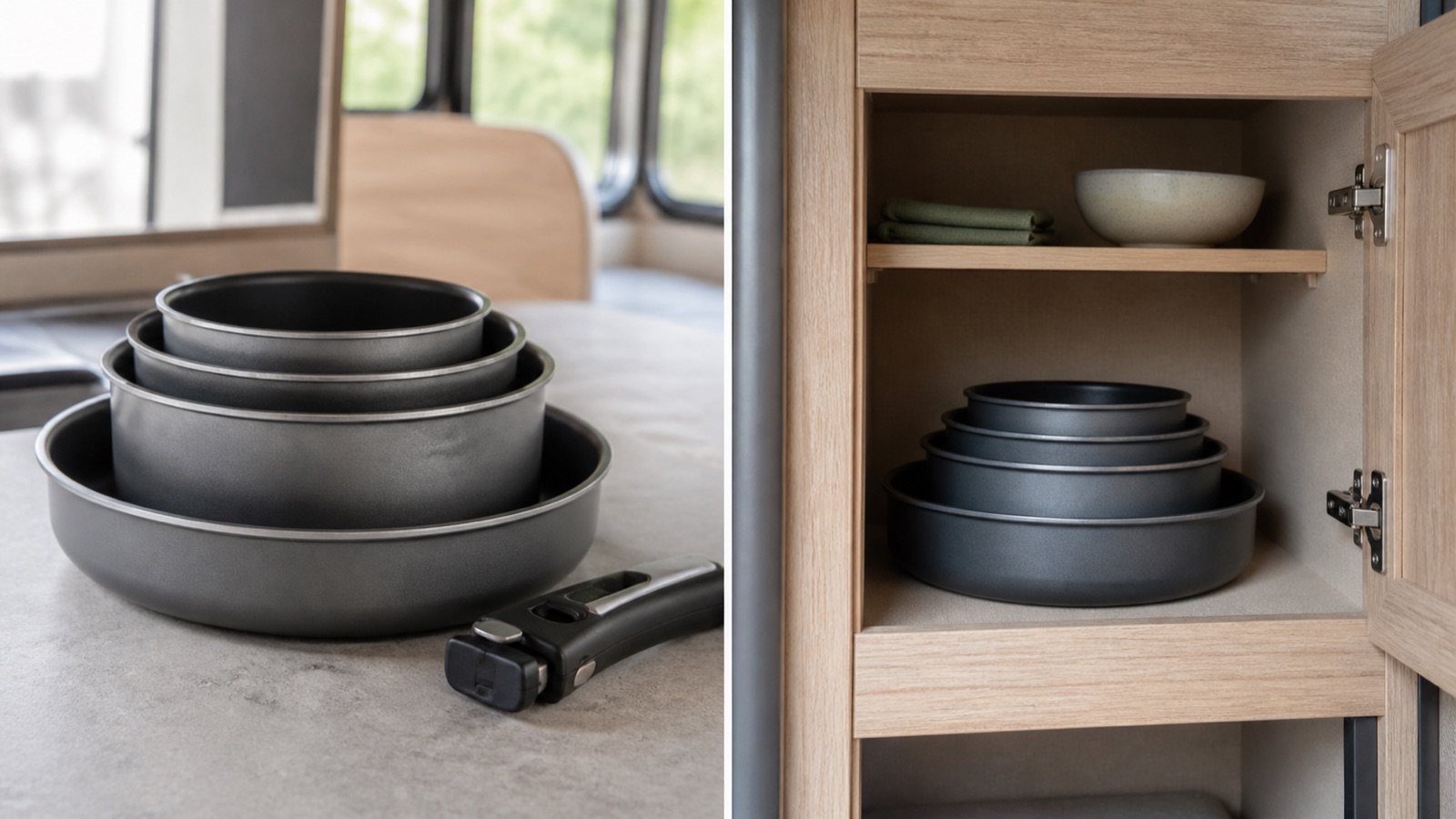
Three pans, two pots, and their lids can fill an entire base cabinet in a small kitchen, and in an RV they rattle every mile. Nesting cookware sets shrink that pile to one stack, but the reviews you find are about searing and sauce, not about whether the stack fits a shallow RV cabinet or whether the detachable handle stays locked with a full pot of pasta. This roundup is part of our small kitchen organizer buying guide and compares nesting sets by design so you can match one to your cabinet and your stove.
Buy a detachable-handle nonstick set if you cook everyday meals and want the smallest possible stack. Buy a detachable-handle stainless set if you sear, deglaze, and put pans in the oven. Buy a fixed-handle stackable set if you distrust removable handles or cook with kids around. Buy a compact camp-style set if the kitchen is a van or a tiny galley. Skip nesting cookware if you already own two pans you love; a set of universal lids and pan protectors will get you most of the space savings for a fraction of the price.
| Product | Pieces | Material | Handle material | Price |
|---|---|---|---|---|
 CAROTECAROTE 19pcs Pots and Pans Set Non Stick, Detach... CAROTECAROTE 19pcs Pots and Pans Set Non Stick, Detach... | 19 | Aluminum | Bakelite, Metal | $54.99 as of Aug 27Check price |
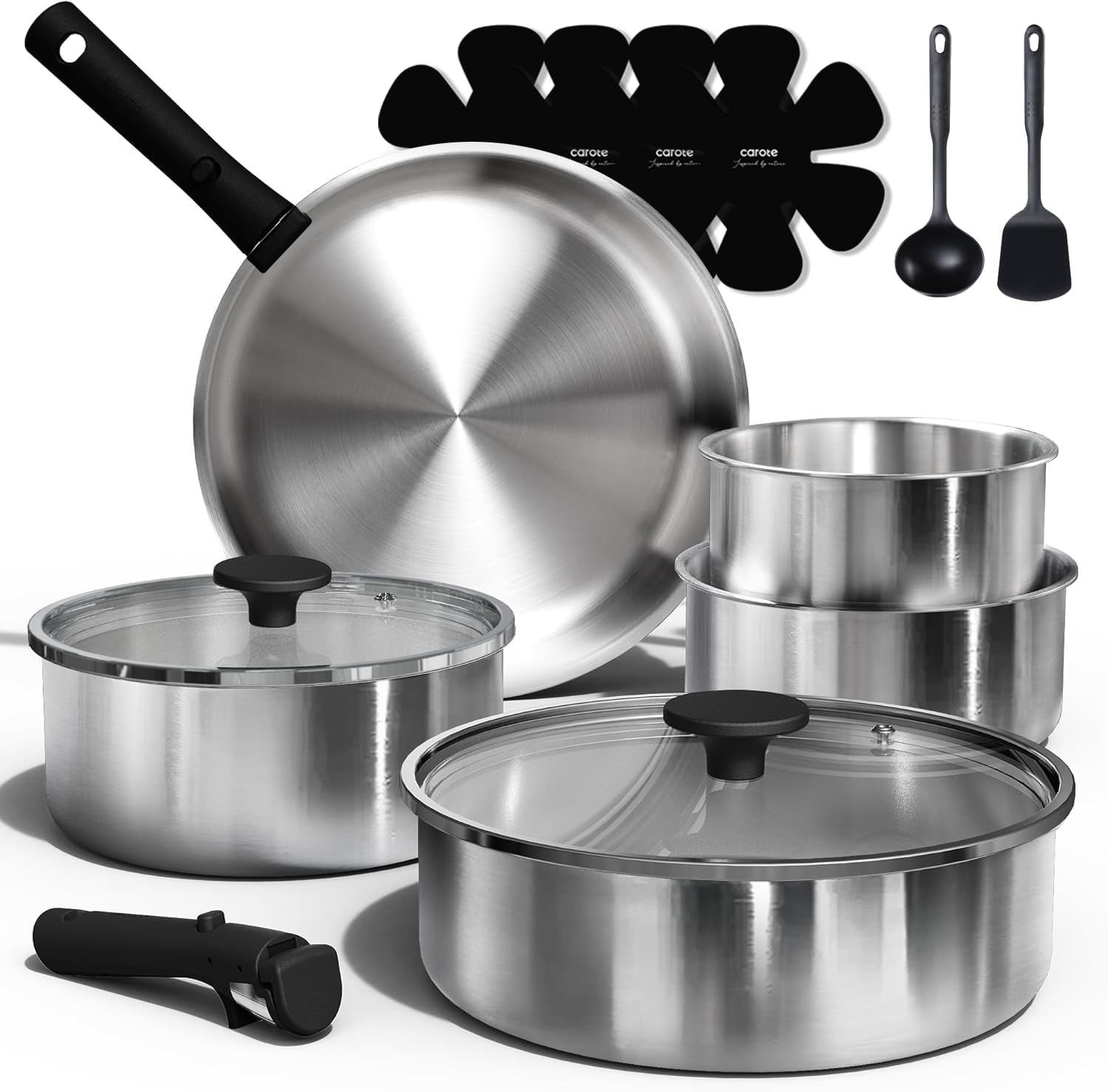 CAROTECAROTE 15pcs Tri-Ply Stainless Steel Cookware Se... CAROTECAROTE 15pcs Tri-Ply Stainless Steel Cookware Se... | 15 | Stainless Steel | Bakelite with silicone | $66.49 as of Aug 27Check price |
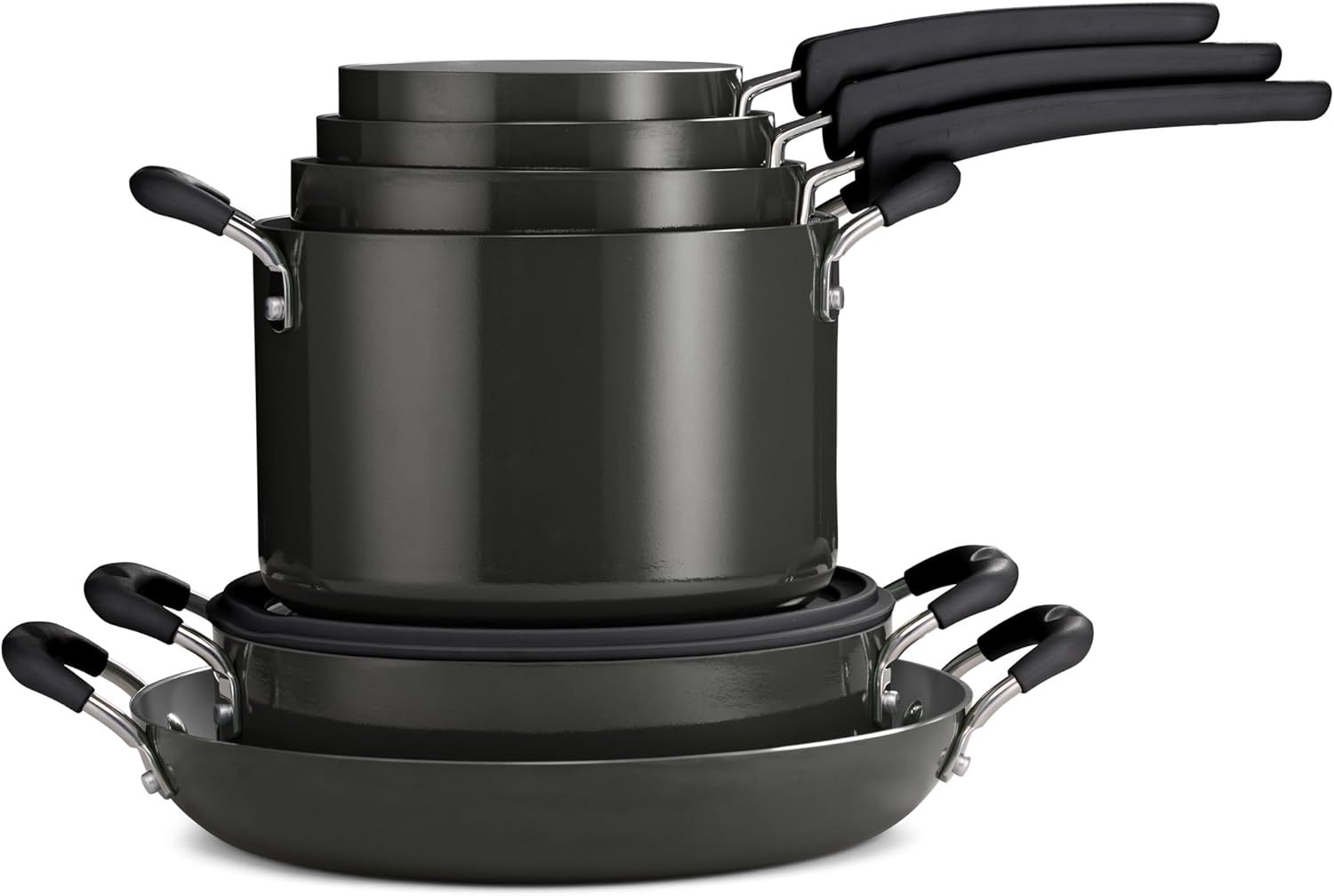 TramontinaTramontina Ceramic Non Stick 11-Piece Nesting Po... TramontinaTramontina Ceramic Non Stick 11-Piece Nesting Po... | 11 | Aluminum, Ceramic | Silicone | $171.44 as of Aug 27Check price |
 MAGMAMagma A10-360L-IND 10 Piece Stainless Steel Nest... MAGMAMagma A10-360L-IND 10 Piece Stainless Steel Nest... | 10 | Stainless Steel | Stainless Steel | $302.22 as of Aug 27Check price |
 BOYANBOYAN Pot and Pan Protectors for Stacking, 12 pc... BOYANBOYAN Pot and Pan Protectors for Stacking, 12 pc... | 12 | Polyester | — | $12.99 as of Aug 27Check price |
Piece counts include lids and detachable handles where the listing counts them.
Take the first one that fits
- Do you cook everyday meals and want the smallest possible stack?Detachable-handle nonstick set
- Do you sear, deglaze, and put pans in the oven?Detachable-handle stainless set
- Do you distrust removable handles, or cook with kids around?Fixed-handle stackable set
- Is the kitchen a van or a tiny galley?Compact camp-style set
- OtherwiseUniversal lids and pan protectors for the pans you own
SkipNesting cookware if you already own two pans you love; lids and protectors get most of the savings
Detachable-handle nonstick sets
These sets use a single clip-on handle that locks onto every pot and pan, so the pieces nest inside each other with nothing sticking out. They are the most compact option on this list and the right choice for apartment kitchens, dorms, and anyone whose cooking is mostly eggs, stir-fries, and one-pot dinners. The pieces double as storage containers with the lids on, which saves fridge space too.
Fit and limits: nonstick coatings wear, and with a nested stack the coating rubs on the pan below unless you use the included protectors or a paper towel. The handle is the wear point: buyers consistently report the locking mechanism loosens over time, and a loose handle on a full pot is a burn risk. Nonstick also limits you to medium heat and no metal utensils.
What to check in the listing: whether the set includes pan protectors, if it is labeled induction-compatible, the oven-safe rating without the handle, and whether a spare handle is sold separately. Sets usually run $80–200.
Pros
- Smallest stack of any style
- Pieces double as fridge containers
- Lightest option for upper cabinets
Cons
- Coating wears where pans nest
- Handle lock loosens with age
- Not for high heat or metal utensils
Detachable-handle stainless steel sets
Stainless sets with removable handles give you the same nesting stack in a material that tolerates high heat, metal utensils, and the oven. They suit cooks who sear steaks, deglaze pans, and finish dishes under the broiler, and they last far longer than nonstick. Most are multi-ply with an aluminum core, which is why they are heavier and cost more.
Fit and limits: stainless is the heaviest nesting option, and a full stack is a two-hand lift out of a base cabinet. Food sticks unless you preheat properly, which frustrates buyers switching from nonstick. The removable handle carries the same locking concerns as the nonstick version, and some sets' lids do not nest as neatly as the pans.
What to check in the listing: whether the pans are labeled as fully clad or just have a disc bottom, the oven-safe rating, induction compatibility, and whether the lids stack inside the largest pan. Expect to pay usually $150–350.
Pros
- Takes high heat, oven, and metal tools
- Lasts years longer than nonstick
- Same compact stack as the nonstick sets
Cons
- Heavy to lift as a stack
- Sticks without proper preheating
- Costs two to three times more
Fixed-handle stackable sets
These are conventional pots and pans with fixed handles, engineered so the pieces stack in a specific order, often with flat lids that sit between them and handles that line up. They are for anyone who does not want to trust a clip-on handle, or who cooks with kids and needs a handle that cannot come off. The stack is taller than a detachable-handle set but still far smaller than a random pile.
Fit and limits: the stacking order matters, and if you skip a piece or mix in a pan from another set the tower no longer sits flat. The fixed handles still stick out, so the set needs a cabinet at least as deep as the longest handle. Nonstick versions scratch where the pans meet unless protectors are used.
What to check in the listing: a photo of the fully stacked set with dimensions, whether protectors are included, the material of the lids, and whether it is induction-ready. Sets usually cost $100–250. For ideas on where such a stack can live when the base cabinet is already full, see how to store pots and pans in a small kitchen.
Pros
- No removable handle to fail
- Familiar to use on a regular stove
- Stack is stable when assembled in order
Cons
- Must stack in the designed order
- Handles need cabinet depth
- Nonstick versions scratch without protectors
Compact camp and galley nesting sets
Camp-style nesting sets are small aluminum or hard-anodized pots with fold-away or clip-on handles, sized for two people and designed to pack into a single bag. They are the pick for camper vans, boats, and tiny galleys where the cabinet is shallow and the stove has one or two burners. Many nest a kettle or cups inside the pot, and a pot gripper replaces the handles.
Fit and limits: these sets are thin, so they heat unevenly and scorch sauces, and the small diameters do not fit family cooking. Aluminum without a coating can react with acidic foods. The folding handles on cheaper sets are the most common complaint in reviews, either wobbling or pinching fingers.
What to check in the listing: the diameter of the largest pot, whether the set works on an induction or a glass cooktop, and if the handles fold or detach. Sets usually run $30–80. If the kitchen moves, our RV kitchen storage ideas cover how to keep a nesting stack from banging around on the road, and the camper van kitchen storage guide covers the even tighter version of the same problem.
Pros
- Fits shallow RV and boat cabinets
- Lightest set here
- Nests cups and a kettle inside
Cons
- Thin metal heats unevenly
- Too small for family cooking
- Folding handles wobble on cheap sets
Universal lids and pan protectors for the pans you own
If your existing pans are fine and the lids are the problem, a set of universal lids in two or three sizes plus felt or silicone pan protectors gets most of the nesting benefit without a new set. One universal lid replaces several lids, and protectors let nonstick pans stack directly. This is the budget path for renters who do not want to buy cookware for a kitchen they will leave.
Fit and limits: universal lids fit a range of diameters but seal less tightly than a matched lid, so simmering takes slightly longer. Pans with tall fixed handles still do not nest neatly. Protectors shift if the pans are not centered.
What to check in the listing: the diameter range each lid covers, whether the lid has a steam vent, and if the protectors are labeled for nonstick. Universal lids usually cost $10–25 each; protector sets run $8–15. Where to put the lids themselves is a separate question that our pot lid storage ideas guide answers with rack, door, and drawer options.
Pros
- Cheapest route to a smaller stack
- Keeps the pans you already like
- Protectors stop nonstick scratches
Cons
- Looser seal than matched lids
- Fixed handles still take space
- Protectors slip if pans are off-center
How to choose a nesting cookware set
Start with the stove. Induction and glass cooktops need a flat magnetic base, so filter for induction-compatible sets first. Next, measure the cabinet the stack will live in: the height of the nested set and the diameter of the largest pan both need to clear it, and fixed handles add to the depth. Then decide how you cook: nonstick for everyday and low fuss, stainless for heat and longevity, camp-style for the road.
Handle design is the tie-breaker. Look for a clip that locks with a visible latch rather than a squeeze grip, check whether a replacement handle is sold on its own, and read the recent reviews for the words "loose" or "wobble." Finally, count the lids: sets where the lids nest inside the largest pan take up far less room than ones where they do not.
Where the stack lives
A nesting set earns its keep when it has a home the whole stack fits into, which is why the cabinet measurement matters more than the piece count. In a tiny house or a studio, that home might be a deep drawer or a rolling cart shelf rather than a base cabinet, and our tiny house kitchen storage guide shows the layouts that work when there is no cabinet to spare.