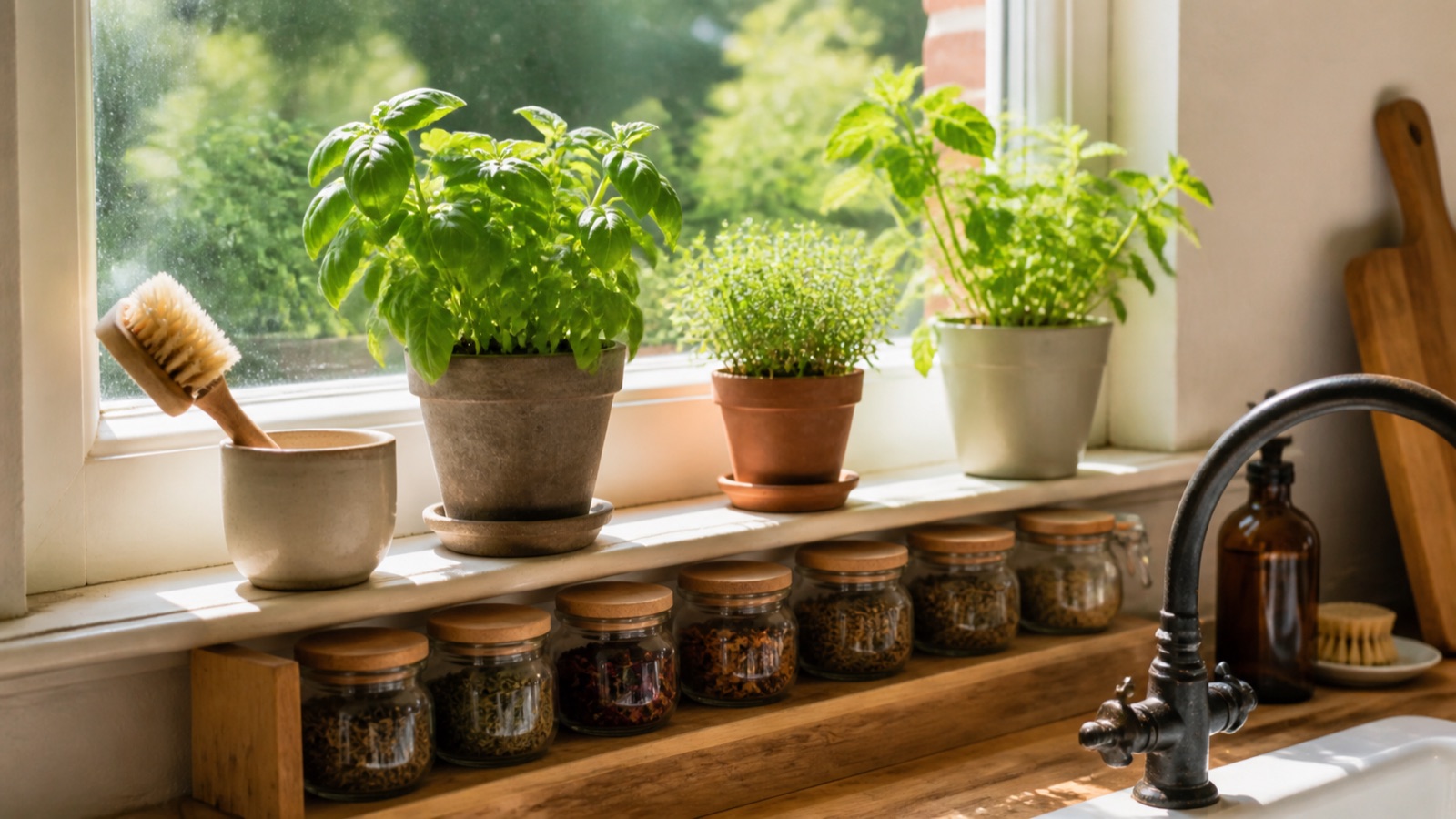
The window over your sink comes with a sill that is either too narrow to hold anything, about 1–2 inches on most vinyl and aluminum windows, or deep enough that it has quietly become a shelf for dish soap, a sponge, a struggling basil plant, and your phone. If you are searching for kitchen windowsill storage, you are usually trying to make that ledge do real work in a kitchen with no other free surface. Most roundups answer with photos of a lush herb garden and a row of glass jars, and skip the two things that decide whether any of it lasts: direct sun and sink steam.
This is the windowsill entry in our small kitchen storage ideas by zone series. It covers what actually survives on a sill, what to do when the sill is too narrow to use, how to borrow the window frame and the air above the sill for storage, and how to keep a deep sill from turning into a second junk drawer. Each option lists when it works and when it does not.
Measure the sill and watch it for a day
Measure three things: the depth of the sill from the glass to the front edge, its length, and the height from the sill to the top of the window frame. Then check how the window opens, because a crank handle needs 3–4 inches of clear swing and a sliding sash will hit anything standing in its path. A sill under 3 inches deep is a frame-and-hook situation; a sill of 5 inches or more can act as a small counter.
Then watch the window for one day. Note how many hours of direct sun hit the sill, whether the glass fogs when you run hot water, and how far faucet splash reaches. Sun and steam decide what can live there, and they are the reason so many windowsill spice racks and wooden trays end up in the trash.
- AHeight from the sill to the top of the frame — a crank handle needs its swing
- BLength of the sill between the jambs
- CSill depth from the glass to the front edge — this is the number that decides what can stand there
What survives a windowsill (and what does not)
Things that belong on a kitchen windowsill are things that are already wet or that like light: dish soap and hand soap, a sponge or brush in a caddy that drains, a scrub brush, and live herbs. A small stone or silicone tray under the soap catches drips and lifts off for cleaning.
Things that do not belong there are anything you want to keep fresh. Spice makers generally advise storing spices away from light and heat, and the most common complaint about windowsill spice racks is flavor fading within a few months. The same goes for cooking oil, coffee beans, tea, chocolate, and vitamins.
Wooden cutting boards and bamboo trays swell and warp in sink steam, and paper labels peel. If spices are the thing you are trying to relocate, our guide to spice storage in a small kitchen covers drawer inserts, door racks, and magnetic tins that keep them out of the sun.
Narrow sills under 3 inches: use the frame, not the sill
On a shallow sill, the sill itself only holds a slim tray. A narrow tray 2–3 inches wide and 12–16 inches long, usually under $15, corrals a soap pump and a sponge so they stop sliding into the sink. Everything else hangs from the window frame. A short rail or a row of adhesive hooks mounted on the fixed trim, never on the moving sash, holds a dish brush, a dish towel, a small hanging planter, or a set of measuring spoons on S-hooks.
This works when the trim has a flat face at least 1.5 inches wide for hooks to grip, and when the hooks sit clear of the crank handle and any blinds. It does not work on trim that is rounded, textured, or painted with peeling latex, where adhesive hooks slide off within a week. Screw-in cup hooks hold better on wooden trim if you own the place or have permission for small holes.
A tension rod across the window
If the window is recessed into the wall so it has solid side jambs, the air above the sill is the most useful space you have. A tension rod across the upper third of the window holds S-hooks for light utensils, a small hanging planter, or a dish towel that dries in the sun. A tension rod shelf, which is two rods with a shelf spanning them, set at mid-height gives you a ledge 3–5 inches deep for a soap dispenser and a couple of herb pots without touching the sill at all.
Tension rods work when the jambs are wood or solid drywall over framing and the window is wide enough for the rod's range, typically 16–28 inches or 28–48 inches depending on the model. The limits are real: vinyl window trim flexes and lets rods slip, most rods hold somewhere in the 5–15 pound range before they sag, and a rod placed in the path of the sash stops the window from opening. It also blocks some light, so keep it above eye level or well below it. Our roundup of the best tension rod shelves for renters compares widths and load ratings, and our guide to no-drill kitchen storage covers the rest of the deposit-safe options.
Deep sills, 5 inches or more: a second counter
A deep sill behaves like a 5–8 inch strip of counter with a view, and it deserves the same treatment as a counter: one container per category and nothing loose. A small turntable 6–9 inches across holds dish soap, hand soap, lotion, and a brush, and spins so the bottle you need is always at the front. A narrow two-tier riser at the far end holds a couple of herb pots or a sponge caddy above a soap tray.
The limits are sun and the window itself. A riser or a stack of jars blocks part of the view and can block the sash lock, so keep the total height below the meeting rail of the window. Anything glass on a sunny sill acts like a tiny greenhouse for whatever is inside, which is fine for a sprouting herb and bad for anything edible. For risers sized to fit a 5–6 inch ledge, see the narrow models in our best shelf risers roundup, and for the rest of the surface-management logic, see freeing up counter space in a tiny kitchen.
Sill extenders and over-the-sink shelves
Two products add depth you do not have. A sill extender is a shelf that rests on or clamps to the existing sill and pushes it forward 4–6 inches; adjustable models span roughly 24–36 inches and cost in the $20–40 range. An over-the-sink shelf stands on the counter behind the faucet on two legs and rises to about sill height, giving you a rack for soap, sponges, and drying dishes that spans the sink without touching the window.
These work when the sill is level, the faucet clears the shelf, and the counter behind the sink has 3–4 inches of free depth for the legs. The main limit is that both sit squarely in the splash zone, so bamboo darkens and warps and cheap chrome rusts; stainless steel or coated steel lasts longer. Check the listing for current dimensions against your faucet height before ordering, because a tall gooseneck faucet clears most shelves and a low one does not.
Growing herbs without the graveyard
Herbs on a kitchen windowsill die for one reason: not enough light. A south- or west-facing window that gets six or more hours of direct sun supports basil, mint, chives, and parsley in 4-inch pots. A north-facing window does not, and the honest fix is a clip-on grow light on the frame, usually under $25, on a timer. Limit yourself to three pots per 30 inches of sill, put a saucer under each to protect the sill from water stains, and use self-watering pots if you forget to water.
Closing
The sill is for wet things, the frame and a tension rod are for hanging things, and the wall beside the window is for everything else; our guide to vertical and wall storage for small kitchens picks up where the window ends. If you only buy one thing, make it a tension rod shelf sized to the window, because it adds a shelf to a kitchen that has none without a single hole.