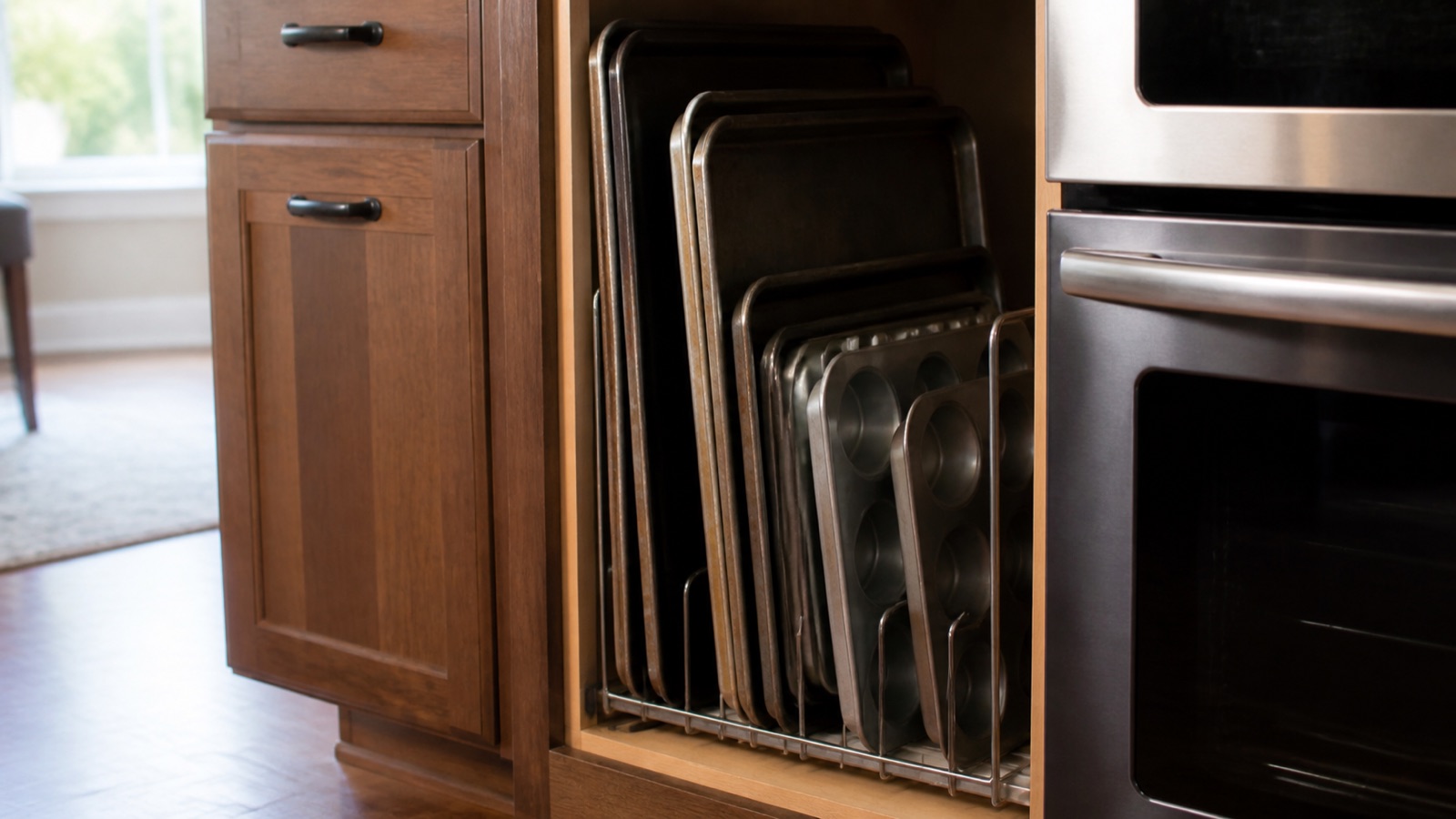
Your baking sheets live flat at the bottom of the pan cabinet, under the pots, and getting one out means lifting everything above it. Search "baking sheet storage" and the answer is always a vertical rack, but nobody mentions that a half sheet pan is 18 by 13 inches, so standing it up needs at least 13 inches of clear cabinet height, and a lot of shelves clear 12. This is one of the item pages in our what-goes-where guide to small kitchen storage, and each option below starts with the measurement that makes it work or not.
Start with what you own. A typical set is two half sheets at 18 by 13, a quarter sheet at 13 by 9, a muffin tin, a cooling rack, and a pizza pan or two, and most of those are different heights when stood on edge. Measure the height and depth of the cabinet you want to use, and note whether the shelf inside is adjustable or fixed, because that one detail decides half the options here.
Stand them in a vertical rack inside a cabinet
A wire bakeware organizer with 4 to 8 slots holds sheets, cooling racks, and cutting boards on edge so you slide one out without touching the rest. Expandable versions adjust from about 9 to 17 inches wide, cost $15 to $30, and sit on the cabinet floor; the same rack often handles lids too, as covered in our guide to inside-cabinet organization. Pans stand on their long edge, so the cabinet needs about 14 inches of clear height for half sheets.
If the cabinet is not that tall, you have two choices: remove the shelf if it is adjustable, or store the pans on the short edge in a cabinet at least 19 inches tall. The most common complaint in reviews is that thin wire slots let heavy sheets lean into each other, so pick a rack with slots at least 1.5 inches apart. Check the listing for current dimensions, since the number of slots is not the number of half sheets that fit.
- AClear height from the cabinet floor to the shelf above — sheets stand on their long edge
- BWidth of the cabinet interior; expandable racks cover a range
- CDepth of the cabinet — the rack sits flat on the floor and the door still has to close
Make slots with tension rods
Two or three short tension rods mounted vertically inside a cabinet, running from the floor to the shelf above, divide the space into slots for under $15 and without a screw. Rods that extend from about 7 to 12 inches match most lower cabinet shelf spacing, and you can reposition them when the collection changes. This is the renter's version of a fixed divider, and it works with sheets, cutting boards, and platters together.
It works when the cabinet floor and the shelf above are flat and firm enough for the rods to press against, and it fails on slick laminate where a heavy sheet leaning on a rod walks it loose. Adjustable shelves resting on pegs also lift when a rod pushes up from below; use the fixed bottom shelf or the cabinet top instead. Our roundup of the best tension rod shelves covers which rod ends grip on which surfaces.
Use the skinny cabinet above the fridge or beside the oven
The cabinet above the fridge is often 15 inches tall and 24 inches deep, which is close to the perfect shape for baking sheets stood on edge, and it is space almost nobody uses well. Many kitchens also have a narrow cabinet beside the range, 9 to 12 inches wide, that fits half sheets on the long edge and nothing else. A vertical rack or a pair of tension rods turns either into a tray cabinet.
The limit is reach. Anything above the fridge is 6 feet up, so keep it to the sheets you use weekly if you want them to actually be used, and leave the seldom-used pizza stone up there. Our guide to above-the-fridge storage covers how to make that cabinet usable, including the step stool question.
Use the oven drawer, but check what it is
The drawer under many ranges is a storage drawer designed for exactly this, and it holds three or four half sheets flat with a cooling rack on top. It is free, it is next to the oven, and it needs nothing bought. Check your range manual first, because on some models that drawer is a warming drawer or a broiler, which gets hot enough to damage nonstick coatings and silicone mats.
Even a true storage drawer runs warm when the oven is on, so store bare metal there and keep nonstick and silicone in a cabinet. The drawer also collects crumbs, and a drawer packed to the top jams on the sheets when it opens. Stack no more than four sheets, and lay a sheet of parchment on the bottom so the pans slide instead of catching on the drawer rails.
Hang them on a cabinet side or door
A magazine-file style rack screwed to the side of a cabinet or the end of an island holds two or three sheets on edge in 3 inches of depth, and an over-the-door rack on a pantry door holds muffin tins and cooling racks. Both put bakeware in places that were empty a minute ago. Racks that hook over a door need no tools, and a screw-in rack on a cabinet side takes four screws that a renter can fill later.
Weight is the constraint: a half sheet weighs about 1.5 pounds, so a rack of three is under 5 pounds, but adhesive-mounted racks in reviews consistently peel off under that load within a few months. Over-the-door racks also add 2 to 3 inches to the door and need clearance behind it. The best over-the-door organizers compare hook widths and basket depths for kitchen doors.
Cut the collection down to pans that nest
Most small-kitchen cooks need two half sheets and one quarter sheet, and the rest of the bakeware is a set from another kitchen. Same-brand sheets in graduated sizes nest flat into a stack about 2 inches tall, and a quarter sheet fits inside a half sheet in the oven drawer. Reviews of nesting bakeware sets praise the space and fault the thin gauge, so buy heavy-gauge aluminum sheets in two sizes instead of a ten-piece set.
Store the survivors in whichever spot you measured first: on edge in a rack if the cabinet is tall enough, between tension rods if it is not, and flat in the oven drawer if you have one. If the pan cabinet is still the bottleneck, the same measure-first approach applies in our guide to storing pots and pans in a small kitchen, and the best tension rod shelves are the cheapest way to add slots to any cabinet.