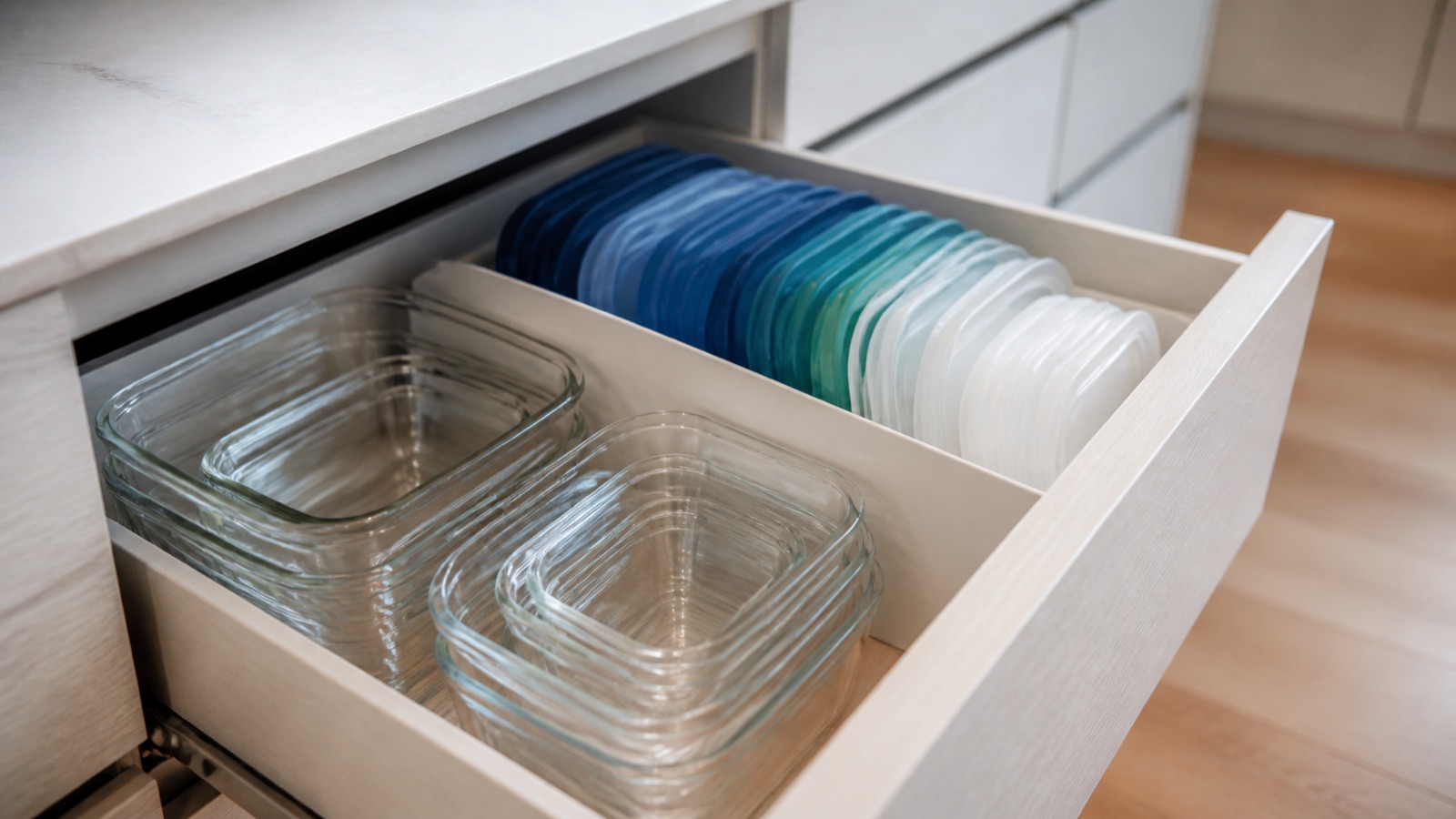
You open the cabinet, three lids slide out onto the counter, and you spend two minutes matching a lid to a container while dinner goes cold. Search "how to store tupperware lids" and most of what comes back is a product page or a 20-second video that assumes you have a spare drawer and a matching set. This is one of the item pages in our what-goes-where guide to small kitchen storage, and it sorts the options by what you actually have: a deep drawer, a shelf, or only a cabinet door.
The reason lids are worse than any other kitchen item is that they are flat, slightly flexible, and come in four or five shapes that do not nest with each other. A typical household owns 20 to 40 containers, and home cooks consistently report that a third of the lids no longer match anything. That mismatch, not the lack of an organizer, is usually the real problem.
Match, purge, and cap the collection first
Pull every container and lid out, pair them, and recycle anything without a partner, anything warped by the dishwasher, and anything stained past cleaning. Then decide how many you actually need; for most households that is 8 to 12 containers in two or three sizes, which is what fits in a single cabinet shelf or drawer. This takes about 15 minutes and does more than any $20 organizer.
The limit here is that purging only helps if you stop the collection from regrowing. Takeout containers, yogurt tubs, and free deli containers are the main source of orphan lids, so either commit to keeping them as a separate stack or recycle them on arrival. If you share a kitchen with roommates, agree on one shape per person so lids stay identifiable.
Stand lids in a drawer with adjustable dividers
A drawer is the best home for lids because you see all of them at once, standing on edge, sorted by size. Spring-loaded or adjustable drawer dividers that expand from about 12 to 20 inches let you make three or four slots, one per lid size, for $15 to $25. Purpose-built lid organizers with fixed slots do the same job but only if your lid sizes match the slot widths.
This needs a drawer at least 4 to 5 inches deep, since a standard rectangular lid stands about 5 to 7 inches tall on its short edge. Shallow utensil drawers do not work, and neither does a drawer already committed to flatware. Flexible silicone and thin plastic lids also bow and slump between dividers, so pack them snugly or lay them flat in one slot. For the rest of the drawer, see our guide to kitchen drawer organization.
Use a bin or file holder on a shelf
If you do not have a free drawer, a plastic bin about 6 by 12 inches, or a magazine file, holds lids on edge on any cabinet shelf. Lids stand upright, you can see the sizes, and the bin lifts out when you need one from the back. A clear bin under $10 works, and a wire or plastic lid rack with a handle is a step up.
The limits are shelf height and lid size. Large rectangular lids for 9-by-13 containers stand about 9 inches tall and do not fit under a shelf spaced at the typical 10 to 12 inches once a bin is under them, so those go flat on top. Round lids also roll and lean in a bin unless they are packed tightly, which is why a bin works best once the collection has been trimmed to two or three sizes.
Put a lid rack on the cabinet door
A rack that hooks over or screws into the inside of a cabinet door holds 5 to 10 lids in space you are not using, and it is the usual pick when every shelf and drawer is full. Hook-over racks need no tools, cost $10 to $20, and fit standard doors about three quarters of an inch thick. Adhesive versions exist for renters, but the most common complaint in reviews is that they peel off within a few months under the weight of a full rack.
The clearance issue is the same one that affects over-the-door storage everywhere in the kitchen: the rack sticks out 2 to 3 inches from the door, so the shelf behind it needs a matching gap or the door will not close. Lids wider than the rack, usually the large rectangles, stick out and catch on the shelf edge. This is a good spot for the small and medium lids and a poor one for the whole collection.
Store lids on the containers
The zero-cost option is to store each container with its lid snapped on, stacked two or three high. It ends the matching problem entirely, and it is what most people with a matched set of 8 to 10 containers end up doing. The cost is space: containers with lids on take about 30 to 40 percent more room than nested containers, which in a small kitchen can be the difference between one shelf and two.
A middle path is snapping the lid to the bottom of its container, which some sets are designed to allow, so the container still nests and the lid travels with it. Check whether your set does this before buying more; not every brand's lid grips the base. This approach fails outright with deli-style lids, which only seal from the top.
Replace the mismatched set
If the lids are mismatched because the containers came from six different places, an organizer will only manage the mess. A single set of stackable containers with attached lids removes the sorting problem entirely, since the lid is hinged to the base and the containers nest into one another. Sets of 10 to 20 pieces generally run $25 to $50, and one set replaces a full cabinet of orphans.
The trade-offs are worth knowing. Hinged lids are the most-reported failure point in reviews, usually cracking at the hinge after a year of dishwasher cycles, and attached lids do not always seal as tightly as a snap-on gasket lid, so they suit fridge leftovers better than soup for the commute. Glass sets are heavier, at roughly a pound per container, but their lids nest more predictably and last longer. Check the listing for microwave, freezer, and dishwasher ratings before you commit.
What to buy first
Purge and match before buying anything, then match the organizer to the space: dividers for a deep drawer, a bin for a shelf, a door rack for the small lids when nothing else is free. If the set itself is the problem, start with our roundup of the best stackable food storage containers, and while you are fixing lids, the same rules apply to the pan cabinet in our guide to pot lid storage.