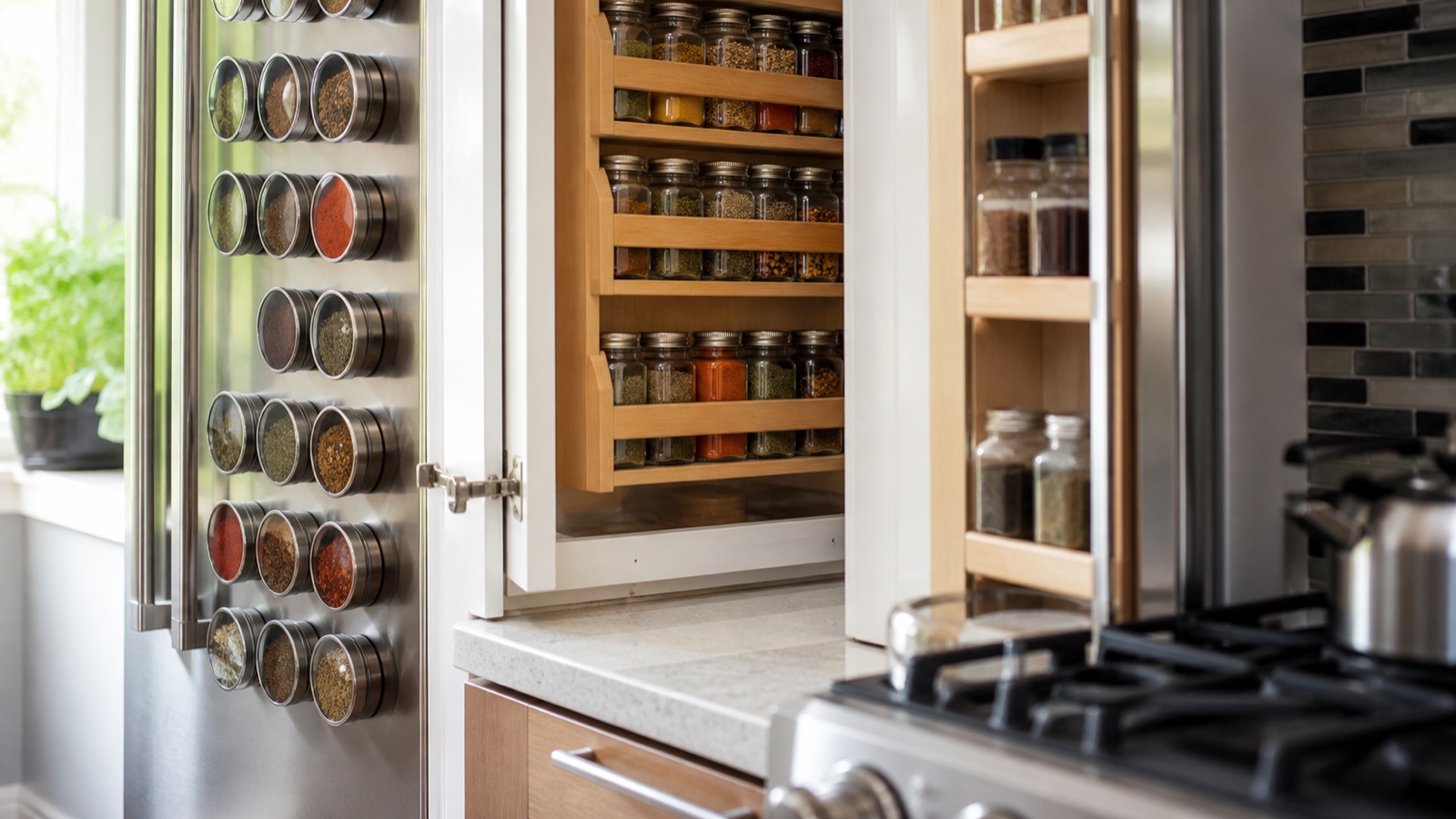
You have 30 or 40 jars, no pantry, and the spices live in a cabinet above the stove where you take out six to reach the one you want. Search "spice storage ideas small kitchen" and you get 25-idea roundups photographed in walk-in pantries, which is not the kitchen you have. This is one of the item-by-item pages in our what-goes-where guide to small kitchen storage, and every option below comes with what it needs from your kitchen: a drawer, a cabinet door, a few inches of wall, or nothing but the side of the fridge.
Two measurements decide most of this. Standard spice jars are about 1.75 to 2 inches in diameter and 4 inches tall, while the big warehouse-club containers run 3 inches wide and 6 inches tall, and most organizers only fit the first kind. Count how many of each you own before you order anything, and keep spices away from the stove and the window if you can, since heat and light are what make a jar taste like dust within a year.
Lay them flat in a drawer insert
A tiered drawer insert holds 20 to 30 standard jars on their backs, labels up, so you read the whole collection from above. Expandable inserts adjust from about 12 to 22 inches wide, cost $15 to $30, and are the option home cooks most often say they should have bought first. Labels go on the lids or the shoulders of the jars, and you can pull a jar without moving another.
It needs a drawer at least 3 inches deep on the inside and, ideally, a spot within reach of the stove. Tall containers do not fit, and neither do square jars, which slide off the tiers. If your drawers are all shallow, a set of adjustable drawer dividers in a deeper drawer can hold jars upright instead. Our guide to kitchen drawer organization covers which drawer to give up.
Step them up on a tiered riser in a cabinet
A three-step riser in a cabinet puts the back rows above the front rows so you can read every label without unloading the shelf. Expandable risers stretch from about 9 to 17 inches wide, hold 18 to 30 jars, and cost under $20. This is the fix for the standard above-the-stove or beside-the-fridge spice cabinet, and it is the cheapest way to make a 12-inch-deep shelf usable to the back.
The riser needs a shelf at least 10 inches deep and around 6 inches of height above the top step. The typical review complaint is that the top step is too shallow for the large containers, which then fall off backward. Mix container sizes by putting the big ones on the shelf beside the riser, not on it. Our roundup of the best shelf risers for cabinets compares step depths and widths.
Spin them on a lazy Susan
A 9- to 12-inch turntable holds 12 to 20 jars in a corner cabinet or the back of a deep shelf, and one spin brings everything to the front. Two-tier versions double that in the same footprint and run $15 to $30. This is the right choice for a corner cabinet with an awkward opening, or for the deep cabinet next to the range where jars otherwise get lost behind the oils.
The limit is the height of the shelf and the shape of the jars. Tall bottles on a spinning turntable fall over when you spin fast, so keep tall containers on the bottom tier or off the turntable. Turntables also need a full circle of clearance, which a 12-inch shelf with a door frame in the way may not have. The best lazy Susans for cabinets and corners include ones with a lip that stops jars sliding off.
Mount a rack on the cabinet door
A door-mounted spice rack holds 15 to 25 jars in the 2 to 3 inches behind a cabinet door. Hook-over versions need no tools and cost $12 to $25; screw-in versions hold more and stay put. It uses space nothing else wants, and it puts spices at eye level next to the stove where you use them.
The rack projects into the cabinet, so the shelf behind it needs a matching gap, and doors with a raised inside panel may not hold a hook-over rack flat. Wire racks with narrow rails only hold jars up to about 2.5 inches wide, so the big containers stay out. Heavy loads on a door also loosen hinges over time; keep the total under about 5 pounds. This is the same set of limits as all over-the-door storage in a small kitchen.
Stick them to the fridge or a magnetic strip
Magnetic spice tins, sold in sets of 12 to 24 for $20 to $40, stick to the side of the fridge or to a wall strip and take up zero cabinet or counter space. A magnetic knife strip makes a good mount for tins on a wall, and adhesive-backed strips work for renters. Clear-lid tins let you see the spice, and the whole set reads like a wall chart.
Check first that your fridge side is actually magnetic; many stainless-steel doors are not, and the sides are often thin enough that a full tin slides. Tins hold about 3 ounces, less than a standard jar, so you refill more often, and the most common review complaint is lids that loosen and dump spices on the floor. Keep the strip away from the stove, since heat on the tins ages the spices faster than any cabinet.
Use a wall rail or a tension rod shelf in a nook
A narrow wall rail with hanging cups, or a short shelf, holds 10 to 15 jars in 3 to 4 inches of depth on the wall between the counter and the upper cabinets. If you have a gap between the fridge and the wall, or a window recess, a spring-loaded tension rod shelf fits the width without a single screw.
Wall rails need screws or adhesive rated for the load, and rails in the backsplash zone collect grease. Tension rod shelves need two solid, parallel surfaces 12 to 40 inches apart and hold 5 to 10 pounds, which is plenty for jars but not for oils and vinegars. On tile, the rod ends grip well; on painted drywall they need a wider pad, and on textured walls they slip.
Decant only what you use weekly
Matching jars look tidy and fit organizers better, but decanting 40 spices into $1 jars costs $40 and an afternoon, and half of them will be stale before the jar is empty. Decant the 10 to 15 you reach for weekly into uniform 4-ounce jars, keep the rest in their original containers on a riser or a turntable, and label everything on the lid.
Start with whichever option uses space you already have: a drawer insert if a drawer is free, a riser if the cabinet is deep, a door rack if neither is. For the cabinet itself, a shelf riser and a good lazy Susan are the two purchases that fix most spice cabinets for under $30.