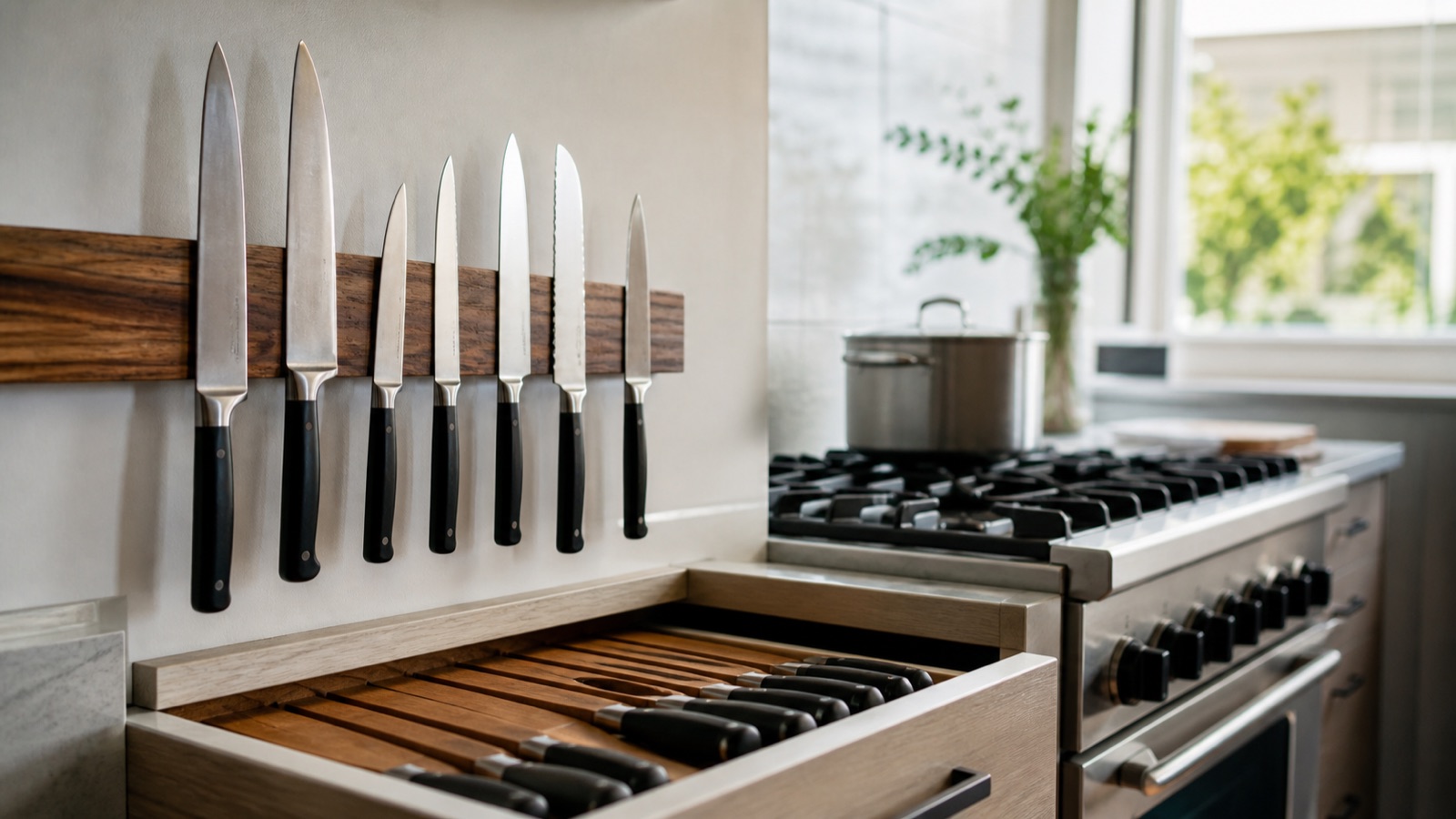
A countertop knife block takes up a 6-by-9-inch patch of counter, and in a kitchen with three feet of workspace that patch is where you would like to chop. Blocks also collect crumbs and moisture inside the slots, which is why home cooks who finally pull theirs out of a rental often decide not to bring it back.
Most articles on knife storage without a block stop at "buy a magnetic strip." They do not say what happens when your backsplash is tile, whether an adhesive strip will hold an 8-inch chef's knife, what to do when your drawers are 2 inches deep, or where blades go when a toddler can reach the counter. This guide is one of the item-by-item pieces in our what goes where guide for a small kitchen, and it covers five places a knife can live, with the conditions that make each one safe and the ones that make it a bad idea.
Magnetic knife strip on the wall
A wall-mounted magnetic strip is the best use of vertical space for knives. A 10-inch strip holds four or five knives, an 18-inch strip holds seven or eight, and prices run from under $15 for stainless to $30 to $50 for a wood-faced bar. Wood-faced strips are gentler on edges because the blade rests on wood rather than bare metal.
Mount it into studs or with drywall anchors rated for at least 15 pounds, 4 to 6 inches above the counter and at least a foot away from the stove so steam and grease stay off the blades. This works on painted drywall, wood paneling, and the side of a solid cabinet. It does not work well on a tile backsplash unless you are prepared to drill with a carbide bit, and it does not work at all with ceramic knives, which are not magnetic.
Adhesive-backed strips are the option renters reach for, and they are the source of the most common complaint in reviews: the strip holds paring knives fine and drops a chef's knife within a few weeks, especially in a humid kitchen. If you have children, mount any strip at least 48 inches off the floor and away from anything they can climb. Our roundup of the best magnetic knife strips and racks separates the screw-mount bars from the adhesive ones and notes their rated holding strength.
Magnetic strip inside a cabinet door or under a cabinet
The same strip works screwed to the inside of a cabinet door or to the underside of an upper cabinet, which hides the blades from sight and from small hands. Most cabinet doors are three-quarters of an inch thick, so use half-inch screws so they do not poke through the front. Under-cabinet mounts hold the blades flat against the cabinet bottom, handles toward you.
Check three things before you commit. The door must be solid wood or plywood, not a hollow-core panel, or the screws will not hold. The knives must clear the shelf edge when the door closes, which usually means the strip goes on the upper half of the door with at least an inch and a half of clearance. And an under-cabinet strip should not sit directly over the spot where you work, since a knife that lets go lands on your hands.
In-drawer knife block or tray
If you have a drawer near the prep area, a bamboo in-drawer block keeps blades separated, edges protected, and completely out of sight. Typical blocks are 13 to 17 inches long and 2.5 to 3 inches tall, hold 8 to 15 knives, and cost $20 to $40. Check the listing for current dimensions, because the slot spacing is what decides whether a wide cleaver or a serrated bread knife fits.
This works when the drawer interior is at least 3 inches tall and 15 inches deep. An 8-inch chef's knife is close to 13 inches overall, so a 12-inch drawer will not close over it. It does not work in the shallow false-front drawers under many sinks, and it does not work in a drawer that also holds every spatula and bottle opener you own, because the block gets shoved sideways and knives ride up out of their slots.
A pair of adjustable dividers on either side of the block fixes the sliding problem. Our picks for the best drawer dividers and organizers include a few that are tall enough to hold a knife block in place, and the kitchen drawer organization guide covers how to give knives the front of the drawer.
Blade guards in a divided drawer
For three to five knives in a small drawer, plastic or felt-lined blade guards do the job of a block without the block. A set of five guards in mixed sizes runs $8 to $15. Slide a guard over each blade and lay the knives in a single divided section so they cannot roll into each other.
The limits are practical. Guards wander off, especially in a shared household, and a knife that goes into a guard wet will develop rust spots, which is a real problem for carbon steel. Dry every blade before it goes in. This is the right answer for a renter with one shallow drawer and a small set, not for a 12-knife collection.
No drawers at all
Some galley and studio kitchens have no drawers, and a block starts to look reasonable again. A slim vertical block 4 to 5 inches wide tucks into a corner behind the toaster and holds five or six knives without the full 6-by-9 footprint. A zippered knife case or roll stores flat in a cabinet and is the safest option if kids are in the house, because it takes two hands and a zipper to open.
Magnet-backed strips that stick to the side of a refrigerator are advertised for exactly this situation. In reviews they hold paring and utility knives but slide under the weight of a heavy chef's knife, so treat them as a spot for the light ones. The kitchen with no drawers guide covers the rest of the utensil problem those kitchens share.
Safety rules that apply to every method
Dry a knife before it goes anywhere, since trapped moisture is what pits an edge. On a magnetic strip, touch the spine to the bar first and roll the edge on, then reverse the motion to remove it, so the edge never drags across steel. Keep edges off bare metal wherever they rest.
With children in the house, the strip goes above 48 inches or inside a latched cabinet, and a drawer block goes in a drawer with a childproof latch, which costs a few dollars. Pets do not usually reach counters, but a strip mounted low on a cabinet side is nose height for a large dog.
Picking one
If you can put screws in the wall, a wood-faced magnetic strip is the answer that costs the least counter space and keeps blades driest. If you rent or have kids, a strip inside a cabinet door or an in-drawer block does the same job out of sight. Start with the magnetic knife strip roundup for the wall and cabinet options, and the drawer divider roundup for the drawer versions. Once the knives are settled, the cutting board storage guide handles the other thing crowding the same corner.