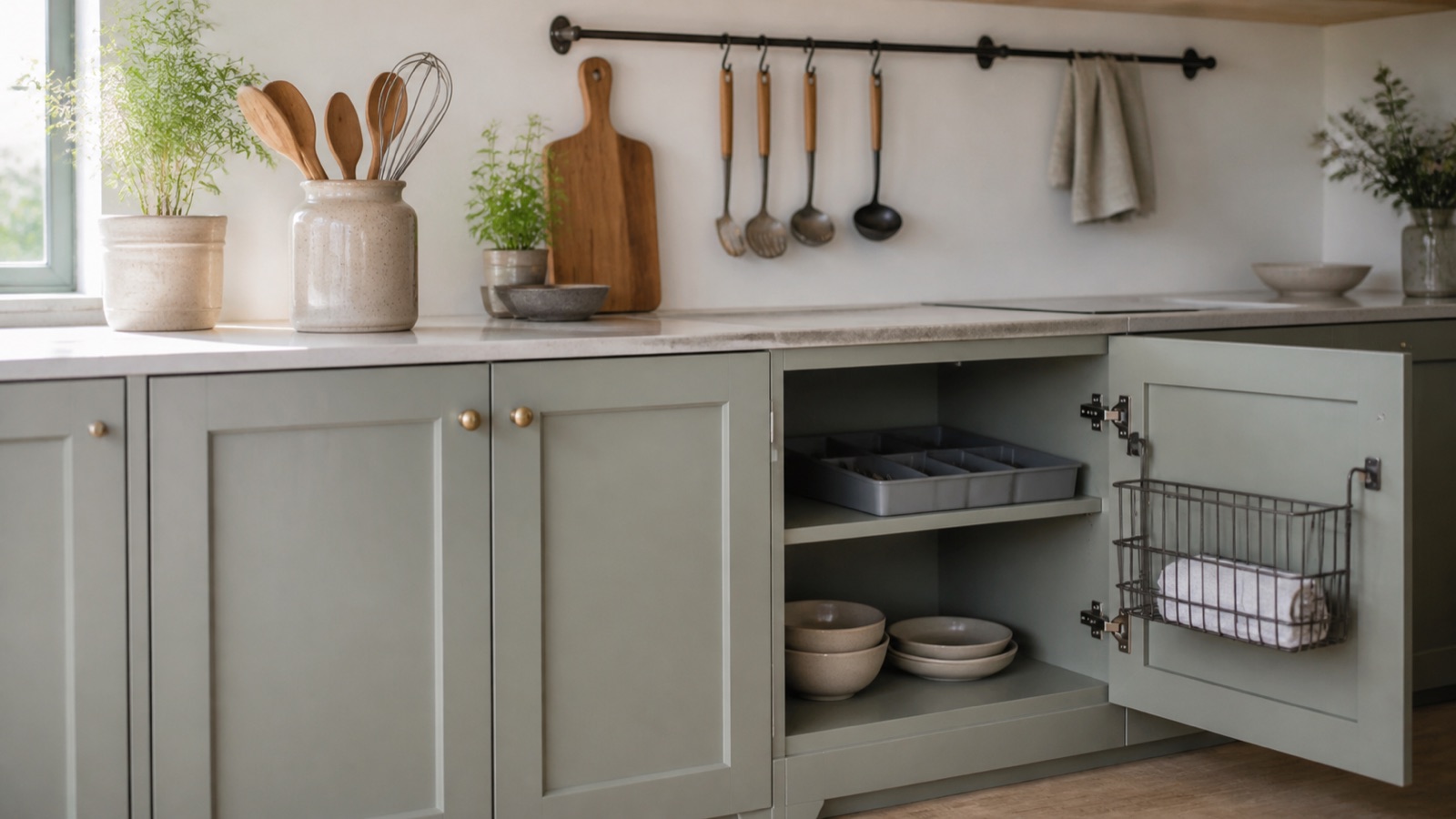
If your kitchen has no drawers, you already know the specific misery: flatware standing in a cup, foil and plastic wrap wedged into a cabinet corner, and a plastic bag of batteries and twist ties that has become your junk drawer. Almost every organizing article assumes drawers exist and tells you how to divide them. Older apartments, basement suites, and galley kitchens often skip drawers entirely or give you one narrow one, and if you rent you can't add a bank of them. The fixes below replace what a drawer does, holding small things flat and within reach, without screwing anything into the cabinets, and they follow the same deposit-safe rules as our renter-friendly kitchen storage guide.
Give flatware a tray inside a cabinet, not a crock
The default move is a utensil crock on the counter, and it fails for flatware within a week: forks and spoons tangle, and the crock eats 5 or 6 inches of the counter you're already short on. A better fix is a standard flatware tray placed on the shelf of a base cabinet or the lowest shelf of an upper. Most trays are 10 to 16 inches long and about 2 inches tall, so they fit on any shelf that is at least 12 inches deep.
Put it at the front edge of the shelf, at waist or eye height, so you can grab and drop without pulling it out. If the shelf also needs to hold plates or bowls, a shelf riser 8 to 10 inches tall lifts them above the tray. Expandable trays are worth the few extra dollars because you can widen them to the cabinet and stop them sliding around; the sorting rules in our kitchen drawer organization guide apply the same way on a shelf.
This works when you have a shelf near the dishwasher or sink and don't mind opening a door for a fork. It doesn't work well in the cabinet over the stove, where grease settles on open flatware, or on a shelf above shoulder height, where you'll knock it out reaching for something else.
Add a sliding under-shelf basket that works like a drawer
The closest thing to a real drawer you can add without tools is an under-shelf basket that clips onto the shelf above and slides in and out. The wire versions hold 2 to 3 inches of stuff: a flatware tray, dish towels, wrap and foil boxes, or a row of spice jars. They usually cost $10 to $25 and install by sliding the top rails onto the shelf.
Check two things before buying. The rails are made for shelves about 3/4 inch thick, which covers most wood and particleboard cabinets but not thick floating shelves or glass. The basket also needs a shelf at least as deep as its rails, usually 10 to 14 inches, so measure the shelf and compare it against the listing's current dimensions. The most common complaint in reviews is that the basket tips forward when it's loaded heavy and pulled all the way out, so keep cans and jars out of it.
Screw-in under-cabinet drawers exist too, and they hold more, but each one leaves two to four holes in the cabinet underside. Some landlords never notice; others charge for it. If you're tempted, the no-drill kitchen storage ideas guide explains what most leases actually treat as damage.
Use a rolling cart with drawers as your utensil station
When there's no shelf to spare, buy the drawers. A small three-drawer cart on casters, about 12 to 15 inches wide and 24 to 30 inches tall, gives you three real drawers for flatware, cooking utensils, and the junk-drawer category, and it parks under a counter overhang or beside the fridge. Rolling carts with drawers also double as a prep surface if the top is flat and sturdy.
Look for drawers with a front lip or stop so they can't fall out when you pull them, and check the listing for the per-drawer weight rating; cheap plastic drawer carts sag under a full flatware set plus heavy gadgets. Fabric-drawer carts are lighter and quieter but stretch out over time. Renters consistently report the plastic units are fine for utensils and dish towels but not for cast iron or small appliances.
This works when you have at least a 15-by-15-inch patch of floor and a cart that fits under counter height. It doesn't work in a galley so narrow that two people can't pass once the cart is in. Our roundup of rolling carts with drawers compares the flat-top models that hold up as an extra work surface.
Move cooking utensils and knives to the wall without drilling
Spatulas, tongs, and ladles don't need a drawer if they can hang. A row of heavy-duty adhesive hooks on the side of a cabinet or on the wall between the counter and the uppers holds a full set, and the strong ones are rated for 3 to 5 pounds each. They come off with a slow pull on the tab and leave no mark on painted drywall or laminate, but they lift paint on old or chalky walls, so test one hook in a hidden spot for a week first.
Knives are the item people most often want out of a crowded cabinet. A magnetic knife strip is the space-saving answer, but most are screw-mounted with two holes; the adhesive-backed versions hold lighter knives and let go of a heavy cleaver. If you rent, weigh two small holes against a countertop block that eats another 6 inches of counter, or choose a strip that stands on the counter or grips the fridge with magnets. The best magnetic knife strips and racks roundup separates the adhesive, magnetic-back, and screw-in options.
Put a tension rod to work under the sink and inside cabinets
A tension rod is the renter's answer to a missing drawer for anything that can hang. Under the sink, a 24- to 36-inch rod across the cabinet holds spray bottles by the trigger, and a second rod near the front with S-hooks holds brushes, dish gloves, and rags. Inside a base cabinet, a rod set about 4 inches back from the door with S-hooks holds measuring cups and small utensils where a drawer would.
Tension rods hold roughly 5 to 15 pounds depending on length and diameter, and the shorter you set them, the more they hold. They don't work between surfaces that flex, like a thin cabinet side panel, or across spans much over 36 inches without sagging. For shelf-style tension units that add a full layer inside a cabinet, see our guide to the best tension rod shelves for renters.
Use the backs of doors for foil, wrap, and cutting boards
Foil, plastic wrap, parchment, and zip bags are the classic drawer items, and without a drawer they end up standing in a cabinet corner, crushed. An over-the-cabinet-door rack with a wire basket 3 to 4 inches deep holds all four boxes flat, and the hooks slide over a standard cabinet door with no screws. Wider over-the-door organizers on the pantry or kitchen door can take cutting boards, pot lids, and dish towels as well.
Measure the door before ordering. Cabinet doors are usually about 3/4 inch thick and the hook must match; a hook made for a 1 3/8-inch passage door will flop around on a cabinet door and scratch it. Also check that the rack clears the shelf inside when the door closes, which is the number-one reason these get returned. Our over-the-door storage ideas guide goes through the options door by door.
Build a junk drawer that isn't a drawer
Every kitchen needs one place for batteries, tape, rubber bands, takeout menus, and the screwdriver. Without a drawer, use a lidded bin roughly the size of a shoebox on a cabinet shelf, or a desktop-style mini drawer unit with three or four 3-inch-tall drawers that sits on a shelf or the counter. Mini drawer units run under $20 and keep categories separate, which is exactly what a junk drawer never did.
The limit is weight and size: mini drawers hold pens and batteries, not a tape measure and a hammer. Put anything heavy in the lidded bin and keep the bin on a low shelf. If you find yourself opening the bin daily, that's the sign to promote its contents to the rolling cart's top drawer.
What to buy first
Start with a flatware tray on a cabinet shelf, since it costs under $15 and fixes the most annoying part of a no-drawer kitchen the same day. If the cabinets are already full, a rolling cart with drawers is the one purchase that adds real drawers without touching a wall. Whichever route you take, the best drawer dividers and organizers guide covers the trays and inserts that work just as well on a shelf or in a cart drawer as they would in a built-in.