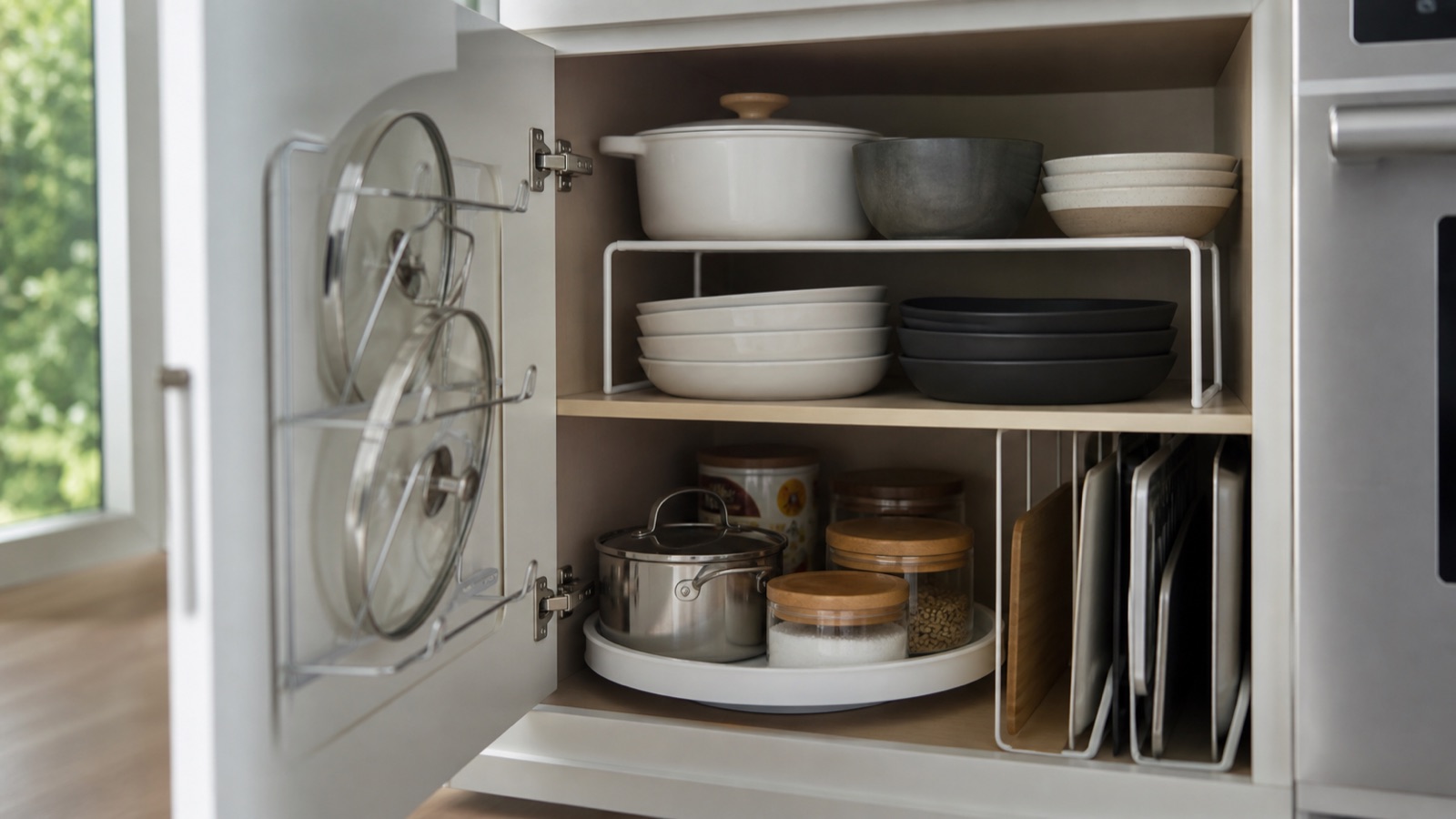
Open any upper cabinet in a small kitchen and you will find the same thing: one shelf stacked three bowls high, 6 inches of dead air above it, and a back row of cans nobody has seen since move-in. Most kitchen cabinet organization ideas you will find are photographed in 15-inch-deep custom cabinetry with pull-outs already built in. Your cabinets are 12 inches deep up top, 24 inches deep below, the shelves are fixed where the builder left them, and the whole thing may belong to a landlord.
This is the inside-cabinet chapter of our small kitchen storage by zone guide. Each idea below is matched to the shelf depth and clearance it needs, and each one comes with the cabinet types where it does not work, because the wrong organizer in the wrong cabinet is worse than no organizer at all.
Measure the three numbers that decide what fits
Before you buy anything, measure the interior shelf depth, the height between shelves, and the clear opening width between the door hinges. Standard upper cabinets are 11 to 12 inches deep inside with 10 to 14 inches between shelves; standard base cabinets are 22 to 24 inches deep with a single shelf and 15 to 20 inches of height in each section. The opening width is the number most people skip, and it is the one that stops a 12-inch-wide organizer going through a 10.5-inch face-frame opening.
Note whether your cabinets are face-frame, with a wooden lip around the opening, or frameless, where the door covers the full box. Face-frame cabinets lose 1 to 2 inches on every side and rule out most slide-in hardware unless it is screwed down. Check the listing for current dimensions on anything you order, and compare it to the opening, not the shelf.
Shelf risers double an upper cabinet shelf
A wire or bamboo shelf riser adds a second level to a shelf, so plates go below and bowls go on top instead of nesting in an unstable stack. Standard risers are about 5 to 6 inches tall and 10 inches deep, which is why they fit the 12-inch upper cabinet and leave 4 to 8 inches of clearance for items on top. Expandable versions stretch from roughly 12 to 24 inches wide, so one unit can span most of a shelf, and the common ones cost under $20.
They work when you have at least 10 inches between shelves and the items on the lower level are under 5 inches tall, which covers plates, saucers and short glasses. They do not work for stacking heavy pots on wire, which sags, or in cabinets where the shelf is under 9 inches tall, because you end up with two unusable slots. Our roundup of the best shelf risers and cabinet shelves sorts them by height and load so you can match one to your clearance.
Pull-out shelves for the 24-inch base cabinet
The back 12 inches of a base cabinet is where things go to vanish. A pull-out shelf or wire basket on drawer slides brings the whole depth to you, and a two-tier pull-out turns a single-shelf base into the equivalent of two drawers. Screw-in units run $25 to $60 and need a flat cabinet floor and about 1 inch of side clearance for the slides.
The limit is the face frame. On a face-frame cabinet a pull-out has to be narrower than the opening, not the box, which often means a 14-inch pull-out in an 18-inch cabinet and 4 inches of wasted width. Renters should look for freestanding pull-outs that sit on the floor without screws, and accept that they will shift slightly and cannot carry the same weight. Anything heavier than about 25 pounds per tier, like a stack of cast iron, needs the screwed-in version.
Lazy susans for corners and deep shelves
A turntable is the fix for a corner cabinet and for any deep shelf where the back row is unreachable. A 9-inch lazy susan fits an upper cabinet shelf and holds oils, vinegars or spice jars; a 12 to 16 inch version works on a base cabinet shelf for cans and bottles. Two-tier turntables add a second level in tall cabinets, and most single-tier models are under $20.
They only work when the shelf is deep enough to spin the full diameter with the door closed, so a 12-inch turntable will not turn on an 11-inch upper shelf. Round trays also waste the corners of a square shelf, which matters in a 12-inch cabinet. For the blind corner cabinet, our corner cabinet storage guide explains when a turntable helps and when you need a different approach, and the best lazy susans for cabinets and corners roundup compares diameters and lip heights.
Vertical dividers for lids, sheets and boards
Anything flat should stand on its edge. A wire or bamboo divider rack with 5 to 7 slots holds baking sheets, cutting boards, pot lids and muffin tins vertically, so each one pulls out without unstacking the rest. Tension-style dividers wedge between the shelf and the cabinet top with no screws, and adjustable racks let you widen a slot for a thick board.
This works in a base cabinet with 14 or more inches of height and in the narrow 9 to 12 inch cabinet beside the stove that is otherwise useless. It fails when the slots are too narrow for a lid with a knob, which reviewers mention constantly, so look for slot spacing of at least 2 inches. Our guides to pot lid storage and storing baking sheets and trays cover the divider layouts for each item.
Use the inside of the cabinet door
The door is a flat 3/4-inch panel that can hold a spice rack, a lid holder or a hook strip for measuring cups. Adhesive-mounted racks avoid holes and hold 3 to 5 pounds; screw-mounted ones hold more but require a solid door rather than a hollow thermofoil one. Door-mounted anything sticks out 2 to 4 inches, so leave a matching gap on the shelf in front of it.
This does not work on doors with a raised center panel, where the mount has no flat surface, or on face-frame cabinets where the shelf runs to the edge of the opening and blocks the rack when the door closes. Inset doors that sit flush inside the frame have almost no clearance at all.
Move the adjustable shelves before adding anything
Most upper cabinets have shelf pins and adjustable shelves that nobody has touched since installation. Dropping one shelf 2 inches and raising another 2 inches often creates a tall section for cereal boxes and a short section for glasses, which is worth more than any organizer you can buy. The pins are usually 5mm or 1/4 inch, and a replacement bag costs under $10 if a few are missing.
The limit is a fixed center shelf, which is common in older cabinets and in some rental units, and a shelf that was glued in place. You can still add a riser above a fixed shelf and a pull-out below it.
Start with risers up top and a turntable in the corner
For most small kitchens the fastest wins are a riser in every upper cabinet and a lazy susan in the deepest shelf, and both go in without tools. Add pull-outs in the base cabinets once you know which ones you reach for daily. The best shelf risers and cabinet shelves and best lazy susans roundups list the sizes that fit standard 12 and 24 inch cabinets, and the storage by zone hub linked above covers the drawers, doors and walls once the cabinets are sorted.