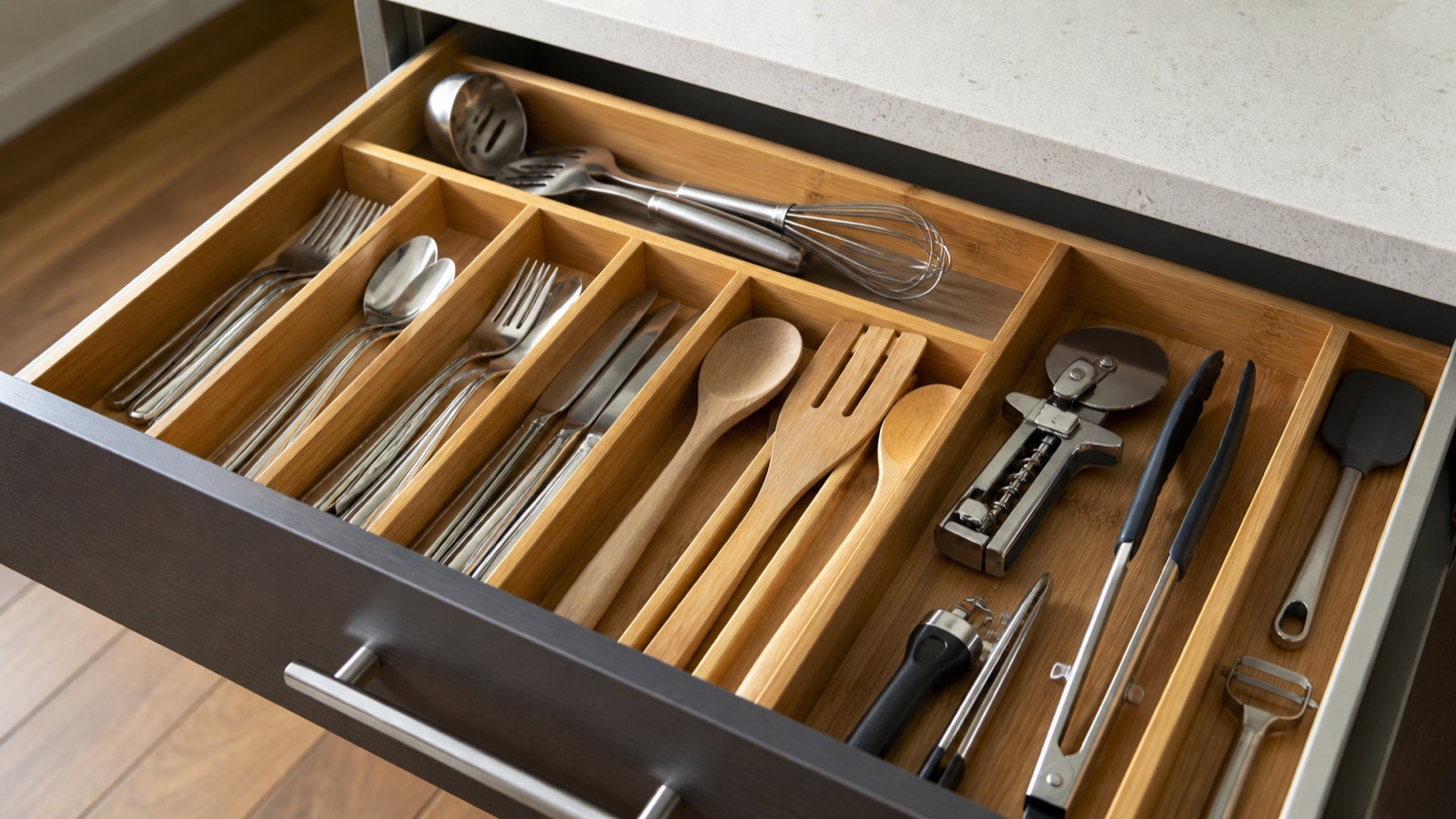
A small kitchen usually gets two or three drawers, and that is it. One is 3 inches deep and full of utensils fighting for space, one is the junk drawer, and if you are lucky there is a deep one holding a jumble of pots. The kitchen drawer organization ideas that show up first are shot in a kitchen with ten wide drawers and a dedicated one for spices, which is not a problem you have. With three drawers, every one of them has to do two jobs.
This is the drawer chapter of our small kitchen storage by zone guide. Each setup below is sorted by the drawer depth it needs, because depth is what decides whether an insert fits or whether the drawer jams on the first pull. Measure first, then pick.
Measure the inside of the drawer, not the front
Pull the drawer all the way out and measure the interior width, the interior depth from front to back, and the interior height from the drawer floor to the top edge of the side. Kitchen drawers come in three rough heights: shallow at 2.5 to 3.5 inches, standard at 4 to 6 inches, and deep at 8 to 10 inches. The interior width is usually 2 to 3 inches less than the drawer front, because the slides take an inch on each side.
Subtract another 1/4 inch from height for anything that sits inside, because the drawer has to close under the counter lip or the drawer above. This is the number that catches people out with spice tiers and knife blocks. Check the listing for current dimensions on any insert and compare to the interior height, not the front.
Expandable dividers vs modular trays for the utensil drawer
There are two approaches to the shallow utensil drawer. Spring-loaded dividers press against the drawer sides and create custom-width slots, and they need a drawer side at least 2.5 inches tall to grip. Modular trays are fixed compartments that you combine to fill the width, and they work in any height but leave 1 to 2 inches of dead space at the end unless you find an exact fit.
Dividers win in drawers wider than about 18 inches, where a fixed tray leaves a gap, and they cost $15 to $25 for a set of four. Trays win in drawers under 14 inches wide and in shallow drawers with low sides, and a non-slip liner under them stops the sliding that is the most common complaint in reviews. Our roundup of the best drawer dividers and organizers compares both by the drawer widths they span.
A knife insert instead of a countertop block
A knife block takes 6 by 9 inches of counter, which is a lot in a kitchen with 4 feet of it. An in-drawer knife insert lays blades in angled slots, holds 8 to 16 knives, and fits a standard 4 to 6 inch drawer. Bamboo inserts run 13 to 17 inches long and cost $20 to $40, and most are meant to sit at the back of a utensil drawer with dividers in front.
It does not work in a 3-inch shallow drawer, because the slots need about 3.5 inches of interior height to hold a chef's knife without the handle catching the drawer above. It also needs a drawer at least 10 inches deep front to back, which rules out the narrow drawer next to the stove. For a wall alternative that uses no drawer at all, see knife storage without a countertop block.
Spices in a drawer, if the drawer is tall enough
A tiered spice insert lays jars on their sides in three or four stepped rows, so you read every label from above. The insert itself is only about 2 inches tall, but the jars lying on it push the total to 4 to 4.5 inches, so you need a standard-depth drawer, not a shallow one. Expandable versions stretch from about 10 to 18 inches wide and cost under $20.
The limit is jar shape. Round 2-inch jars roll neatly into the tiers, while square jars and the tall 4-ounce bottles from the grocery store do not sit flat and end up sliding into the neighbors. If your only free drawer is the shallow one, our guide to spice storage in a small kitchen covers the door and wall options that take no drawer at all.
Deep drawers for pots, plates and containers
A deep drawer, 8 inches or more, is the best place in a small kitchen for pots and pans, because they lift out flat instead of unstacking from a cabinet. A pegboard insert with adjustable dowels holds a stack of plates upright, and a pair of adjustable dividers keeps pans from sliding into each other. Deep drawers on standard slides are rated for 75 to 100 pounds, which covers a full set of cookware.
Check the slide rating before loading cast iron, because the cheaper 50-pound slides in some rental cabinets will sag and stick. Food storage containers also belong here, stacked by size with lids stood on edge along the back wall. Our guide to storing Tupperware and container lids shows the layout that stops the lid avalanche.
The junk drawer gets one drawer and small compartments
Every kitchen has a junk drawer, and the mistake is letting it become two. Give it a set of small compartment trays, roughly 3 by 3 and 3 by 6 inches, and a single rule: if it does not fit in a compartment, it does not live in the drawer. Batteries, tape, twist ties and the takeout menus each get a slot, and the drawer stays usable.
If you have no drawers at all, which is common in older studio and basement kitchens, everything above still applies to a freestanding drawer unit or a cart with drawers. Our guide to kitchens with no drawers covers the units that add two or three drawers without touching the cabinets.
Match the divider to the drawer, then stop buying
For a two-or-three-drawer kitchen, one set of expandable dividers in the utensil drawer and a pegboard or divider set in the deep drawer solves most of the problem for under $50. The best drawer dividers and organizers roundup lists which sets fit shallow drawers, which need standard depth, and which span the wide drawers, and the storage by zone hub covers the cabinets and doors that take over when the drawers are full.