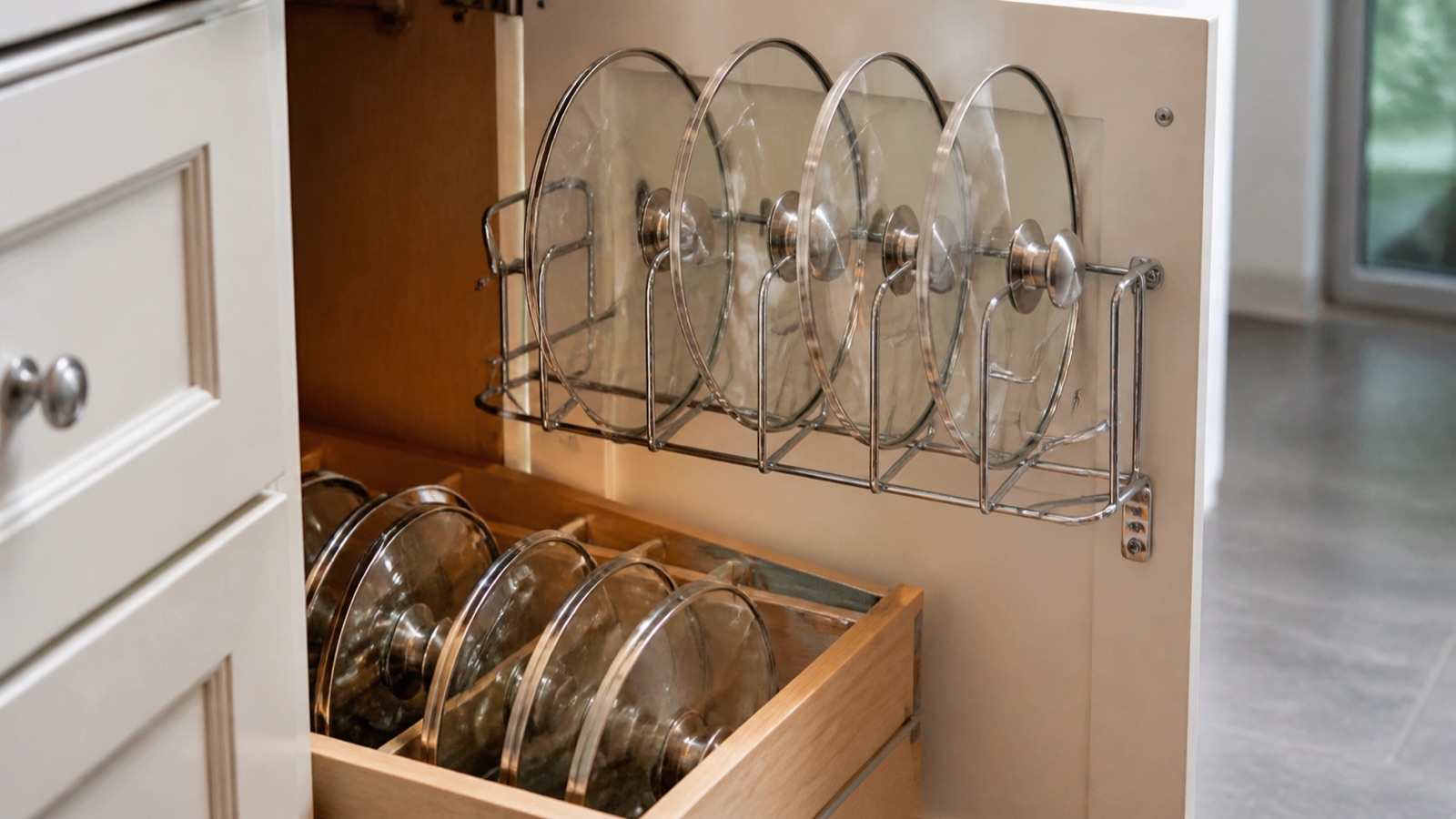
You have four pots and six lids, and the lids have taken over the bottom of the cabinet because nothing about a domed glass lid with a knob stacks with anything. Search "pot lid organizer" and you get product pages with staged photos and no mention of the two things that decide whether a rack works: the shape of your lids and the depth of your cabinet. This page is one of the item-by-item guides in our what-goes-where guide to small kitchen storage, and it goes option by option with the fit limits that reviews keep running into.
Before comparing racks, measure two things. Note the diameter and total height of your biggest lid, knob included, because a 12-inch glass lid with a tall knob is the piece that fails most organizers. Then measure the interior depth of the cabinet or drawer you plan to use; most lid racks need 10 to 12 inches of clear depth, and cabinet doors need about 3 inches of clearance behind them.
Hook a lid rack over the cabinet door
An over-the-door lid rack hangs from the top edge of a cabinet door with two hooks and holds 3 to 5 lids in the dead space behind the door. It is the cheapest fix, usually $10 to $20, and it needs no tools, which makes it the go-to for renters. Hook-over versions fit standard doors around three quarters of an inch thick; thicker doors or doors with a raised inside panel may need the screw-mount version instead.
It works best with flat metal lids and small to medium glass lids up to about 10 inches. The most common complaint in reviews is that a domed glass lid hits the cabinet shelf when the door closes, so subtract the rack's projection from your shelf clearance before ordering. Heavy lids on a door also change how the door closes over time, and doors with soft-close hinges may stop closing fully with more than 4 or 5 pounds hanging on them.
- ADoor thickness — hook-over racks fit standard doors; thicker or raised-panel doors need the screw-mount version
- BGap above the door top for the hooks; a soft-close door with no gap will not close fully
- CRack projection plus the lid dome vs. the shelf edge — a domed lid hits the shelf when the door closes
Stand lids in an adjustable rack inside the cabinet
An expandable lid rack sits on the cabinet floor or a shelf and holds lids upright in slots, like a dish rack for lids. Most adjust from roughly 12 to 22 inches wide and hold 5 to 8 lids; the good ones have adjustable divider spacing so a thick Dutch oven lid and a thin saucepan lid both stand up. Prices run from $15 to $30, and the same rack can double as a baking sheet divider if you have spare slots.
The limit is slot width versus lid shape. Fixed-slot racks are typically sized for lids around a half inch thick at the rim, and a glass lid with a wide rim or a stainless lid with a rolled edge either wedges or slips through and tips. If your lids are mostly domed glass, pick a rack with adjustable dividers, and check the listing for current dimensions on slot spacing rather than trusting the count of lids in the photo.
Hang lids from a wall rail or hooks
Lids with a loop or bar handle can hang from a short wall rail with S-hooks or from a row of adhesive hooks on the side of a cabinet. It uses vertical space you probably are not using, keeps the lids visible, and works on a strip of wall as narrow as 12 inches. For a renter, adhesive hooks rated for 3 pounds each handle stainless lids comfortably.
Knob-style lids are the problem; a round knob has nothing to hang from, so this only suits maybe half of what most people own. Glass lids also weigh 1 to 2 pounds each, which is where the light adhesive hooks fail, particularly on textured or freshly painted walls. Wall-mounted lid holders with a lip, which hold the lid rim instead of the handle, solve the knob issue but need screws.
Make slots with tension rods
Two or three short tension rods, mounted vertically inside a cabinet from floor to shelf, create slots that hold lids on edge at almost no cost. Rods that extend from about 7 to 11 inches cover most cabinet heights and cost under $15 for a multipack. Spaced 2 to 3 inches apart, they hold a lid each and can be moved in minutes when your pot collection changes.
This works when the cabinet floor and shelf are flat, solid surfaces the rod ends can press against. It fails on slick laminate where rods walk under load, and on adjustable shelves that lift when pushed from below. Keep the lids under about 2 pounds each here; heavier lids leaning on a rod will eventually pop it loose. Our roundup of the best tension rod shelves for renters covers the rod sizes and end caps that grip best.
Give lids a drawer with dividers
If you have a deep drawer, at least 4 inches inside, lids can lie flat or stand on edge between adjustable dividers, and this is the option people rarely regret. Spring-loaded drawer dividers that expand from about 12 to 20 inches let you set the spacing to your lid sizes and change it later, and a standard drawer holds 6 to 8 lids on edge.
Shallow drawers make this useless, because a 10-inch lid standing on edge is 10 inches tall and needs the drawer to clear it under the counter. Laid flat, lids nest only if they are the same shape, and the moment two glass lids nest they slide when the drawer opens. Line the drawer with a non-slip mat, and reserve this for kitchens where the drawer is already free, since it uses the same space that kitchen drawer organization usually gives to utensils.
Store lids on the pots, or buy pots that share them
The zero-hardware option is to store each lid upside down on its own pot with a felt protector between them, which keeps pairs together and adds about an inch of stack height per pot. It works when knobs are short enough to sit inside the pot above and when you have one lid per pot. It works badly when you have three lids for two pots and no idea which is which.
If you are replacing cookware, the structural fix is a nesting set where two or three lids fit every pot in the set. The best nesting cookware sets reduce a drawer full of lids to two or three, at the cost of the deep, domed lids that cast-iron and Dutch oven owners tend to prefer. The rest of the pan cabinet is covered in our guide to storing pots and pans in a small kitchen.
Which lid organizer to buy first
Start with the door rack if you have a cabinet door with clearance and mostly flat lids, or an adjustable in-cabinet rack if your lids are glass. Renters with laminate cabinets and no free drawer should try tension rods before spending more. If you have a free drawer, a set of adjustable drawer dividers is the most flexible purchase, because it keeps working when the lid collection changes.