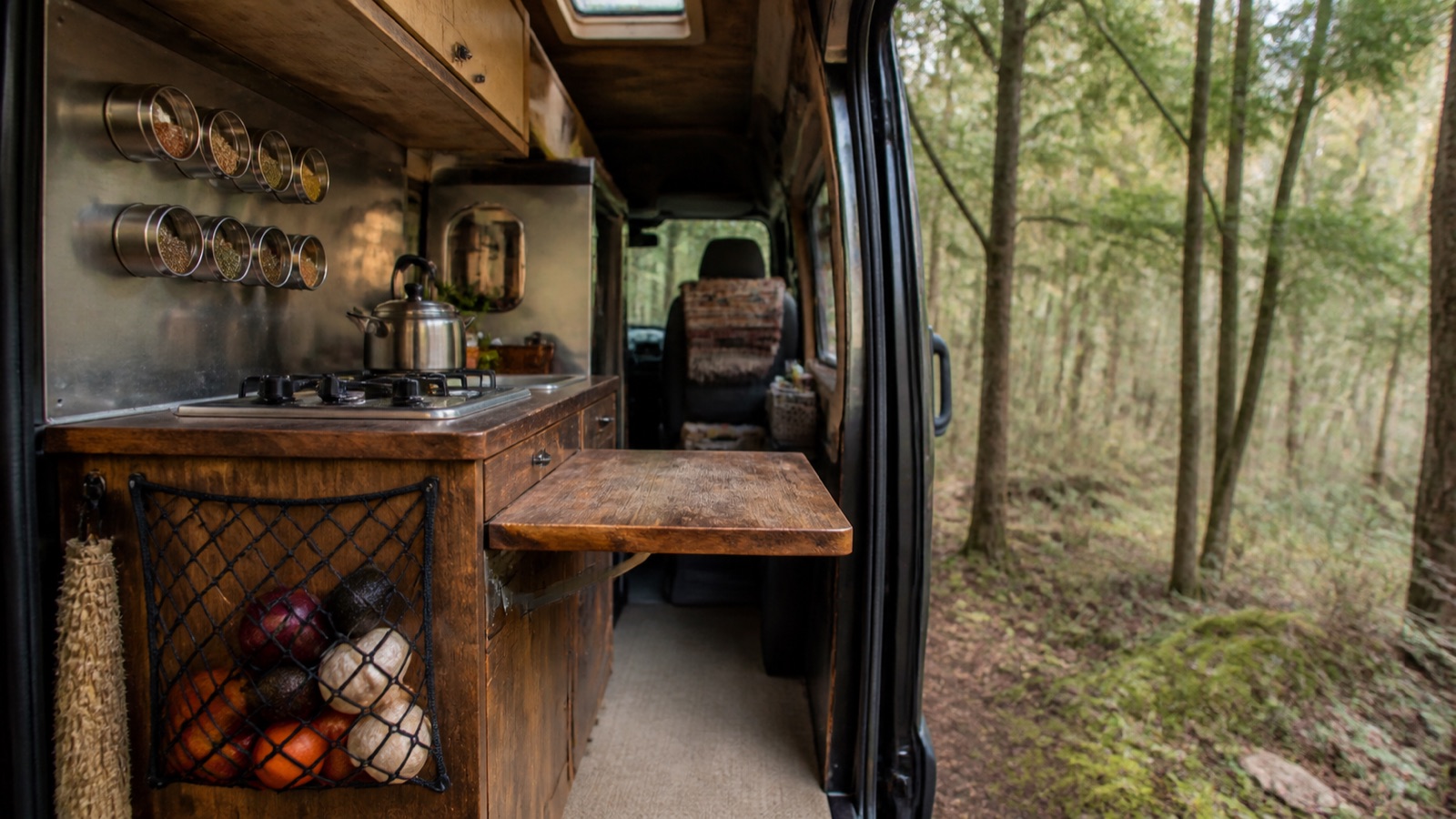
A camper van kitchen is usually a two-burner stove, a 12-volt fridge or a cooler, maybe a sink, and one or two cubbies you built yourself or inherited with the van. Unlike an RV, there is no wall of cabinets and barely a counter. Unlike a house, everything you own has to stay put on a dirt road and weigh next to nothing. Van build videos show finished custom cabinetry; what they skip is what to buy when you are not building cabinets because you are in a rented van, a weekend minivan camper, or a conversion you are still finishing.
The ideas below are the ones van owners consistently report living with for years, sorted by how they mount, what they weigh, and what happens to them on a washboard road or in a hot parking lot. They start from the no-drill toolkit in our renter-friendly kitchen storage guide and add straps, magnets, and latches.
The Chuck Box: One Crate Holds the Whole Kitchen
The oldest van kitchen solution is still the most reliable one. A single latching-lid tote in the 27 to 35 quart range, or a purpose-built camp kitchen box with fold-out sides, holds the stove, a nesting cookware set, utensils, a cutting board, soap, and a towel. It rides strapped down by the slider or at the back doors and slides out onto the tailgate or a folding table when you cook.
This works when you cook outside or in the doorway, which is most van camping in decent weather. It fails when it rains for three days and you need to cook inside, and it gets heavy: a loaded box runs 30 to 40 pounds, more with cast iron. Two cam straps through the box handles to floor D-rings keep it from becoming a projectile in a hard stop.
The most common complaint about camp kitchen boxes is digging through everything to find one spoon. The fix is a second, smaller daily box with the six things you use at every meal, so the big box only opens for real cooking.
Nesting Cookware and Collapsible Everything
A two-pot, one-pan set with a removable handle nests to 5 or 6 inches tall and fits a cubby 12 inches wide. Add a collapsible silicone kettle, colander, and a set of nesting bowls, and the whole cooking kit fits in a space the size of a shoebox. Stainless nests better than nonstick in a van because pieces rub against each other for miles and nonstick coatings scratch.
This works with one cubby or one bin. It does not work well on high-output camp stoves if the set has a thin base, which scorches and warps; check the listing for base thickness or a layered bottom. If you run an induction cooktop off a battery bank, confirm the set is induction rated, since many lightweight camp sets are pure aluminum and will not heat.
Our comparison of the best nesting cookware sets separates the camping-weight sets from the ones sturdy enough for daily use in a rig you live in.
Hanging Organizers Strapped Where You Have No Doors
An over-the-door pocket organizer has no door to hang on in a van, so van owners strap it instead: to the back of the driver's seat with the headrest posts, to a bulkhead, or from the roof ribs with zip ties or short bungees. Mesh pockets hold utensils, spice packets, snacks, and paper towels within reach of the stove.
This works when the organizer hangs where you cook and holds light items. It fails when you load it with jars or cans, which swing, hit you, and pull the straps loose on rough roads. Sun through a window fades and stiffens vinyl pockets within a season, so fabric or mesh lasts longer. Anything hung behind a seat also has to clear the seat's recline.
The best over-the-door organizers for this use are the soft fabric ones with a top bar you can lash, not the rigid wire baskets designed for a house door.
Magnets Work in a Van, Better Than in an RV
A van body is steel, which is the one advantage a van has over a fiberglass RV. Magnetic spice tins stick to exposed ribs and panels, a magnetic strip holds utensils and a small paring knife, and magnetic hooks hold towels and mitts. A magnetic paper towel holder on a bare panel costs under $20 and needs no drilling.
This works on bare or painted steel. Once you insulate and panel the walls, the magnet has nothing to grab unless you screw a thin steel plate to the paneling first. Summer heat weakens cheap ceramic magnets over time; neodymium tins hold better. Tins still slide under hard braking, so the strip goes lower than head height and a small bin catches the spice tins for driving days.
Owners consistently report that a magnetic knife strip is a parked-only tool. Knives ride sheathed in a drawer or the chuck box, and the strip is for the spatula and tongs. See the best magnetic knife strips for the difference between adhesive-backed and screw-mounted models, because in a hot van only the screw-mounted ones stay up.
A Dry Pantry in Stackable Containers
Van food lives in a bin, and the bin should hold square containers rather than bags and boxes. Six to eight containers in the 1 to 2 quart range cover oats, rice, pasta, coffee, nuts, and snacks. Filled close to the top, they stop rattling, which is the sound that makes a dirt road unbearable. Square shapes pack a bin with almost no wasted air.
This works when the bin has a lid and a strap or a snug spot. It fails when you leave containers loose on an open shelf, where they walk to the edge and fall. Gasketed lids also matter in a van because the interior swings from cold nights to 100-degree afternoons, and cheap lids pop. Our guide to the best stackable food containers notes which sets have interchangeable lids, which matters when one goes missing at a campsite.
Latches, Bungees, and Drawer Slides: Keeping Things Closed
Every cubby, drawer, and shelf in a van needs a way to stay shut. Push-button or baby-proof latches on cubby doors, magnetic catches on lightweight doors, and bungee nets across open shelves cost a few dollars each and prevent the most common van complaint: opening the slider to find the floor covered in your kitchen. Drawer slides for a slide-out kitchen should be rated for at least 100 pounds and have a lock-in and lock-out detent.
Adhesive latches and catches fail in heat just like adhesive hooks, so screw them. A tension rod across the front of a shelf works as a fence if the shelf has solid sides, but keep it short, since rods over about 24 inches pop out on rough roads.
Keep the Weight Low and the Daily Kit Small
Vans have a payload limit, and a kitchen build plus water plus a battery bank eats it fast. Heavy items, including the water jug and the chuck box, belong on the floor near the rear axle, not on a shelf. Keep the daily kit to about ten items and store the rest in the big box, so you handle less every meal and the van stays balanced.
If you are moving up to a rig with real cabinets, our RV kitchen storage ideas cover vibration-proofing at cabinet scale. For a van, start with the nesting cookware and the container pantry; those are the two purchases that owners say reduced both weight and mess the most.