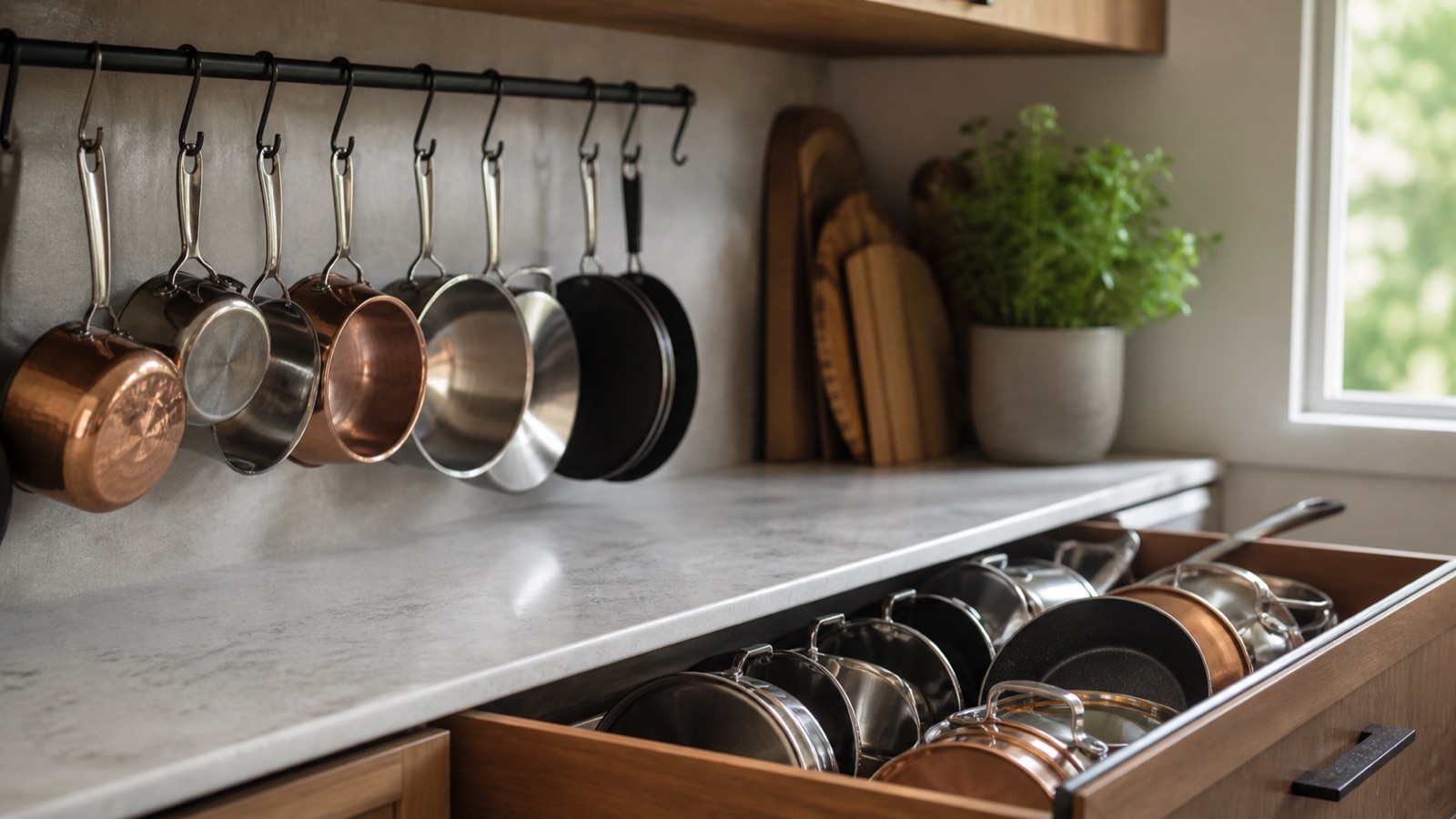
You have one deep lower cabinet, maybe a second shallow one, and a stack of pans that has to come all the way out every time you want the skillet at the bottom. Most pots-and-pans guides assume you can hang a ceiling rack or screw a rail into a stud wall, which does nothing for a renter with a galley kitchen and a landlord who counts holes. This page is part of our what-goes-where guide to small kitchen storage, and it sorts the realistic options by what your cabinet can actually take: its depth, its interior height, and whether the pans are nonstick.
Before you buy anything, count what you cook with in a normal week. Most home cooks reach for a 10- or 12-inch skillet, one 2- to 3-quart saucepan, a stockpot, and maybe a Dutch oven. Everything else in the stack is what makes the stack unmanageable, and no organizer fixes a cabinet holding nine pans you use twice a year.
Nest them with pan protectors
Nesting is the default in a small kitchen because it needs zero extra hardware and works in any cabinet at least 12 inches deep. The problem is that bare metal on nonstick scratches the coating, and the most common complaint in reviews of nested cookware is exactly that: a ruined skillet after a few months of stacking. Felt or foam pan protectors, sold in sets of 8 to 12 for under $15, sit between each pan and stop the scratching.
Nesting works best when your pans step down in size, like 12, 10, and 8 inches, so each one sits inside the next. It works poorly when handles are riveted at different angles, because the stack fans out and takes twice the width. Tall stockpots and Dutch ovens should not be part of the stack at all; set them beside it and nest smaller saucepans inside them instead.
Use a pull-out or tiered rack inside a deep cabinet
If your lower cabinet is 20 inches deep or more, a pull-out cookware rack turns the back half of it from dead space into the most useful shelf in the kitchen. Tiered versions hold each pan on its own shelf so you grab one without moving the others, and expandable models adjust from roughly 12 to 20 inches wide to fit your cabinet. Expect to spend $25 to $50, and check the listing for current dimensions before you order, because interior cabinet height is what kills most of these.
The limits are structural. A cabinet with a center stile between two doors blocks anything wider than a single opening, and sink cabinets with plumbing in the back rarely have a clear run. Tiered racks also need at least 4 to 5 inches of clearance per shelf, so a deep skillet with a tall handle may only fit on the top tier. If your cabinet is shallow, a simple set of cabinet shelf risers does most of the same job for saucepans at a lower cost.
Get the lids out of the pan cabinet
Lids are what turn a workable pan stack into an avalanche, because they do not nest and they slide. Moving them to their own spot, whether that is a rack on the cabinet door, a slim divider, or a drawer, frees roughly a third of the pan cabinet on its own. The options and their fit limits, with glass lids and tall knobs as the usual failure, are covered in our guide to pot lid storage that actually works.
If you only have one lid per pan, an easy interim fix is storing the lid upside down on top of its pan with a protector between. It adds about an inch of height per pan and keeps matched pairs together, but it only works when the lid has a flat handle or a knob short enough to sit inside the pan above it.
Hang them on a wall rail or hooks
A wall rail with S-hooks stores four to six pans in about 24 inches of horizontal space and lets you see everything at once. This is the classic solution because it works, but it has a weight problem: a 12-inch cast-iron skillet weighs 6 to 8 pounds, and a rail needs to go into studs or use proper anchors to hold three of them. Renters can use heavy-duty adhesive hooks for lightweight aluminum or nonstick pans, but these are usually rated for 3 to 5 pounds each and consistently fail under cast iron.
Hanging also means your pans are on display, and in a small kitchen the wall next to the stove is often the only free wall. Grease settles on anything hung within 2 feet of a burner, so plan on wiping hung pans more often. For rails, pegboards, and no-drill alternatives, see our guide to vertical and wall storage for small kitchens.
Move the pans to a rolling cart
When the cabinets are simply full, a three-tier rolling cart parked in a 12- to 18-inch gap beside the fridge or at the end of a counter run becomes a dedicated cookware station. Steel-frame carts in the $30 to $60 range typically rate each shelf for 20 to 30 pounds, enough for a skillet, two saucepans, and a stockpot per tier if you check the listing's load rating first.
This fails when the gap is narrower than the cart's wheels or when the floor is carpet, and a cart loaded with Dutch ovens on the top shelf tips easily. Put the heaviest pieces on the bottom tier, and if the cart lives next to the stove, keep the top shelf a few inches below the counter so it does not become a landing spot for hot pans. Our roundup of the best rolling carts for small kitchens compares shelf sizes and weight ratings.
Replace the set with nesting cookware
If your pans are due for replacement anyway, a nesting set with detachable handles stores 8 to 10 pieces in the footprint of one 10-inch pot. The space saving is real, often 60 to 70 percent compared with a conventional set, and it is why these sets are the standard recommendation for RVs and tiny houses.
The trade-offs are also real. The most common complaint in reviews is a detachable handle that develops play after a year of use, and nesting sets rarely include a true 12-inch skillet or a heavy Dutch oven. They work when you cook mostly on two burners and value the cabinet space, and they do not work when you want to keep your cast iron and carbon steel, which do not nest with anything.
Which option fits your kitchen
Start with pan protectors and a lid rack, because together they cost under $30 and fix the two things that make a pan cabinet unusable. If the cabinet is deep enough, add a pull-out or tiered rack; if it is not, a rolling cart absorbs the overflow. And if you are replacing pans this year, compare the best nesting cookware sets before you buy another conventional set that only stacks badly.