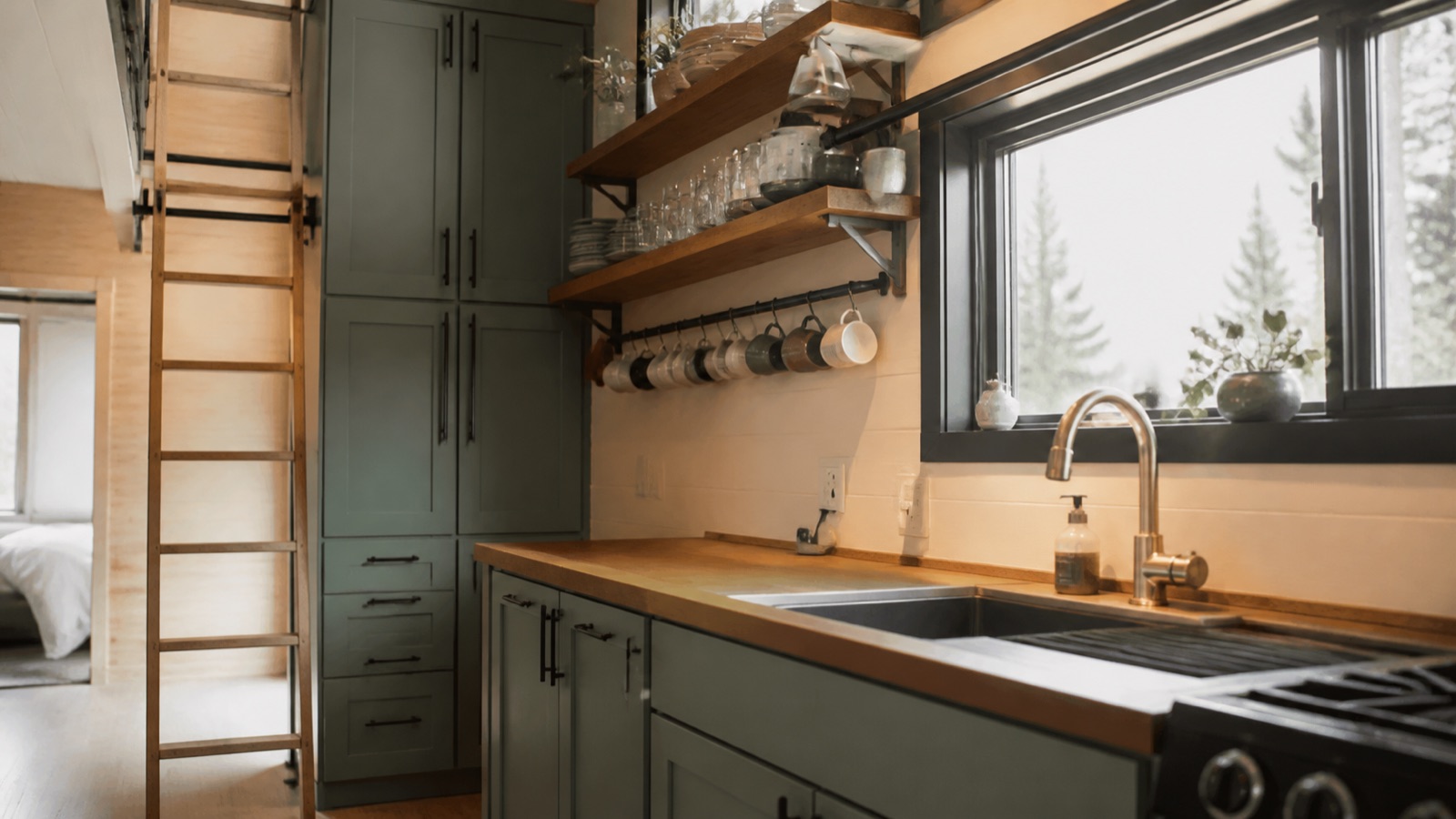
A tiny house kitchen is usually 6 to 10 linear feet of counter and cabinet, an apartment-size fridge, a two-burner or 24-inch range, and a wall that runs 10 or 11 feet up to a sleeping loft. Two things make it different from a small apartment kitchen. If the house is on wheels, every pound you add counts against a trailer that is already near its rating. And the space is vertical in a way most storage advice ignores, with more empty wall above the cabinets than cabinet.
If you rent your tiny house or bought a pre-built model, you also cannot fix the problem with custom cabinetry the way the build blogs assume. The ideas below are sorted by what they weigh, what they need to mount to, and whether they survive a tow. They build on the no-drill methods in our renter-friendly kitchen storage guide with a tiny-house twist: you may own the walls, but you still cannot make them thicker.
Go Up the Wall, but Only Into Studs
The wall between the upper cabinets and the loft is the largest unused surface in most tiny houses. A wall rail with S-hooks for pans and utensils, a pegboard panel, or two open shelves between 5 and 7 feet up hold everything that does not fit below. Owners consistently report that the top shelf becomes the "monthly" shelf: the stockpot, the slow cooker, the extra flour.
This works when you screw into studs. Tiny house walls are often framed with 2x3 or 2x4 studs at 16 or 24 inches on center and sheathed with 1/4-inch plywood or shiplap to save weight, which is too thin for drywall anchors or toggle bolts to hold a loaded shelf. Find the studs with a magnet or a finder, and keep loaded shelves under about 15 pounds per foot.
If you rent, a tension rod shelf in a window recess or between the cabinet side and the wall gives you a level for light items without a hole. Our comparison of the best tension rod shelves lists the spans and weight limits, which matter more here because a tow will test them.
Double Every Cabinet Shelf With Risers
Tiny house builders tend to install either full-depth 24-inch base cabinets with one shelf or shallow 12-inch uppers, and both waste vertical space inside. A wire or bamboo shelf riser 5 to 6 inches tall turns one shelf into two for plates, mugs, and cans. An under-shelf basket that hooks over the shelf edge adds a third level for foil, bags, and tea.
This works in any cabinet with at least 10 inches between shelves. It fails when the riser legs sit on a lip or an uneven cabinet floor and rock, which on a house that gets towed means the riser walks. A dab of museum putty under each foot fixes that. Expandable risers that adjust in width are the safest buy when cabinet widths are odd, which they usually are in a custom build; check the listing for the expansion range.
The best shelf risers for a tiny house are wire, because they weigh under 2 pounds and let you see what is on the lower level.
The Blind Corner and the Deep Shelf: Lazy Susans
Many tiny houses use an L-shaped kitchen to fit a bathroom door, which creates one blind corner cabinet where things go to be forgotten. A 9 to 12 inch turntable on the corner shelf, or a two-tier turntable in a deep 24-inch base cabinet, brings the back of the cabinet to the front. Oils, vinegars, and spices are the usual tenants.
This works when the cabinet opening is wider than the turntable; measure the door opening, not the cabinet interior, and check the listing for the turntable diameter. It fails on the road unless the turntable has a raised lip, because items on a flat turntable shift and jam the rotation. A lipped model with a non-slip surface is the one owners of houses on wheels recommend.
Our guide to the best lazy susans covers lipped versus flat, single versus two-tier, and which sizes fit a standard corner base cabinet.
One Pot Set: Nesting Cookware and Multi-Use Tools
A two-burner cooktop means you rarely use more than two pans at once, so a set of eight to ten nesting pieces with a detachable handle covers a full kitchen in a column 6 to 8 inches tall. Add a kettle that nests or a stovetop kettle that doubles as a pot, and one 12-inch skillet with a lid for the meals that need a real pan.
This works when you commit to the set and let go of the mismatched pans you brought from a bigger kitchen. Nesting nonstick needs pan protectors between pieces, and for a house that travels, stainless survives better. Check that the set is induction rated if your cooktop is; many tiny houses run induction to skip propane.
See our comparison of the best nesting cookware sets by weight, which matters when a full set can range from 8 to 20 pounds.
Under the Sink Is Full of Plumbing, and Maybe a Pump
In a tiny house the under-sink cabinet often holds a water pump, an accumulator tank, a small water heater, or a filter, plus the trap and shutoff valves. That leaves an irregular space that a standard under-sink shelf will not fit. A two-tier expandable under-sink organizer with removable shelf panels works around pipes, and a door-mounted caddy holds the sponge, brush, and dish soap.
This works when you measure around the equipment first and buy an organizer that adjusts in both width and depth. It does not work if the pump needs service access; leave a clear path to anything with a fitting. Put a shallow tray under everything, because a pump fitting that weeps is a cabinet full of wet cleaning supplies. Our guide to the best under-sink organizers flags which models remove panels for pipes.
A Rolling Cart That Doubles as Counter
With 4 to 6 feet of counter, a rolling cart with a butcher block or stainless top at counter height (34 to 36 inches) adds a prep surface and two shelves of storage. It parks at the end of the run or under the loft stairs, rolls out for cooking, and rolls out of the way when the house needs to feel bigger.
This works on a level floor with locking casters. On a house that gets towed, the cart has to be strapped or parked against a wall with the casters locked, or it will wander. Carts in the 30 to 50 pound range are the practical limit for a tiny house on wheels, so skip the heavy cast-iron-topped ones. The best rolling carts for small kitchens include a few narrow enough for a 24-inch gap.
The Weight Rule for Houses on Wheels
A tiny house on wheels typically has a few hundred pounds of margin between what it weighs and what the trailer is rated for, and kitchen gear is the easiest place to lose it. Keep heavy items low and over the axles, choose wire over wood and stainless over cast iron where you can, and weigh the house at a truck scale after you set up the kitchen. The vibration side of the problem is covered in our RV kitchen storage ideas, and most of it applies directly to a towed house.
If you buy three things from this list, make them the shelf risers, the nesting cookware, and the tension rod or wall rail, because those three add the most storage for the least weight and the fewest holes.