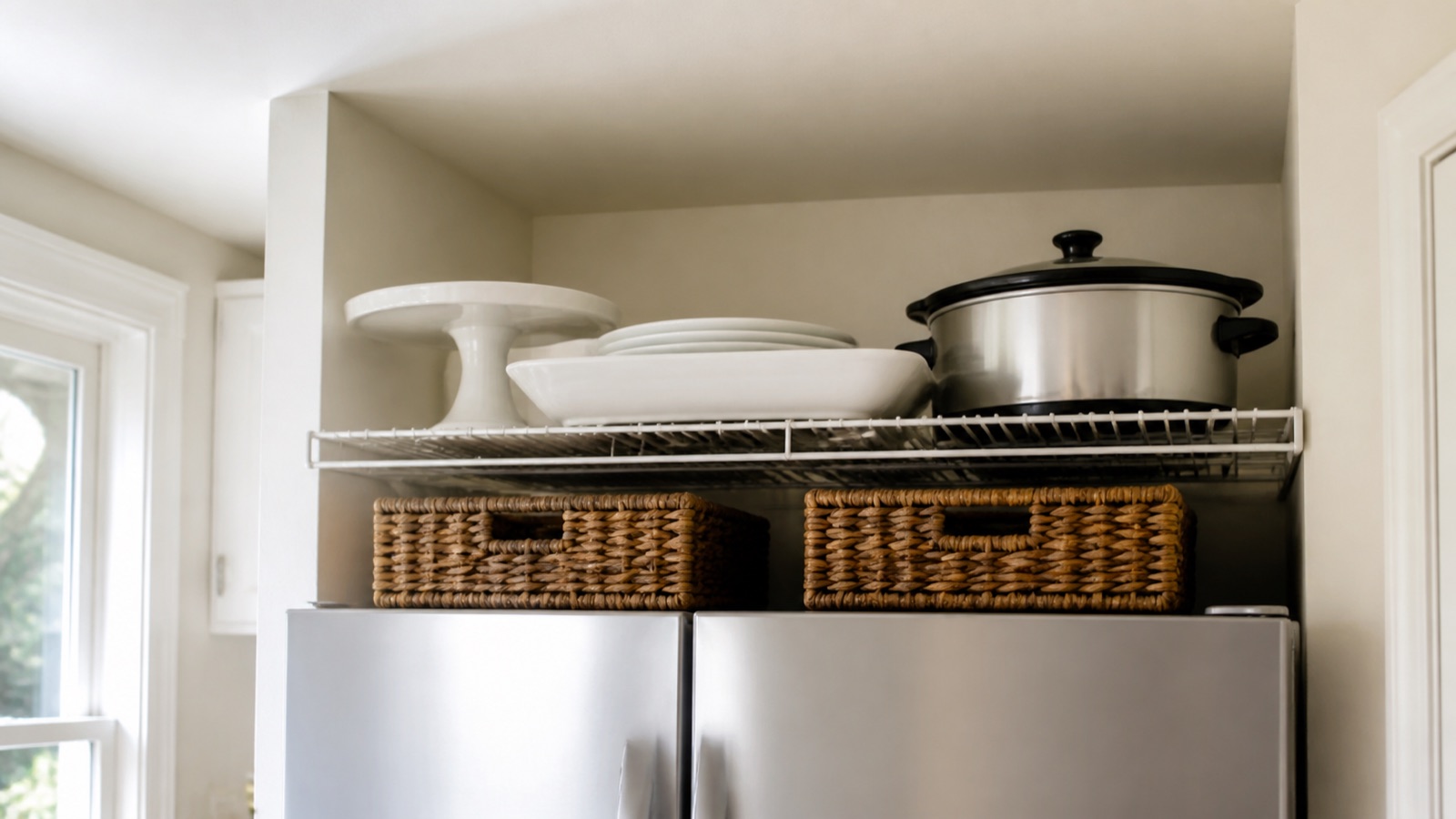
The gap between the top of your refrigerator and the ceiling, or the cabinet above it, is usually the last empty surface in a small kitchen, and it stays empty for good reasons. It is hard to reach, it collects a film of dust and cooking grease within a month, and on many refrigerators the top runs warm whenever the compressor cycles. Most "above fridge storage ideas" posts show a pair of styled baskets and stop there, without mentioning the heat, the freezer door that has to swing open underneath, or the fact that the fridge top is often not level.
This guide is one zone in our small kitchen storage ideas by zone series, and it treats the fridge top as what it is: a warm, high, awkward shelf that is still worth using if you put the right things up there in the right containers. Below are the measurements to take first, the three ways to build usable storage above and beside the fridge, and a short list of what should never go up there.
Measure the gap and check for heat
Start with a tape measure and your hand. Measure the height from the fridge top to whatever is above it, which is typically anywhere from 8 to 14 inches in a small kitchen, and the depth of the fridge top from the back wall to the front edge, not counting the doors. Then open the freezer door and note how far the door and its hinge rise above the top surface, because anything sitting near the front edge cannot overhang that hinge.
Next, wait until the compressor has been running for a while and put your palm flat on the top. Older units and models that vent through the back often feel noticeably warm, and that warmth is why people report melted chocolate, rancid oil, and stale bread from above-fridge baskets. If the top is warm, plan to store only things that do not care about temperature: paper goods, sealed dry goods in boxes, bakeware, and light gear you rarely use.
- AHeight from the fridge top to whatever is above it
- BWidth of the fridge top between the side walls or cabinets
- CDepth from the back wall to the front edge — nothing may overhang the freezer door hinge
The cabinet above the fridge
If you have a cabinet over the fridge, it is probably deep, low on height, and above your head, which makes it useless for anything stacked. The fix is to store things vertically instead. A wire or bamboo divider rack, usually under $25, turns that cabinet into slots for sheet pans, cooling racks, cutting boards, and serving platters, all of which you can pull out with one hand from a step stool. Our guide to storing baking sheets and trays goes deeper on divider sizing.
For the rest of the cabinet, use bins with a front handle or cutout so you can hook a finger and slide the bin toward you before lifting. Keep each bin light, since you are taking it down from above eye level, and keep anything glass or heavy out of this cabinet entirely. A shelf riser only helps here if the cabinet interior is at least 12 inches tall; below that, a second tier leaves no room to lift anything out.
The open fridge top: baskets with handles
On an open fridge top, the goal is to make everything up there liftable in one motion, and baskets with handles are the simplest way to do that. Two woven or wire baskets 12–15 inches wide, sized so their depth is a couple of inches less than the fridge top, typically cost under $30 for the pair. Set them back about 2 inches from the front edge so the freezer door and hinge clear them, and fill them with paper towels, cereal boxes, chip bags, party supplies, and backup napkins.
This works when the fridge top is reasonably level and the gap above it is at least 10 inches, which leaves room to lift a basket out without tipping it. It does not work well if the fridge sits next to the stove, because open baskets collect grease spatter and everything inside them ends up tacky. In that case, switch to lidded bins and wipe the lids once a week. People with small kitchens consistently report that open baskets up there look good for a month and then become the dustiest spot in the room, so choose containers you are willing to take down and wash.
Over-the-fridge racks and two-tier risers
If your ceiling is high and the gap above the fridge is 18 inches or more, you can add a second level. There are two ways to do it. A two-tier shelf riser sized to the fridge depth sits directly on the fridge top and holds light boxes on both levels; check the listing for current dimensions so the riser does not extend past the front edge. A floor-standing over-the-fridge frame straddles the fridge on two legs and carries its own weight, which lets you store heavier items like a bread machine or a case of seltzer without putting that load on the appliance.
The floor-standing frames need 3–4 inches of clearance on each side of the fridge for the legs, and they need a level floor, so measure before you buy. The most common complaints in reviews are wobble on cheaper models and shelves set so low that the freezer door hits them, so buy a frame with adjustable shelf height. For the riser option, our roundup of the best shelf risers and cabinet shelves lists expandable models that adjust in width to match a fridge top.
The side of the fridge: magnetic and hanging racks
The exposed side of a refrigerator is a vertical panel about 24–30 inches deep and 5–6 feet tall, and it is often more useful than the top because you can reach it. Magnetic spice racks, magnetic paper towel holders, and multi-tier magnetic shelves attach without tools and come off cleanly when you move; most are under $25. Racks that hang over the top edge of the fridge on hooks handle more weight, such as a roll of foil plus wrap boxes, and they do not depend on magnets at all.
Before you order anything magnetic, hold a fridge magnet against the side panel. Many stainless-steel finishes are not magnetic, and the most common one-star review on these racks is "did not stick." You also need at least 3 inches of clearance between the fridge side and the nearest wall or cabinet so the rack does not stop the fridge from sliding out for cleaning. If spices are what you want up there, see our guide to spice storage in a small kitchen for the tradeoffs between magnetic tins, racks, and drawer inserts.
What should live up there (and what should not)
The fridge top and the cabinet above it are best treated as backup storage, the place for the second bag of coffee filters and the extra roll of paper towels, not for anything you reach for every day. Good candidates are paper goods, boxed cereal and crackers you rotate through, sealed snack bags, lightweight serving pieces, and holiday or party supplies. If you have no pantry, this zone can hold the overflow from your cabinets; our guide to where to put food when you have no pantry shows how to split dry goods between the fridge top and a cart.
Keep oils, chocolate, spices, wine, and bread off a warm fridge top, and keep anything heavier than a few pounds off any surface above your head. A stand mixer or a countertop oven stored up there is the kind of thing that comes down on a wrist, and the trip to the counter defeats the point of storing it at all. For heavy appliances that do not fit on the counter, our guide to where to put small appliances in a tiny kitchen covers safer spots.
Keeping it clean
Whatever goes above the fridge, put dry food in sealed containers rather than in its original bag, because grease and dust settle on everything up there and cardboard soaks it up. Airtight stackable containers keep flour, cereal, and snacks fresh on a warm shelf and stack two high inside a basket; our roundup of the best stackable food storage containers covers sizes that fit a 12–15 inch basket. Wipe the fridge top when you swap seasonal items, and lift the baskets out to do it rather than wiping around them.
If the fridge top turns out to be too warm or too high to be useful, do not force it. A rolling cart parked beside the fridge holds more, stays cool, and moves when you need to pull the fridge out; the best rolling carts for small kitchens roundup compares sizes that fit a 12-inch gap next to an appliance.