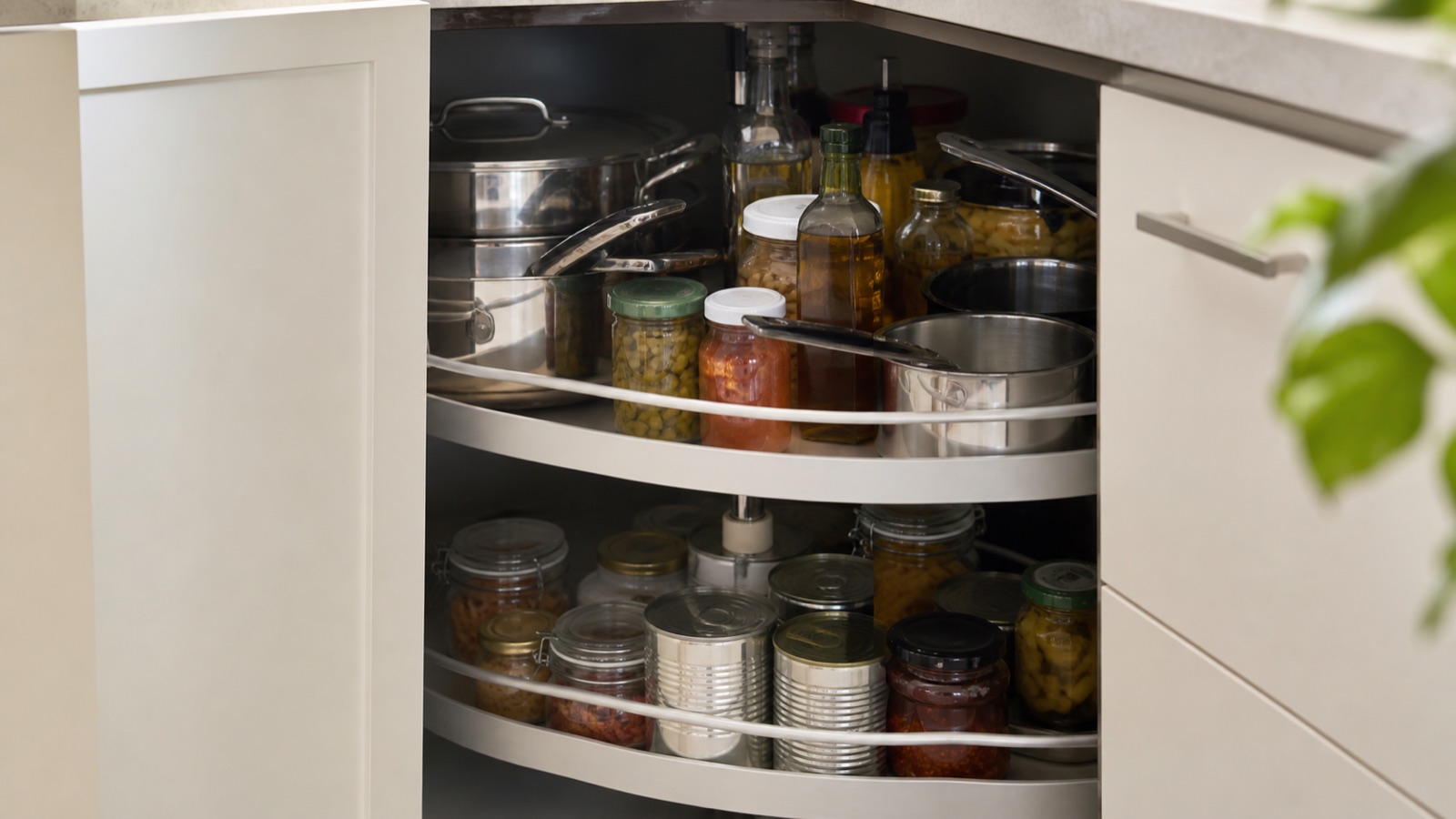
Your corner cabinet is probably one of two things: a blind corner, where a narrow door opens onto a deep L-shaped cavity that swallows whatever you push back there, or a diagonal corner with a built-in lazy susan that jams, tips bottles, and wastes the space around its edges. Either way, the most common complaint people with small kitchens share is the same: the corner is the biggest cabinet in the room and the least usable. Most "corner cabinet ideas" roundups answer that with a $400 custom pull-out and a contractor, which is no help if you rent or just want the space to work by this weekend.
This guide is part of our small kitchen storage ideas by zone series, and it takes the opposite approach. It starts by identifying which corner you actually have, because the right fix for a diagonal corner is the wrong fix for a blind one. Then it walks through options from under $20 and no tools up to a screwed-in pull-out, with the limits of each spelled out.
First, figure out which corner you have
There are three common layouts, and they take different hardware. A blind corner has a normal-looking door, usually 12–18 inches wide, and behind it the cabinet runs 24 inches or more sideways behind the neighboring cabinet. A diagonal corner (sometimes called a pie-cut corner) has one angled door and often a center post with shelves that spin. A bifold-door corner has two door panels hinged together that fold back to expose an L-shaped opening, with or without a turntable.
Before you buy anything, measure four things: the narrowest point of the door opening, the depth from the door to the back wall, the clear height between shelves, and whether there is a center post or a fixed shelf you cannot remove. Write those numbers down, then check the listing for current dimensions on any organizer you consider. Reviews of corner organizers are full of "it didn't fit" complaints that come down to a turntable that could not pass through the door opening, not a bad product.
- ANarrowest point of the door opening — a turntable or pull-out has to pass through it
- BDepth from the door to the back wall
- CHow far the cabinet runs sideways behind the neighbor — the blind section you cannot see from the door
Lazy susan turntables for diagonal corners
For a diagonal or bifold corner, a freestanding turntable is the cheapest fix and usually the right first move. Single-tier plastic turntables in 9-, 12-, and 16-inch diameters generally run under $20, and two-tier versions that double a tall shelf sit in the $25–45 range. The turntable has to pass through the door opening lying flat, so buy the largest diameter that clears your narrowest measurement rather than the largest that fits the shelf.
Turntables work best for things that are short, heavy at the base, and used often: oils, vinegars, canned goods, spice jars, a bag of coffee. The most common complaint in reviews is bottles sliding off models with a low or missing rim, so pick one with a raised lip of at least an inch if you are storing anything tall. A turntable does not fix a blind corner; the back of the L is beyond the turning radius, and that space stays dark. It also eats the corners of a square shelf, so plan on losing 15–20 percent of the surface area in exchange for being able to reach all of what is left.
Pull-out organizers for blind corners
A blind corner needs hardware that brings the back of the cabinet to the door. The two common designs are half-moon (kidney) shelves that pivot out on a post, and two-tray blind corner pull-outs where the front tray slides out and the back tray swings around behind it. Expect to spend somewhere in the $60–200 range depending on size and whether it is chrome wire or solid trays, and expect an hour of assembly plus mounting.
These work when you own the place or have a landlord who allows screws, because every version bolts to the cabinet floor or side wall, and when your door opening is at least 12 inches wide with no center stile blocking it. The limits show up in reviews: per-tray weight ratings often land in the 20–40 pound range, which rules out a stack of cast iron on one tray, and some cabinets have a fixed center shelf that has to be cut out first. If you rent, skip to the next option; a screwed-in pull-out is a deposit risk and a nuisance to remove.
Clear bins as pull-out drawers, the no-tools version
The renter-friendly approach to a blind corner is to treat it like a deep drawer you load from the front. Use long, shallow clear bins with handles, 12–16 inches long, arranged in a row so a front bin holds daily items and the bins behind it hold bulk and backups. To reach the back, you pull the front bin out and set it on the floor, which takes about five seconds and beats crawling in with a flashlight. A set of four to six bins usually runs under $30.
This works when the clear height under the shelf is at least an inch taller than the bin and when you can accept that the corner is still a kneel-down cabinet. The limits are friction and visibility: bins drag on rough plywood, so lay down a shelf liner or stick felt pads under them, and anything in an opaque bin gets forgotten. Label the front edge of each bin so you know what is in the back row without pulling it. For a deeper look at bins, risers, and liners in standard cabinets, see our guide to organizing the inside of kitchen cabinets.
Give the corner a job: long-term storage on purpose
The most reliable fix is not hardware at all but deciding what belongs in the corner. Because reaching it costs effort, the corner is the right home for things you touch weekly or less: the stock pot, the stand mixer, the roasting pan, a case of paper towels, seasonal bakeware. Daily cookware should live in the cabinet closest to the stove, and our guide to storing pots and pans in a small kitchen covers how to make that cabinet work.
If the corner is where your pots are stuck, shrinking the pile helps more than any organizer. A nesting cookware set collapses five or six pans into one stack about the height of a single stock pot, which turns a blind corner from a jumble into one bin. Lids are the other space thief; a vertical pot lid rack on the cabinet wall or door keeps them from sliding under everything else.
Upper corner cabinets
An upper diagonal corner has the same problem as the lower one with an added reach issue, and the fix is the same turntable, sized to the door opening. A two-tier turntable or a shelf riser doubles the usable height in a cabinet that is often 24–30 inches tall inside, and puts short jars at eye level instead of behind tall ones. Keep the weight modest, because you are lifting things down from above your head; glass jars and boxed goods are fine, a cast iron dutch oven is not.
An upper blind corner is the hardest space in the kitchen to use well. Put rarely used, lightweight items in a bin with a handle or a pull loop of ribbon so you can drag it forward with one hand from a step stool. Do not store anything there that you would be tempted to reach for while standing on the counter.
Which to buy first
If you have a diagonal or bifold corner, start with a rimmed turntable, because it fixes most of the problem for under $20 and you can take it with you if you move. Our roundup of the best lazy susans for cabinets and corners compares sizes, rim heights, and two-tier options. If you have a blind corner and can use screws, a pull-out is worth the money; if you cannot, bins plus a liner get you most of the way there.
For the upper cabinet, or any shelf that is much taller than what you store on it, the best shelf risers and cabinet shelves roundup covers expandable and stackable models that turn one tall shelf into two. Whatever you pick, measure the door opening first and check the listing for current dimensions before you order.