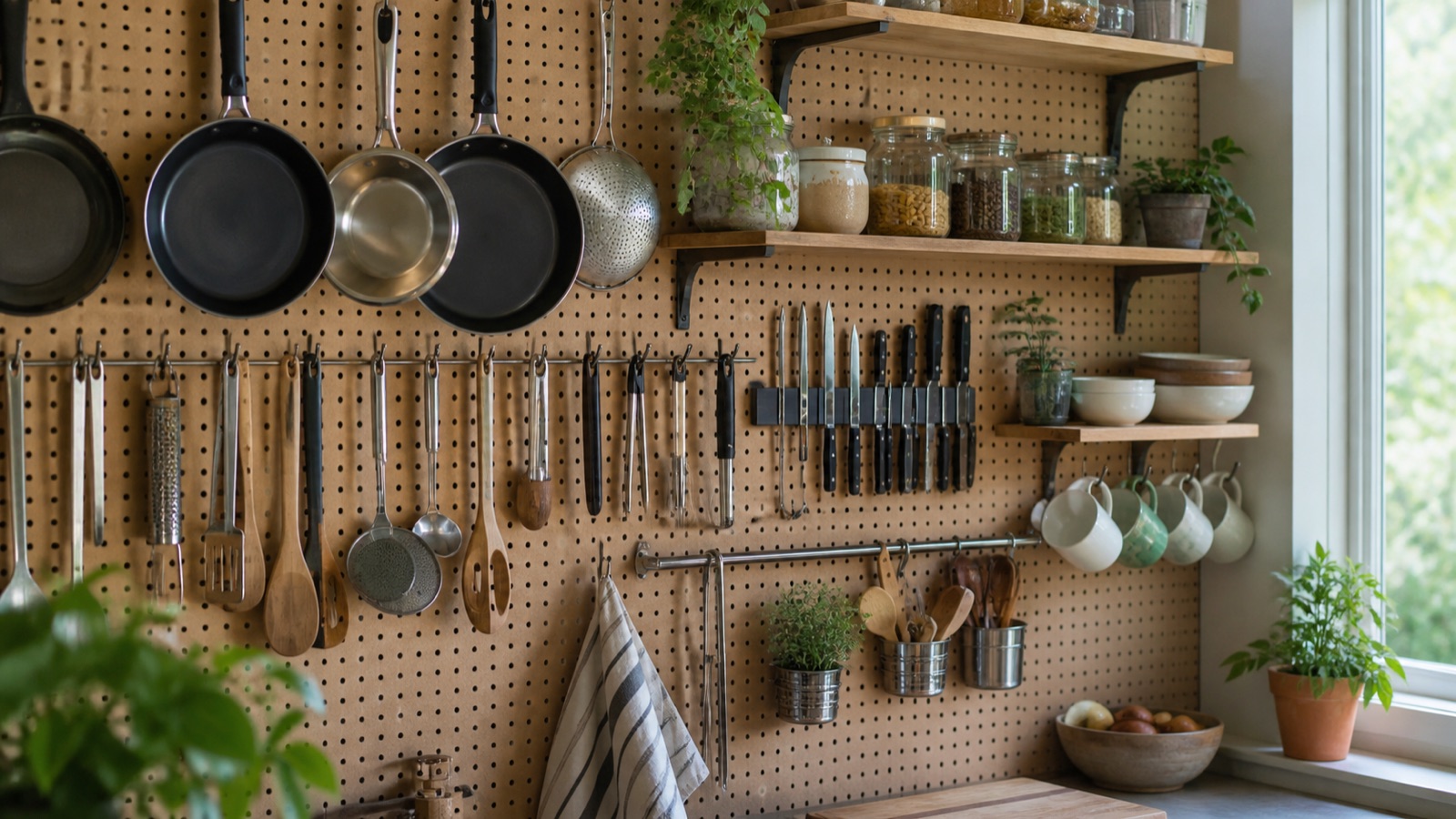
When the cabinets are full and the counter is gone, the only space left in a small kitchen is the wall, and there is more of it than you think: the 18-inch band of backsplash between the counter and the upper cabinets, the blank wall beside the fridge, and the strip above the door. The kitchen wall storage ideas that rank well tend to show a pegboard wall of copper pots screwed into a farmhouse, and they skip the two questions that decide everything, which are what your wall is made of and how much weight it can take.
This is the wall chapter of our small kitchen storage by zone guide. Every setup below is matched to a wall type, drywall, tile or plaster, and gives you the load it can carry and the point where it fails, with a no-drill version wherever one exists.
Know your wall and your weight limit first
Tap the wall. Drywall sounds hollow and takes a screw easily, but a screw alone holds only 5 to 10 pounds, and you need either a stud, usually every 16 inches, or an anchor rated for the load, which is 25 to 50 pounds for a good toggle. Tile over drywall needs a carbide bit and is a renter deal-breaker, so on tile you are limited to adhesive or to the grout-free zones. Plaster in prewar buildings crumbles around screws and needs anchors set into the lath or the stud behind it.
Then be honest about the load. A rail of utensils is 5 pounds; a row of spice jars is 8 to 10; a pegboard of pots and a cast-iron skillet is 30 to 40. Adhesive strips top out around 10 to 15 pounds per pair on smooth painted drywall and far less on textured or freshly painted walls, and reviews of adhesive kitchen hardware consistently report the failure comes in the first humid week, not the first day.
A rail with S-hooks on the backsplash
A single 16 to 24 inch stainless rail mounted on the backsplash holds utensils, a small colander, measuring cups and a dish towel on S-hooks, and it clears the utensil crock off the counter in one move. Rails cost $15 to $30 with hooks, mount with two screws or a pair of adhesive brackets, and carry 10 to 15 pounds of utensils. This is the highest-value wall fix for a tiny kitchen.
It works on painted drywall and on smooth tile with adhesive brackets, as long as the brackets land on tile, not grout. It fails within 12 inches of the stove, where grease coats everything hanging, and with heavy tools like a cast-iron press that overload the hooks. Keep the rail 2 to 3 inches below the upper cabinets so the hanging tools clear the cabinet bottoms.
A magnetic knife strip instead of a block
A 12 to 18 inch magnetic strip holds 6 to 10 knives flat against the wall and frees the 6 by 9 inches of counter a block takes. Screw-mounted steel strips hold the heaviest cleaver, and adhesive-mount versions are fine for standard chef's and paring knives up to about 10 ounces each. Prices run $15 to $40 depending on whether the face is bare steel, stainless or wood.
It works on any wall that will take two screws, and on smooth tile or laminate with the adhesive versions. It does not work with ceramic knives, which are not magnetic, and it is a poor fit above a stove or directly above a prep area where a knife could be knocked loose. Mount it at 48 to 54 inches from the floor, out of reach of children and below the cabinet bottoms. Our roundup of the best magnetic knife strips and racks compares hold strength and mounting, and our knife storage guide covers the in-drawer alternatives if the wall is not an option.
Pegboard for pots and pans
A 24 by 36 inch pegboard with hooks turns a blank wall beside the fridge into a pot wall that holds 6 to 10 pans and the lids, and it is the only fix on this list that gets cookware entirely out of the cabinets. Metal pegboards are stiffer and hold 40 to 60 pounds; the classic hardboard kind needs 1/2 to 3/4 inch spacers behind it so the hooks can seat, and it holds less. A full kit with hooks runs $30 to $70.
It only works when you can screw into studs or use heavy-duty anchors, because a loaded pegboard on drywall anchors alone will pull out. It does not work on tile or for renters who cannot patch four to six screw holes, and it looks cluttered fast if the wall is in the main sightline. Our guide to storing pots and pans in a small kitchen weighs the pegboard against a ceiling rack and an in-cabinet organizer.
Floating shelves and narrow ledges
A shelf 4 to 6 inches deep is shallow enough to sit on the backsplash wall without crowding the counter and holds a row of spice jars, oils and mugs on hooks underneath. Two shelves in the 18-inch gap above the counter add about 3 feet of storage for $20 to $40. Deeper 8 to 10 inch shelves work beside the fridge or above the door for the things you use monthly.
Floating shelves need their bracket screwed into at least one stud or a pair of 50-pound anchors, and a 6-inch shelf over the stove is a grease and heat problem. Adhesive shelves exist, but they are limited to about 5 pounds, which is three spice jars, so treat them as a display ledge rather than storage.
No-drill options: tension rods, adhesive hooks and doors
If the wall belongs to a landlord, you still have three good moves. A tension rod shelf wedged between the counter and the upper cabinet, or between two walls in a nook, holds 10 to 20 pounds of spices and jars with no holes, and a tension rod under the upper cabinets makes a hanging rail for mugs. Adhesive hooks rated for 3 to 5 pounds handle a towel, an apron and a measuring cup set. And the back of every door is a wall that already has a top edge to hang from.
Tension rods fail on walls that are not parallel and on textured or crumbly plaster where the end caps slip, and adhesive fails on textured paint and anywhere steam hits. Our roundup of the best tension rod shelves for renters compares the spans and load ratings, the no-drill kitchen storage guide covers the full deposit-safe toolkit, and the over-the-door storage guide handles the doors.
Start with the backsplash, then the wall beside the fridge
The 18-inch backsplash band is where a rail and a magnetic strip clear the most counter for the least money and the fewest holes. Once that is full, the wall beside the fridge takes the pegboard or a pair of deeper shelves, and the doors take the rest. If you can drill, the best magnetic knife strips roundup is the first purchase; if you cannot, start with the best tension rod shelves and work outward from there.