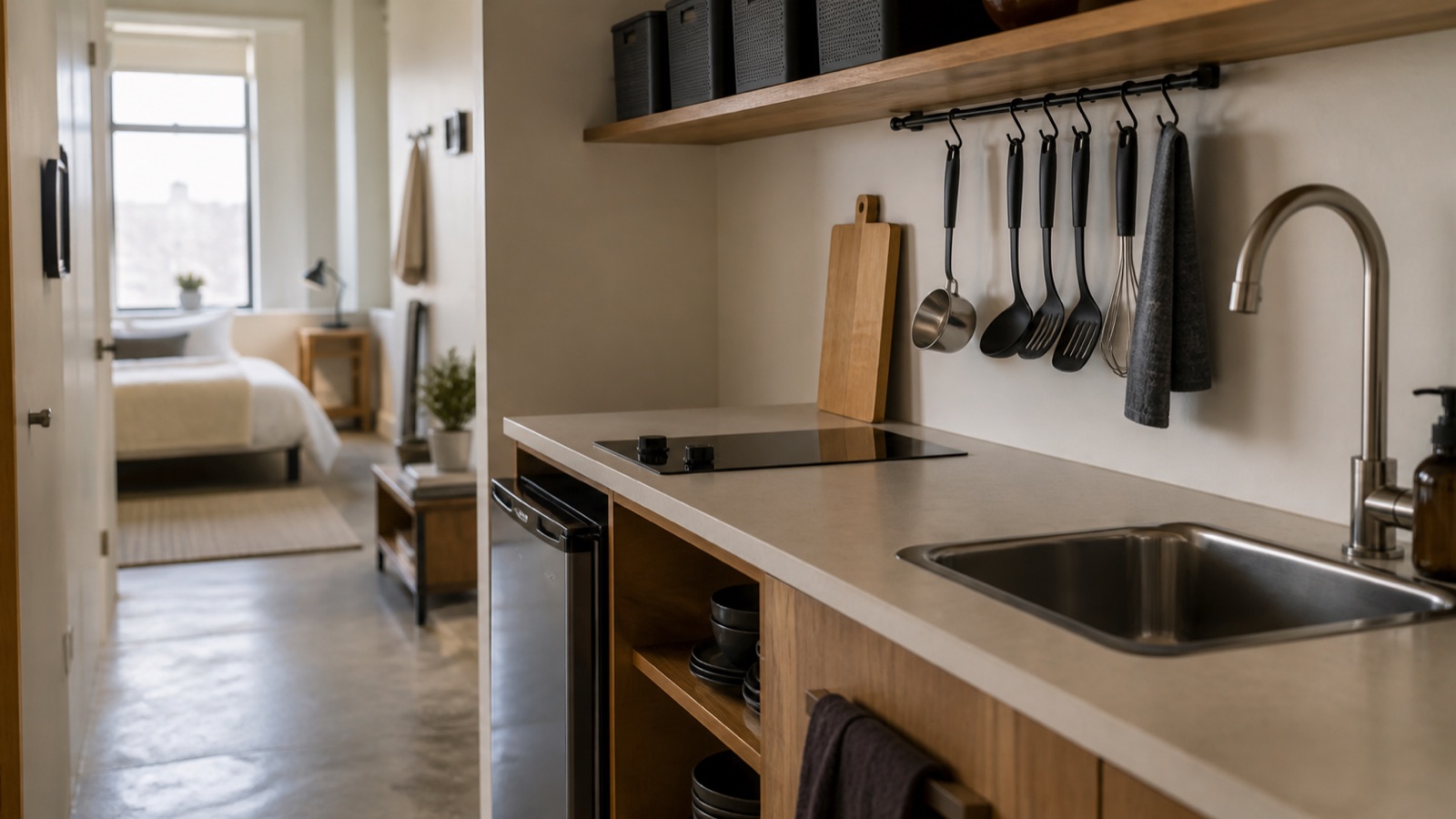
A studio kitchenette is a strip of wall: a two-burner cooktop or an apartment-size range, a fridge that may be half height, 2 to 4 feet of counter, and two to four cabinets, all in full view of your bed and your sofa. "Small kitchen" guides assume a room with a door and a few empty walls, and studio guides are about beds and room dividers and treat the kitchen as an afterthought. The problem in a studio is different: the kitchen has to hold a real cook's gear in the space of a closet and still look like part of a living room.
The approach below, which studio renters consistently report as the one that sticks, is to stop treating the kitchenette wall as the only place kitchen things can live. It follows the no-drill rules in our renter-friendly kitchen storage guide, since nearly every studio comes with a lease that forbids holes in the walls.
Decide What Leaves the Kitchenette
With two to four cabinets, only daily-use items get to live on the kitchen wall: the pans you cook with this week, one set of dishes per person plus two spares, the coffee setup, and the food you open every day. Everything else moves to a kitchen annex elsewhere in the studio: a closet shelf for the stand mixer and the roasting pan, a bookcase shelf for backup dry goods, and a lidded bin under the bed for the once-a-year items.
This works because a studio, unlike a separate kitchen, keeps all of its storage within about ten steps of the stove. It does not work if the annex is open shelving in your line of sight, where cereal boxes and a roll of foil read as clutter from the bed. Closed bins, a cabinet door, or a curtain are what make the annex disappear, and a set of three or four matching lidded bins runs $15 to $30.
Take an inventory before you buy anything, and be honest about the 12 mugs. Most studio renters find that a third of what came out of the moving boxes never needs to be within reach of the stove.
A Cart or Island That Doubles as Counter and Divider
The piece studio renters buy first is a kitchen cart with a butcher-block or laminate top, 20 to 36 inches wide, on locking casters. Parked at the end of the kitchenette it adds the 2 to 3 square feet of prep counter the kitchenette is missing, and turned sideways it becomes a low wall between the kitchen and the bed. The shelves below hold the microwave or air fryer, a basket of produce, and the dry goods that would otherwise fill a cabinet.
A cart this size typically runs $60 to $150 and needs about 24 inches of clear floor plus room to walk past it. It works on hard floors and low-pile carpet, and it does not work in a studio where the only free floor is the path from the door to the bed, which is common in units under about 400 square feet. In that case a slim three-tier cart 13 to 18 inches wide, usually under $40, is the fallback; check the listing for current dimensions and for the top's weight rating if a microwave is going on it.
The most common complaint in reviews of the larger carts is wobble when the top is loaded, which usually traces back to skipped leveling feet or a cross brace left off during assembly. The best rolling carts for small kitchens roundup separates the sturdy ones from the ones that rattle.
A Freestanding Unit as the Pantry and the Dish Cabinet
A bakers rack or a bookcase 24 to 36 inches wide on the wall beside the kitchenette is the pantry and the second dish cabinet a studio never comes with. Because it stands in the room rather than in a kitchen, the bottom two shelves should hold closed bins or matching containers, and the top shelf can be the display shelf for mugs, a plant, and the one good cutting board.
Decanting dry goods into square stackable containers is what makes open shelving look intentional rather than like a grocery bag exploded. A set of six to eight in the 1.5 to 4 quart range typically runs $25 to $50 and stacks two or three high without wasting the shelf height. Look for sets with replaceable gaskets, since lids that stop sealing are the most common review complaint.
Tall units are designed to be anchored to the wall, which most leases forbid. Either keep the unit under about 48 inches tall with the heavy items on the bottom shelf, or ask the landlord in writing about a single anchor screw, which many will allow as one hole they can fill later. Our guide to where to put food when there is no pantry covers the layout, and the best stackable food containers comparison covers the sets.
Get Two Levels Out of Two Cabinets
With only two to four cabinets, each one has to hold twice what it was built for. A shelf riser 5 to 8 inches tall doubles a plate shelf, a small lazy susan 9 to 12 inches across turns the back third of the one awkward corner cabinet into a spice and oil rack, and a clear bin turns a deep base cabinet into something you can see into.
Risers need a flat shelf at least 10 inches deep and 12 inches of clearance above it. They do not work in the very shallow cabinet above a studio range, which can be as little as 8 to 10 inches deep, so measure that one before buying anything for it. Kitchenette cabinets are also often mounted higher than standard to clear a range hood, so put the things you use daily on the lowest shelf and reserve the top shelf for light, rarely used items.
A two-pack of risers is usually under $25, and the best shelf risers roundup compares the ones that hold a stack of plates without bowing.
Use the Wall Above the Counter Without Drilling
The 18 or so inches between the counter and the upper cabinets is the most valuable vertical space in a kitchenette, and a tension rod shelf fills it with no holes. A shelf 12 to 18 inches wide wedged between the counter and the underside of the cabinet holds spices, oils, and a few mugs on hooks, and it comes down in a minute. On the fridge side, a magnetic knife strip and magnetic spice tins take the knives and jars off the tiny counter entirely.
Tension shelves work when the cabinet bottom and the counter are both flat and solid. They do not work with a sloping cabinet underside, a tile backsplash with a raised edge in the way, or a load of much more than a few pounds; check the listing for the weight rating. Magnetic mounts need a steel fridge side and fail on many stainless fronts, so test with a magnet first.
Because the shelf is in view from the whole room, this is also where a matching set of jars earns its keep. See our no-drill kitchen storage ideas for the other mounts that leave no trace, and the best tension rod shelves comparison for the ones that hold.
Cookware and Appliances: Buy Nesting and Multi-Use
A studio kitchenette usually has one base cabinet for cookware, and a standard five-pan set will not fit in it. A nesting set with removable handles stacks five pieces into the footprint of the largest pan, about 10 to 12 inches across and 6 to 8 inches tall, and it matches the studio pattern of one or two burners and one pan going at a time. The lids and the handles live in a bin beside the stack.
Nesting sets do not suit anyone who runs two large pots at once, and some sets restrict which lids fit which pans, so check the listing. On appliances, a single multi-cooker or a toaster oven that also air-fries usually replaces two or three counter appliances, and one appliance on the counter is about all a 2-to-4-foot kitchenette can afford.
Keep It Looking Like a Living Room
Everything in a studio kitchenette is on display, so the last step is hiding what should not be seen and containing what smells. A tension rod and a short curtain across the open space under a counter or a bakers rack hides the trash, the recycling, and the bins of cleaning supplies for under $20. Airtight containers for the dry goods and a lidded trash can with a tight seal keep the kitchen from announcing itself across a 350-square-foot room.
Uniform containers and one color of bin cost a little more than a random mix but do most of the visual work. If your kitchen has more cabinets and a door of its own, the fuller version of this plan is in our small apartment kitchen storage ideas.
Where to Start
For most studios, the cart and a set of stackable containers solve the two biggest problems, no prep counter and no pantry, for well under $150 combined. Add the tension shelf once you know which items keep landing on the counter, and the risers once you know which cabinet is the crowded one.
All of it rolls, stacks, or wedges into place without a single screw, which is the only kind of storage a studio lease allows. The rolling cart and stackable container roundups linked above are the two places to start.