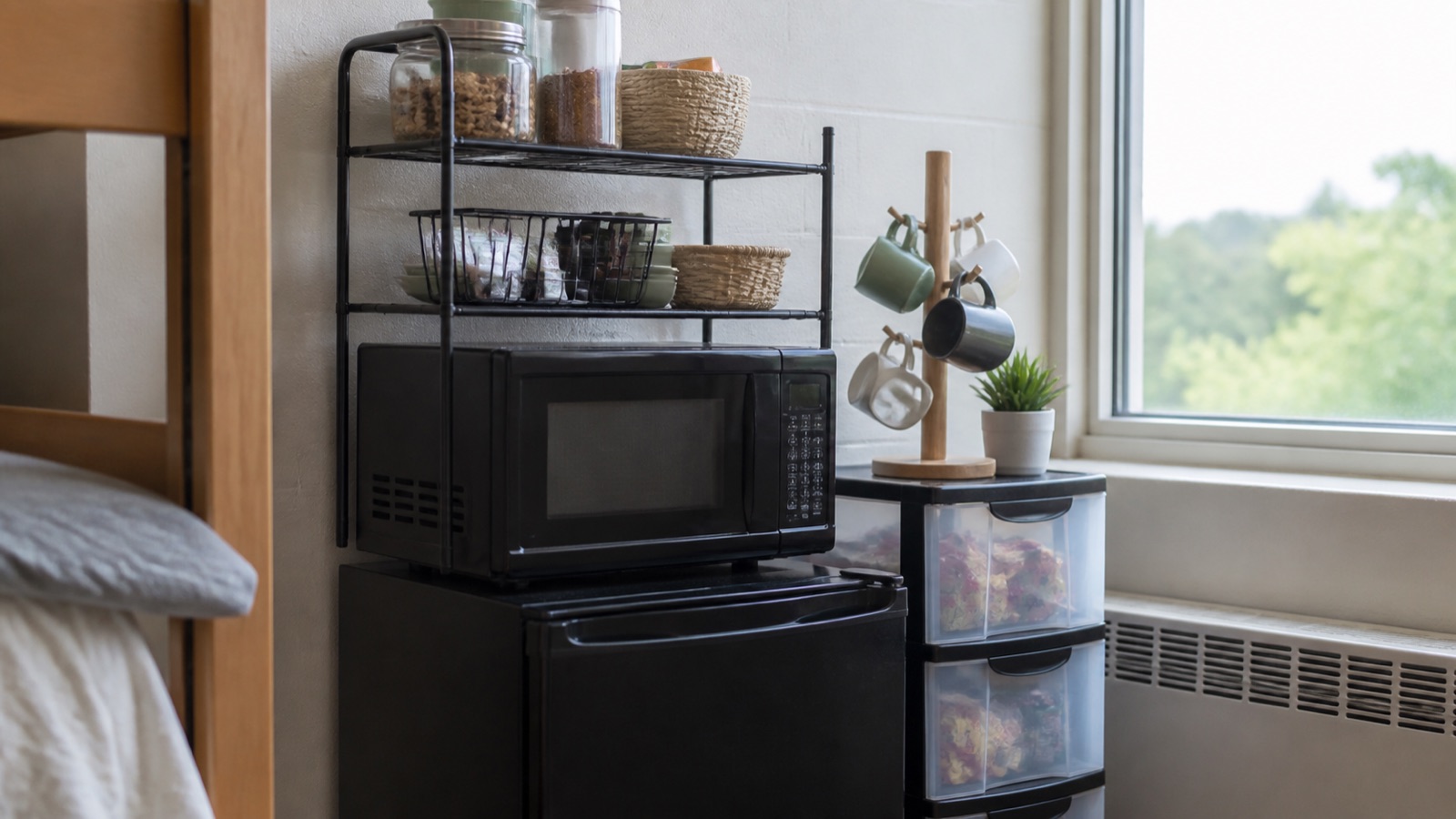
You have a mini fridge, a microwave, a desk, a closet, and somewhere in that 12-by-15-foot room you need to fit cereal, ramen, two mugs, a bowl, snacks, and whatever your roommate brought. Most "dorm storage" articles are about under-bed bins and closet rods. Most "small kitchen" articles assume you have at least one cabinet. A dorm has neither, and it comes with housing rules that ban drilling, most adhesives on painted walls, and anything with an exposed heating element.
The setups below are the ones students and parents consistently report working through a full academic year, and every one of them packs into a car on move-out day. They follow the same no-drill logic as our renter-friendly kitchen storage guide, scaled down to a room with no counter and a resident advisor who does walkthroughs.
Build a Fridge-and-Microwave Tower, Not a Sprawl
Dorm fridges are usually in the 2.7 to 4.4 cubic foot range and stand 30 to 34 inches tall, which puts the top at a convenient counter height. Most housing offices cap microwaves at 700 to 1,000 watts, so check your handbook before you buy anything. The goal is to stack these two appliances into one footprint, because spreading them across the room eats the only floor you have.
The simplest version is a microwave directly on a flat-topped fridge. A better version is a fridge-top shelf riser, usually 4 to 6 inches tall and under $30, that lifts the microwave and leaves a gap underneath for mugs, cereal, and the coffee setup. If your school rents combined MicroFridge units, that is often the cheapest tower of all.
This works when the fridge top is flat and rated for weight, and when there is an outlet within reach without a daisy chain of extension cords (which most housing rules prohibit). It does not work on curved-top fridges, and you should never block the microwave's side or rear vents; keep 2 to 3 inches of clearance. Check the listing for the riser's weight rating against your microwave, which typically weighs 20 to 30 pounds.
Turn the Door Into a Pantry
An over-the-door organizer with clear pockets or wire baskets is the closest thing a dorm gets to a pantry. Five or six baskets hold cereal boxes, granola bars, instant oatmeal, utensils, and mugs, all off the floor and off the desk. Pocket versions are lighter and quieter; basket versions hold heavier items like jars.
The catch is the door itself. Standard interior doors are 1 3/8 inches thick, but many dorm doors are 1 3/4-inch fire-rated metal or solid-core doors with a closer arm at the top. Look for hooks rated for doors up to 2 inches and check whether the closer plate sits where the hooks need to go. Some housing offices also ban anything hung on the room door; the closet door is usually fair game.
Students consistently report two complaints: the door will not fully close if the hooks are too thick, and basket versions rattle every time the door slams. A strip of felt under each hook fixes the second problem. Keep glass out of the organizer entirely. For more approaches that survive inspection, see our no-drill kitchen storage ideas and the best over-the-door organizers for small spaces.
A Slim Rolling Cart Is Your Only Cabinet
A three-tier rolling cart, 13 to 18 inches wide and 28 to 32 inches tall, is the piece students most often say they wish they had bought in August instead of November. It fits beside the fridge, rolls under the desk during a room check, and holds a full "kitchen" in about 1.5 square feet of floor.
Top tier: kettle or coffee gear if your building allows them. Middle tier: food in containers. Bottom tier: bowls, plates, and the dish tub.
Most are under $40, and the useful features are deep baskets (at least 3 inches) and locking casters. The most common complaint in reviews is shallow baskets that let things slide off when the cart moves, so put small bins inside the baskets rather than loose items. Heavy items belong on the bottom tier, because cheap carts wobble when the top is loaded.
This works on hard floors and low-pile carpet. It does not work well on thick carpet, where the casters sink, or in rooms where the only free floor is a walkway to the bunk. See our picks for the best rolling carts for small kitchens if you want one that will survive four moves.
Airtight Containers Beat Open Boxes, Because Pests Are Real
Ants, fruit flies, and in older buildings mice are the reason housing offices care what food you keep in your room. An open cereal box on a desk is the number one attractant. Decanting dry food into airtight containers solves the problem and, because square containers stack, doubles what fits in a cart basket.
Three or four containers in the 1.5 to 2 quart range cover cereal, rice, pasta, coffee, and snacks for one person. Square shapes stack better than round ones in a cart or on a closet shelf. Clear sides let you see what is running low without opening anything.
The most common review complaint on latching containers is the lid latches loosening after several months of daily use, so buy a set with replaceable gaskets if you can. Glass is more airtight but too heavy and breakable for a dorm move. Our roundup of the best stackable food containers covers the trade-offs.
Use the Closet Shelf and Desk Hutch as Cabinets
Every dorm closet has a shelf above the rod, usually 12 to 14 inches deep and with 12 or more inches of empty air above whatever you put there. A shelf riser turns that into two levels: mugs and bowls underneath, containers on top. On a desk hutch, a two-tier riser does the same for dishes and snacks.
This works when the closet shelf is solid wood or laminate. Wire closet shelving sags under weight and lets small items fall through, so add a flat piece of cardboard or a shelf liner first. Keep food in sealed containers when it shares a closet with clothes, because odors travel both directions. The best shelf risers for this job are wire or plastic, weigh under 2 pounds, and pack flat.
Pack a Carry Caddy for the Shared Floor Kitchen
Most dorms have one shared kitchen per floor, and the rule students learn fast is that nothing left there stays there. A caddy with a handle holds everything for one cooking session: a pot, a pan, a spatula, a cutting board, dish soap, a sponge, and a towel. It lives in your room and walks to the kitchen with you.
A two-pot nesting set with a removable handle takes up about as much space as a large textbook, and it fits in the caddy. Add a collapsible colander and one set of nesting mixing bowls. Label everything with your name and room number, because unlabeled pans in a shared kitchen tend to migrate. The best nesting cookware sets are worth it here because they move to an apartment kitchen next year.
What to Buy First
If you are shopping for the whole year at once, the rolling cart, the over-the-door organizer, and a set of airtight containers cover 90 percent of dorm kitchen storage for well under $100 combined. Add the fridge-top riser only after you know which fridge you have. Everything on this list rolls, hangs, or stacks without a single screw, which means it passes the move-out inspection and works again next year in a studio apartment kitchenette.