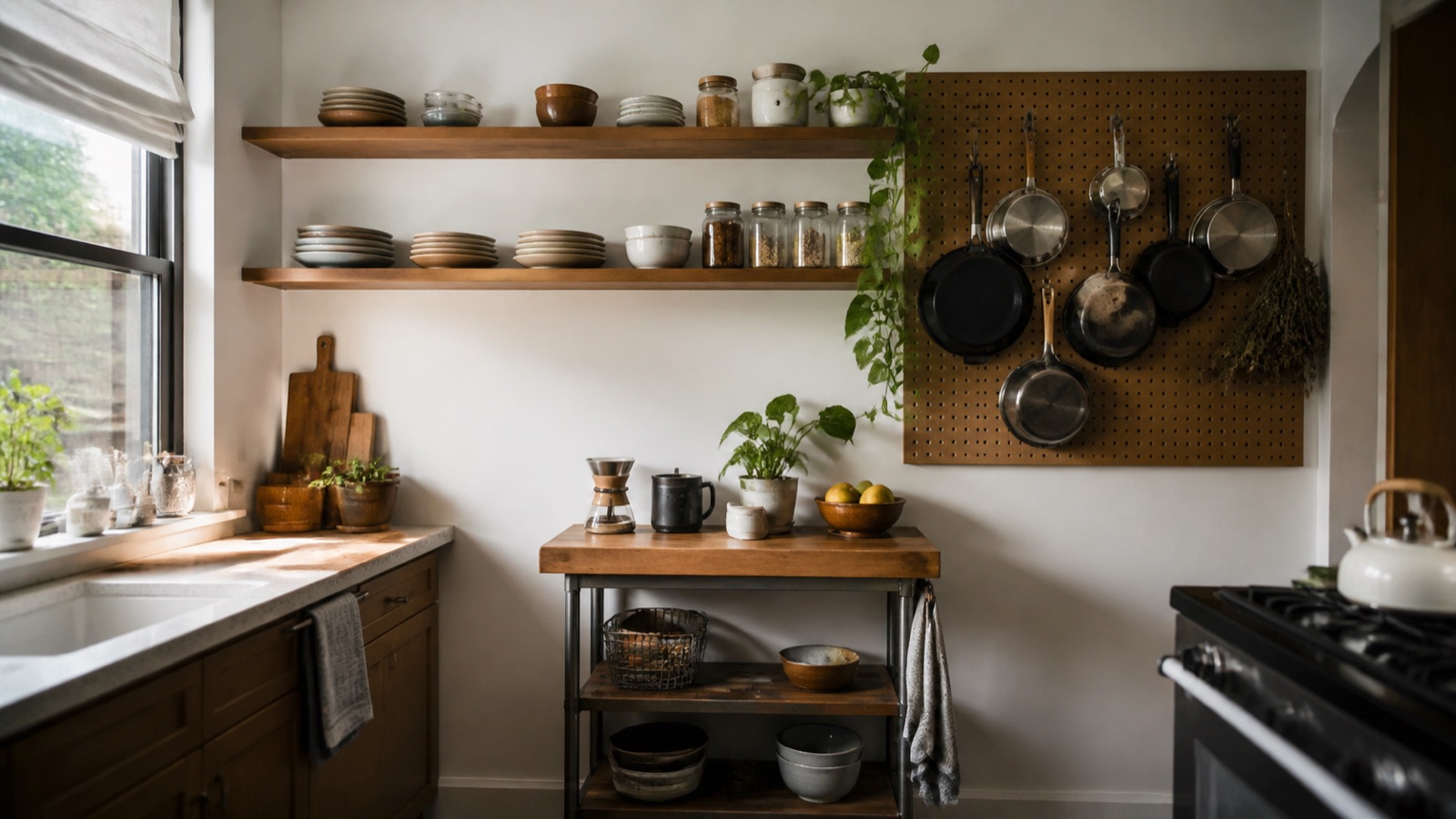
A kitchen with no cabinets is usually a kitchenette that came with a sink, a cooktop, a small fridge, and maybe one door under the sink. Every organizing guide starts with "clear out your cabinets," and you have nothing to clear. The problem is total rather than partial: pots, plates, food, and cleaning supplies all need a home, and if you rent, none of that storage can be screwed to the wall. What follows is the order to build kitchen storage without cabinets from freestanding pieces, sized to fit a tight footprint and leave with you, following the deposit-safe rules in our renter-friendly kitchen storage guide.
Start with one freestanding cabinet or shelving unit
One large piece does more than five small ones, so buy the big piece first. Your two realistic options are a freestanding pantry cabinet, typically 24 to 36 inches wide, 15 to 18 inches deep, and 60 to 72 inches tall with doors, or a steel wire shelving unit around 36 by 18 by 72 inches with five adjustable shelves. The cabinet hides clutter and keeps grease off your plates; the wire unit costs less, holds more weight per shelf, and assembles with nothing more than a rubber mallet.
Wire shelving is the better choice if you cook a lot and own heavy pots, because the shelves are often rated for a few hundred pounds each and you can set them at whatever spacing your tallest items need. A doored cabinet is the better choice if the kitchen is visible from the living room, or if the kitchenette sits near a window and you want food out of the light. Either way, put it on the wall nearest the sink, because that's where dishes get put away.
The catch for renters is tip restraint. Tall units ship with an anti-tip strap that wants one screw in the wall; a loaded wire unit is stable on its own on a level floor, but a tall cabinet with doors is not, especially with kids in the home. Ask the landlord about a single filled screw hole, and read the no-drill kitchen storage ideas guide for what usually counts as damage. If the only thing you're actually missing is a pantry, the no-pantry storage ideas guide covers smaller fixes.
Add a rolling cart as the base cabinet and counter you don't have
A kitchenette with no cabinets usually has no real counter either, so the second piece should be a cart that gives you both. A kitchen island cart with a wood or butcher-block top, roughly 24 to 36 inches wide and counter height at 34 to 36 inches, adds a cutting surface on top, a shelf or drawer in the middle, and a lower shelf for pots. Narrower three-tier carts around 13 to 18 inches wide fit a smaller footprint and work as a rolling pantry or appliance stand.
Weight is the thing to check in the listing. A wood-top cart with a shelf typically holds 100 pounds or more in total and is fine for a microwave or toaster oven; a lightweight tube-and-mesh cart holds far less and will wobble under an appliance. Lockable casters matter more than they sound, since a cart that drifts while you chop is a cart you stop using.
This works when you have a floor patch of at least 2 by 3 feet that isn't a walkway. It doesn't work in a galley or hallway kitchenette where the cart would block the fridge door. Our roundup of the best rolling carts for small kitchens separates the sturdy island-style carts from the light utility ones.
Build up from the counter with risers and countertop shelves
Whatever counter you do have has to work as a cabinet. A two-tier countertop shelf, 20 to 30 inches wide and about 10 inches deep, lifts plates, bowls, and mugs off the counter and leaves the prep surface underneath. Shelf risers, the same ones people use inside cabinets, do the same job in the 8- to 12-inch range and stack two high if you're careful about what goes on top.
Look for steel or bamboo rather than thin plastic, since a countertop unit near the stove gets heat and grease, and check that the shelf's leg spacing clears whatever sits under it. The most common complaint in reviews is that a riser meant for cabinet use flexes under a stack of dinner plates, so favor units with a listed capacity of 30 pounds or more per shelf. Our guide to the best shelf risers and cabinet shelves flags which ones are stiff enough for plates.
The limit is depth: risers are designed for 10- to 12-inch shelves, so on an 18-inch-deep counter they leave a strip behind them that collects clutter. Push them to the wall and keep only the toaster or kettle in front.
Put the walls to work without a single screw
Walls are the biggest unused surface in a no-cabinet kitchen, and renters have three ways to use them without holes. Tension pole shelving, a floor-to-ceiling pole with three or four shelves that presses against the ceiling, fits a corner beside the sink for dish soap, sponges, spices, and mugs; the shelves hold light loads, usually 5 to 10 pounds each, and the pole needs a ceiling under about 9 feet and a floor that doesn't flex. Tension rod shelves that span between two walls, like the alcove beside a fridge, do the same for cans and jars.
Heavy-duty adhesive hooks and adhesive rails hold utensils, dish towels, and a lightweight rack for cutting boards, rated around 3 to 5 pounds per hook on smooth painted walls or tile. They fail on textured, freshly painted, or chalky walls, so stick one up for a week before you commit. The best tension rod shelves for renters roundup covers both the pole and spanning styles and their real load limits.
Turn the fridge into a cabinet
In a kitchenette the fridge is often the largest steel surface in the room, and magnetic storage treats it like a cabinet. Magnetic spice racks, a magnetic paper-towel holder, and magnetic shelves that grip the side hold about 5 to 10 pounds each, and a magnetic knife strip on the side keeps knives off the counter. Check the fridge with a kitchen magnet first, because some stainless finishes and most plastic-sided mini fridges won't hold anything.
Keep magnetic shelves to lightweight, frequently used items, since a loaded shelf creeps down the side a little every time the door slams. A slim rolling rack 5 to 8 inches wide in the gap beside the fridge holds cans and bottles and needs no magnets at all.
Use the one cabinet you probably have: under the sink
Most kitchenettes give you exactly one door, under the sink, and it has a drain trap in the middle and water lines hogging the back. A two-tier expandable under-sink organizer, sized around 12 to 28 inches wide with shelves that slide around the pipes, roughly doubles what fits there. Because it's the only enclosed storage you have, reserve it for cleaning supplies and the trash bin, not food, since cleaning products and a leaky trap don't belong next to rice.
Measure the cabinet opening and the trap height before you buy; the most common return reason is a shelf that can't clear the pipe. Our roundup of the best under-sink organizers for small kitchens sorts them by the pipe layouts they fit.
Own less, and nest what you own
Every storage piece above has a ceiling, and in a no-cabinet kitchen you hit it fast. The single highest-leverage change is cookware and dishes that nest: a pot set that stacks into one footprint, bowls that fit inside each other, and a few square food containers instead of a cupboard of round ones. Renters in studios consistently report that swapping a mismatched pot collection for a nesting set freed an entire shelf on the wire unit.
Start with the pots, since they're the bulkiest thing you own. The best nesting cookware sets for small kitchens and RVs guide compares sets by stacked height and handle style, which is what decides whether they fit on a 12-inch shelf. Measure the shelf spacing on your cabinet or cart first, then check the listing for the current stacked dimensions.