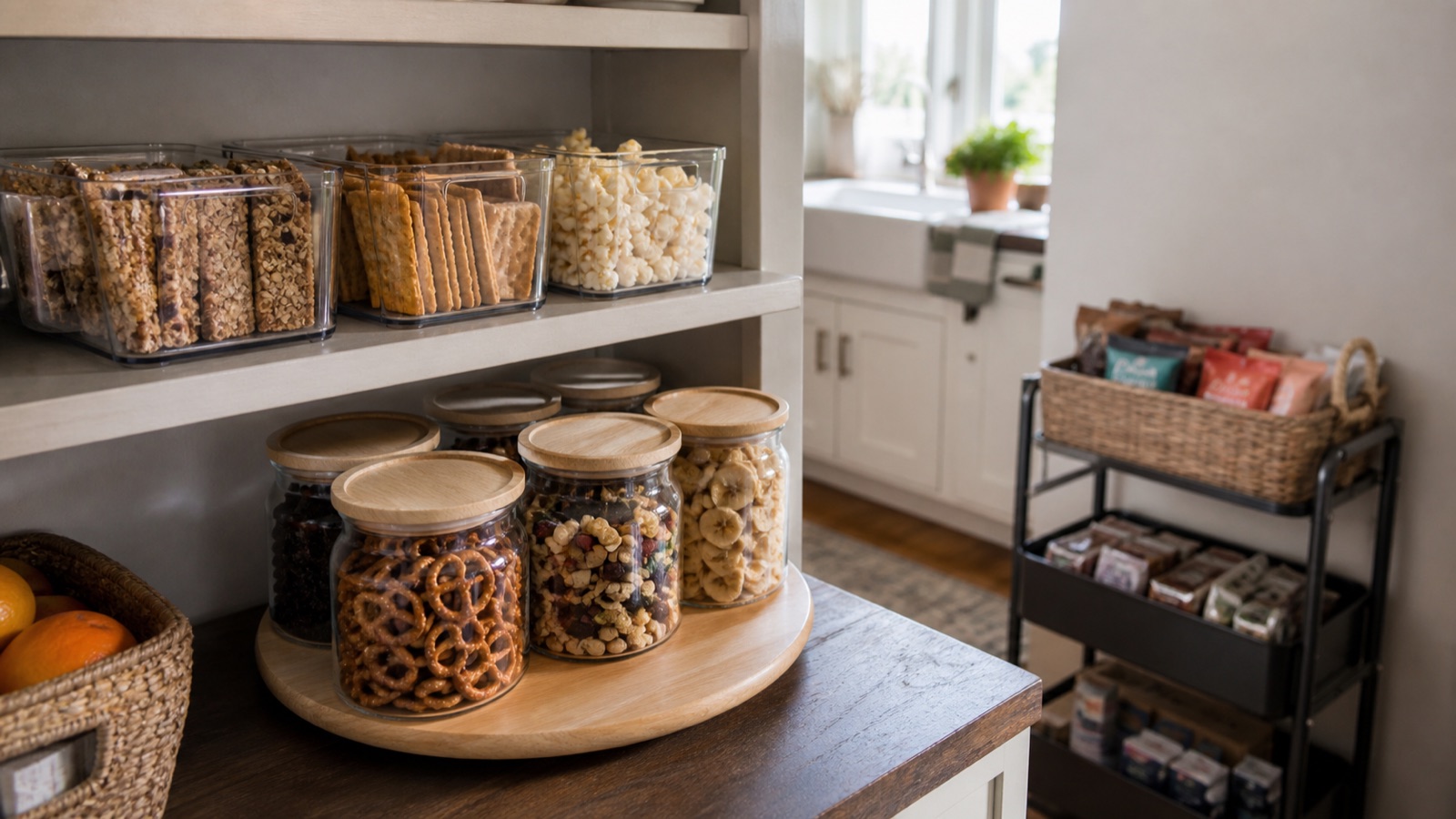
The snack shelf in a small kitchen usually looks like this: four chip bags folded over and clipped, three boxes of granola bars each a fifth full, a family-size pretzel bag wedged in the back, and the kids' pouches split between the cabinet, the counter, and a basket on top of the fridge. There is no pantry, so all of it has to fit in one upper cabinet that is 12 inches deep and 30 inches wide.
Search "snack organization ideas" and the results are a pantry wall with matching acrylic bins and a label maker, which is not a plan for a single 12-inch shelf. This piece is part of our what goes where guide to storing everything in a small kitchen, and it covers seven ways to organize snacks in a cabinet, on a door, or on a cart, with the sizes that fit and the situations where each one falls apart.
Ditch the boxes and keep the bags
Cardboard is the main reason a snack shelf overflows. A box of granola bars is 40 percent air once it is opened, and three of them take a whole shelf. Pull the bars, pouches, and packets out of every box and put them in one bin. Chip bags get a clip and stand upright, since a folded bag lying flat takes twice the shelf.
The most common complaint in snack bin reviews is that the bins overflowed within a week, and almost every photo shows boxes still inside them. Do the unboxing before you buy anything, and the shelf will likely look half empty.
Stackable containers for bulk snacks
Airtight stackable containers work for the snacks that come in floppy bags: pretzels, crackers, cereal, nuts, and trail mix. A 1.5- to 2-quart container holds a standard bag, stacks square, and shows you when you are running low. A set of four to six runs $30 to $60, so buy only for the three or four things you always have.
This works when the bags are things that do not crush. It does not work for chips, which break into crumbs when poured and go stale faster than they do in the original bag. Write the expiration date on a strip of masking tape on the lid, because reviewers consistently mention losing track once the packaging is gone. Our roundup of the best stackable food storage containers sorts sets by footprint so you can match them to a 12-inch shelf.
Bins by category, not by brand
Group snacks into four bins: bars, pouches and packets, chips, and sweet. Open-front plastic bins about 4 or 6 inches wide and 12 inches long fit two to four across a standard upper cabinet and slide out like drawers. Plain bins cost $3 to $8 each; check the listing for current dimensions, since a bin 13 inches long will not sit flat on a 12-inch shelf.
Pulling the whole bin down is the habit that makes this work, because the person looking for a bar sees every bar, not the one in front. The limit is depth. Upper cabinets are 12 inches deep, so bins with a long handle on the front stick out past the door. If you have no cabinet to give, the no-pantry food storage guide covers where else a snack zone can go.
A lazy susan for the chip-bag pile
Standing chip bags and jars of nuts belong in a deep lower cabinet on a turntable. A 10- to 12-inch lazy susan with a raised rim holds four to six bags upright and spins the back ones to the front, so nothing gets crushed behind something else. Turntables in this size cost $12 to $25.
This needs a cabinet at least 13 inches wide and deep for the turntable to spin, and a rim of at least 2 inches so tall bags do not tip off the edge. A flat turntable without a rim is the version reviewers describe as launching bags onto the cabinet floor. Our picks for the best lazy susans for cabinets and corners note rim heights and which ones fit a corner cabinet.
A kids' grab-and-go bin at their height
Give kids one bin on a low shelf or the bottom tier of a cart, fill it once a week with the week's snacks, and when it is empty it is empty. This ends the negotiation and keeps the rest of the snack shelf out of reach. A 6-by-12-inch bin holds a week of packets for two kids.
With toddlers, put the bin behind a cabinet door with a latch rather than out in the open. With a dog in the house, chocolate, raisins, and grapes never go in a low bin, and the bin sits in a closed cabinet, not on an open cart tier a nose can reach. Adult snacks live on the top shelf, which is the shelf the kids cannot see into.
Over-the-door pockets on a pantry or closet door
If you have a pantry door, a closet door, or even a bedroom door within a few steps of the kitchen, a clear over-the-door pocket organizer holds 20 or more bars, pouches, and packets in a space that was doing nothing. Each pocket takes three to five bars, and the organizer costs $12 to $25.
It works for lightweight packaged snacks and needs 1 to 1.5 inches of clearance at the top of the door for the hooks. It does not work for jars, cans, or anything heavy, and a hollow-core door will flex if the total load passes about 10 pounds. Our roundup of the best over-the-door organizers and racks lists pocket sizes and which hooks fit thin doors.
A rolling snack cart
For a kitchen with no cabinet to give, a three-tier rolling cart 17 inches wide holds the four category bins on top, containers in the middle, and the kids' bin on the bottom. It parks beside the fridge, rolls to the table for homework snacks, and rolls back. Carts in this size run $25 to $50.
The tradeoff is that everything is visible and reachable, which is fine for adults and a problem with toddlers or a tall dog. Keep the cart for a household that can handle open shelves, and see the best rolling carts for small kitchens for ones with tier clearance for a 2-quart container.
Pick your setup
Start by unboxing, then sort into four bins on the shelf you already have. Add stackable containers only for the three or four bulk snacks you always keep, and a turntable if chip bags have taken over a lower cabinet. A door organizer or cart comes in only when the cabinet runs out. If you do go the container route, our roundup of stackable food storage containers is the place to start, and the food container lid storage guide keeps the new lids from becoming the next pile.