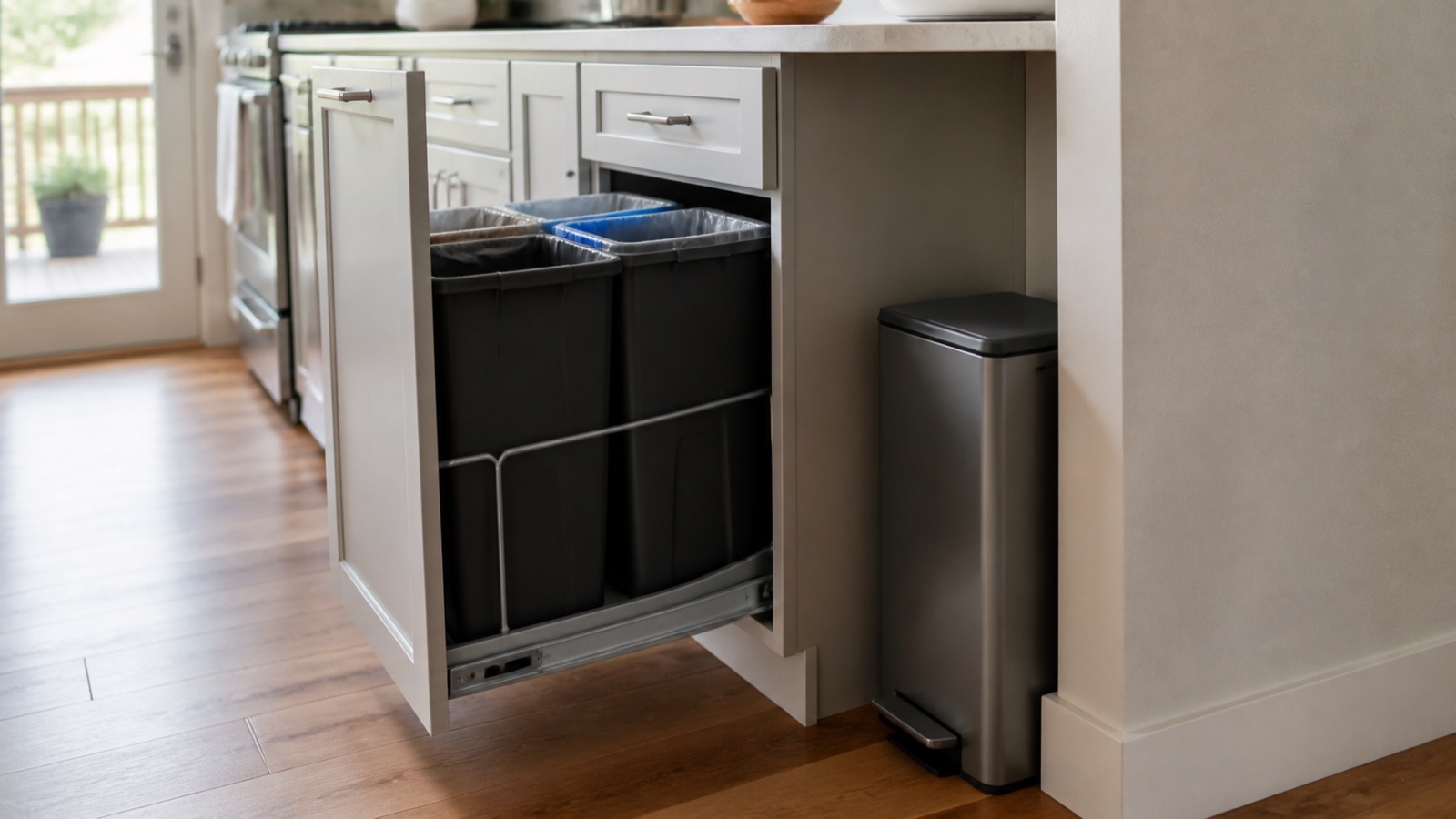
A standard 13-gallon kitchen trash can has a base around 12 by 16 inches and stands about 25 inches tall. Add a recycling bin next to it and you have given up 2 to 3 square feet of floor in a kitchen that may only have 10 square feet of open floor to begin with. In most small kitchens the can ends up parked in front of the one cabinet you open ten times a day.
Search "small kitchen trash can ideas" and you get galleries of slim cans without a word on which cabinet they fit, how much the lid needs to swing, or what to do when the city wants glass separated from paper. This guide is part of our what goes where guide for a small kitchen, and it covers six ways to handle trash and recycling in a small kitchen, each with the cabinet widths, door limits, and bag-change frequency it demands.
Under-sink pull-out or freestanding bin
The cabinet under the sink is 30 to 36 inches wide in most kitchens, and the front half of it is usually empty floor. An 8- to 10-gallon bin needs about 11 inches of width and 16 to 18 inches of height, which leaves room beside it for the trap and a few supplies. Pull-out frames screw to the cabinet floor with four screws and slide the bin out with the door; a freestanding bin on the cabinet floor does most of the same job for renters who do not want holes. Frames run $30 to $60, a plain bin under $20.
This works when the cabinet door opens a full 90 degrees, when the garbage disposal sits far enough back to leave the front clear, and when you are willing to change the bag every two to three days, because a 10-gallon bin fills fast. It does not work when the cleaning supplies already fill the cabinet floor, so decide which of the two wins. Our cleaning supplies storage guide shows how to lift the sprays and sponges onto a two-tier frame so the floor is free for a bin, and the best under-sink organizers roundup lists frames that leave a bin-sized gap on one side. Check the listing for current dimensions on any pull-out, since the frame height plus bin height has to clear the trap.
Cabinet-door hanging bin
A 2- to 3-gallon bin that hooks over a cabinet door catches peels and wrappers while you cook, then empties into the main can. It costs $10 to $20 and needs no tools. Home cooks consistently report it cuts trips to the main bin during prep, which matters when the main bin is across the room.
It works on doors up to about an inch thick with enough clearance at the top edge for the hooks, and with loads under 5 pounds. It does not work as the only trash can, since it is full after one dinner, and it does not work on doors that bounce or on concealed hinges that leave no gap for the hook. Empty it daily or it becomes a fruit fly farm.
- ADoor thickness at the top edge — the hooks are sized for standard cabinet doors
- BGap for the hooks between the door top and the frame; concealed hinges with no gap rule it out
- CHow far the bin projects vs. what is stored behind the door — it has to clear when the door closes
Slim can in a gap
Slim cans are 7 to 8 inches wide, 24 to 26 inches tall, and hold 10 to 12 gallons, which is almost a standard bag in a footprint that fits between the refrigerator and the wall or at the end of a counter run. Prices run $20 to $40 for plastic and more for stainless.
Measure the gap and the lid swing before you buy. The gap needs to be at least 8 inches wide, and a hinged lid needs 4 to 6 inches of clearance above the can to open, which rules out a spot under a counter overhang. A pedal-lid can needs floor space in front for your foot. If the gap is beside a stove, choose plastic over a stainless can that will heat up.
Dual-compartment can
A dual-compartment can puts two 8-gallon bins side by side in a footprint around 18 by 12 inches, or stacks them in a tower that is taller but no wider than a single can. They cost $60 to $150 and replace two cans with one.
This works when your city uses single-stream recycling, so one bin takes everything. It does not solve the problem for households that have to separate glass or paper, and a two-bin can with two 8-gallon liners means two bag changes as often as one large can. The stacked versions put one lid at 30 inches or higher, which is awkward for kids.
Recycling without a floor bin
Recycling does not have to be a bin at all. Rinse containers, flatten cardboard, and drop them in a reusable bag hung from a hook inside a cabinet door or on the side of the refrigerator. A bag holds a week of cans and boxes for one or two people and takes zero floor space. An over-the-door pocket organizer on a pantry or closet door holds trash bag rolls, grocery bags, and a folded stack of flattened boxes; our picks for the best over-the-door organizers and racks include clear-pocket versions sized for bag rolls.
For a household that sorts glass, paper, and plastic, a narrow three-tier rolling cart in a hall closet or laundry nook holds three bags or small bins and rolls out on pickup day. The rolling cart roundup for small kitchens lists a few under 14 inches wide that fit a closet.
Smell, pests, and the routine
Small bins mean more frequent trips outside, and skipping them is how a small kitchen starts to smell. Take out an 8- to 10-gallon bag every one to two days, keep meat and fish scraps in a container in the freezer until trash day, and use a 1-gallon countertop compost bin with a charcoal filter for vegetable scraps if your building composts. Filters last two to three months.
Fold the trash run into a nightly reset along with wiping the counter and running the dishwasher. The weekly kitchen reset routine lays out the same habit for the rest of the room, and a small can becomes far less annoying once emptying it is automatic.
Which setup fits
If the sink cabinet has clear floor and a door that opens wide, a bin under the sink is the only option that costs zero visible space. If the cabinet is spoken for but you have an 8-inch gap by the fridge, a slim can is the next best thing. If you have neither, a door-hung scrap bin plus a hanging recycling bag gets you through the week without a can on the floor. Start with the under-sink organizer roundup if you are clearing that cabinet, and the under-sink organization guide for measuring around the disposal.