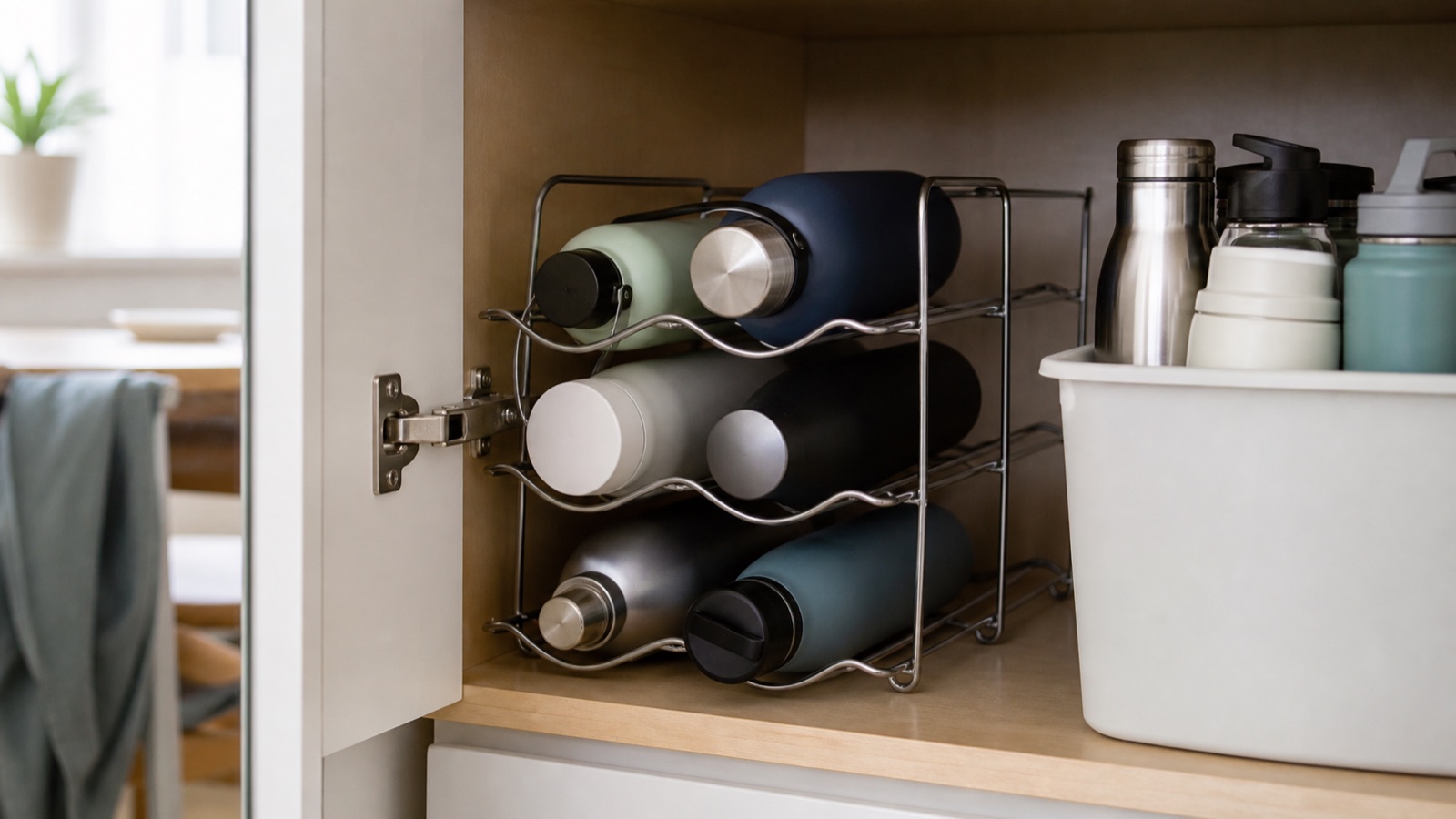
A 32-ounce insulated bottle stands about 10 inches tall, and a 40-ounce tumbler with its lid on is closer to 12. A standard upper cabinet shelf gives you 11 to 12 inches of clearance, so the bottles either lie down and roll toward you every time you open the door, or they live on the counter. Multiply that by a household of three, where two or three bottles per person is normal, and you have 8 to 12 bottles with no home.
Most water bottle storage ideas online are pantry makeovers with 24-inch-deep shelves and room for a dedicated bin. That is not the problem a small kitchen has. This guide belongs to our what goes where guide to storing everything in a small kitchen, and it works through seven ways to store water bottles inside a 12-inch cabinet, on a door, or on a cart, with the bottle sizes and clearances each one actually handles.
Thin the herd first
The most common regret in bottle organizer reviews is buying a 12-slot rack for a household that uses six bottles. Set a rule of one daily bottle plus one backup per person, and cap kids' spares at two. Everything else, including the free promotional bottles, goes in a donation bag.
Do this before you measure, because the count decides the solution. Six bottles fit on one shelf with a rack. Twelve need a door or a cart.
Lay them down in a stackable bottle rack
A wire or plastic bottle rack holds bottles on their sides in a cradle, three to five per tier, and stacks two tiers high. Each slot is usually 3.5 to 4 inches wide, and the whole rack is 10 to 14 inches deep, so it fits on a standard upper shelf. Prices run from under $15 for a single tier to $25 to $35 for a two-tier set. Check the listing for current slot dimensions against your widest bottle.
This works when the bottles go in empty and dry with the lids off, since a bottle stored with water in it will leak into the cabinet. It works for standard 20- to 32-ounce bottles up to about 3.75 inches in diameter. It does not work for 40-ounce tumblers with handles, which are over 4 inches wide and do not sit in a cradle, and stacking three tiers gets wobbly enough that reviewers report the top row sliding off when the door opens.
Stand them up in a deep lower cabinet
Lower cabinets are about 24 inches deep and 30 inches tall, and if you pull out the middle shelf you get a space where even a 12-inch tumbler stands upright. The problem is that bottles standing loose in a deep cabinet tip when you reach for the one in back. A plastic bin or a wide magazine file corrals four to six bottles so the whole group slides out together.
For short kids' bottles at 7 or 8 inches, a 5- to 6-inch shelf riser on the cabinet floor gives you two rows, one under and one on top. The inside-cabinet organization guide covers how to split a deep lower cabinet into zones, and our roundup of the best shelf risers and cabinet shelves lists the heights that fit under a lower cabinet shelf.
This does not work if the only deep cabinet you have is under the sink. Bottles do not belong next to the trash bag and the spray cleaners.
Over-the-door pocket organizer
A clear pocket organizer on the back of a pantry, closet, or laundry door is the highest-capacity option in a small kitchen. Pockets 4 to 5 inches wide hold bottles up to about 3.5 inches in diameter, with the top row reserved for lids and straws. A 12- to 24-pocket organizer usually costs $12 to $25.
It works when the door has 1 to 1.5 inches of clearance at the top for the hooks and swings freely without hitting a wall or shelf. It does not work on a hollow-core door loaded with full bottles, since a dozen full 32-ounce bottles weigh close to 30 pounds and the door will flex and the hooks will bend. Store bottles empty on a door, always. Our picks for the best over-the-door organizers and racks call out which pocket widths take wide bottles and which hooks fit thin doors.
Hooks and rails for bottles with handles
Bottles with a handle, a carabiner loop, or a strap can hang. A tension rod under an upper cabinet with S-hooks holds four to six empty bottles by their handles and costs under $20 total. Adhesive hooks on the side of a cabinet take one empty bottle each and should be rated for at least 3 pounds, with the usual warning that they let go near a steamy sink.
Magnetic hooks on the side of the refrigerator work for the same handled bottles, as long as the fridge side is steel and not the painted aluminum some newer models use. If you go the rod route, our guide to tension rod shelves and rails covers the rated loads and the rubber caps that keep a rod from sliding on cabinet paint.
Kids' bottles and the lid problem
Kids' bottles come with two or three parts each, and the parts are what end up loose in the cabinet. Give the bottles a low bin at a height a kid can reach, and give the lids and straws a separate small bin next to it. Both bins get emptied into the dishwasher at night and refilled in the morning.
The lid bin matters more than the bottle bin. Loose lids behave exactly like food container lids, and the same fix from our food container lid storage guide applies: one narrow container, lids standing on edge, nothing stacked.
A rolling cart as a hydration station
If you have no cabinet to give up, a three-tier rolling cart around 17 inches wide and 14 inches deep holds the whole system. Bottles stand on the top tier, lids and straws go in the middle, and drink powders, filters, and electrolyte packets fill the bottom. The cart parks beside the fridge or in a hallway and rolls to the sink for refills.
The limit is tier height. Some carts have only 9 to 10 inches between tiers, which will not clear a tall tumbler. Our roundup of the best rolling carts for small kitchens lists the tier clearances so you can match one to your tallest bottle.
Which fits your kitchen
If you have one free upper shelf, a two-tier rack handles six to ten standard bottles lying down. If you have a pantry or closet door, an over-the-door organizer handles a dozen or more, empty. If you have neither, a rolling cart gives every bottle, lid, and straw one address. Measure your widest bottle and tallest bottle first, then pick the rack, door organizer, or cart with the clearance to match.