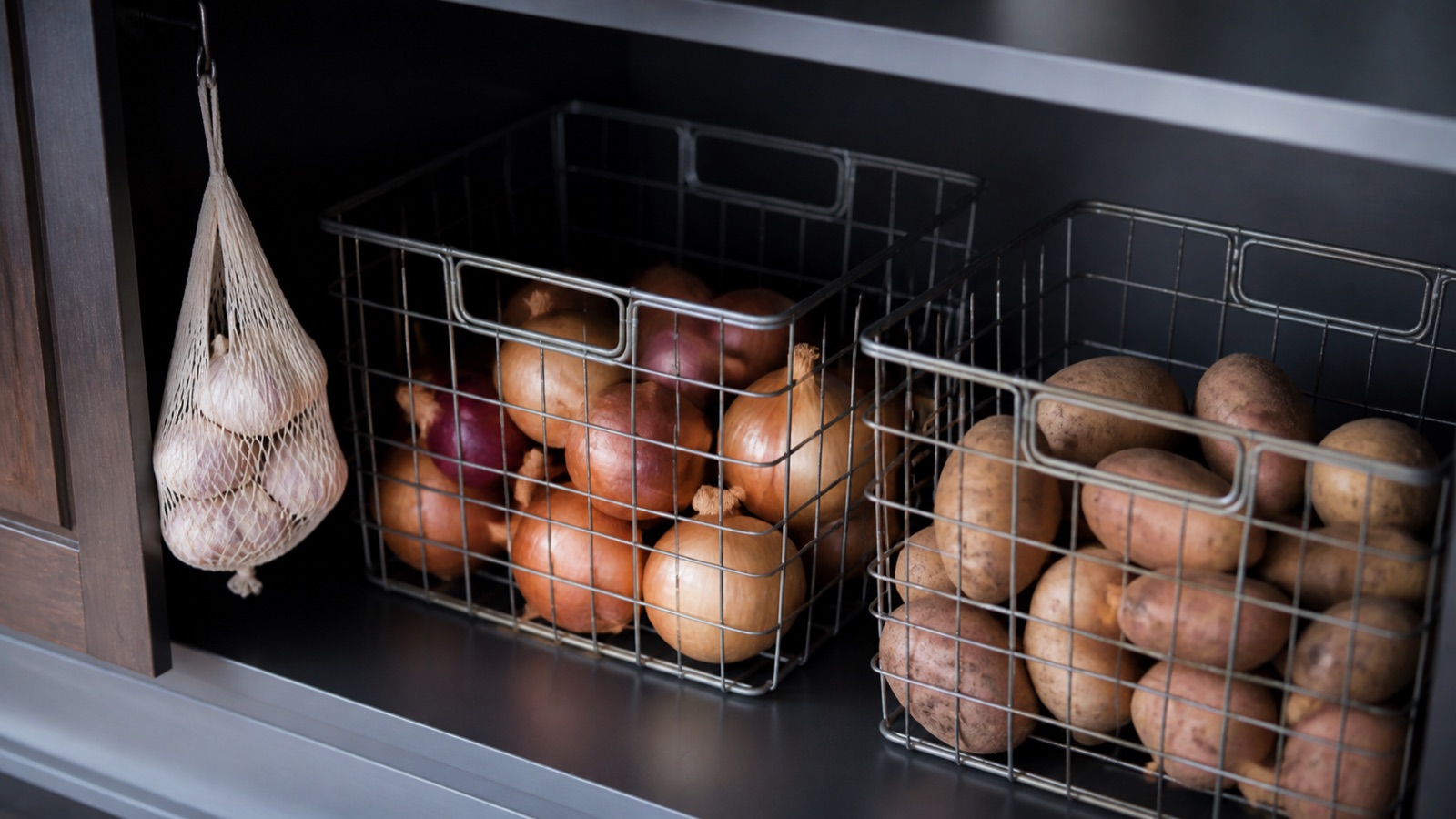
Every guide to storing onions and potatoes says the same thing: a cool, dark, dry place with good airflow. In a small apartment kitchen that place does not exist. There is no pantry and no cellar, the cabinet under the sink is damp, the top of the fridge is warm, and the one open shelf gets afternoon sun. So the potatoes sprout in the store bag within two weeks and the onions go soft in the bowl on the counter.
This is one of the item-by-item guides in our what goes where guide to storing everything in a small kitchen. It covers the storage rules that actually matter, five spots in a small kitchen that meet them, the spots that quietly ruin produce, and how long to expect each to last.
The rules that do not change
Potatoes want dark and cool. Light turns the skin green and bitter, and warmth makes them sprout. The ideal range is roughly 45 to 55°F, but a 65 to 70°F cabinet keeps them fine for two to three weeks. Do not refrigerate whole raw potatoes, since cold converts their starch to sugar and they brown unevenly and taste sweet when cooked. Do not leave them in the plastic store bag, which traps moisture and speeds rot.
Onions want dry and ventilated, and they tolerate a bit more light than potatoes. Whole onions do not belong in the fridge, where the humidity makes them soft, and they do not belong in plastic. Garlic and shallots follow the onion rules. Sweet potatoes follow the potato rules and are even more cold-sensitive.
Keep the two apart. Stored together in one bin, both spoil faster, because potatoes give off moisture that onions hate and the gases from each speed the other's sprouting. A couple of feet of separation or two separate ventilated bins is enough. And buy in 3- to 5-pound quantities, which one or two people use in two to three weeks, rather than the 10-pound bag that looked like a deal.
Ventilated bins in a lower cabinet
The floor of a lower cabinet is the closest thing an apartment has to a cellar: it is the coolest, darkest spot in the room. Stackable wire or mesh bins 10 to 12 inches wide give you two tiers with airflow on every side, and a set of two or three costs $20 to $35. Onions go loose in one bin; potatoes go in a paper bag or a breathable cloth bag inside another so they stay dark even when the door is open.
This works when the cabinet is away from the oven, the dishwasher, and the radiator, since all three heat the cabinet beside them. It does not work under the sink, where the humidity is exactly what both vegetables hate, and it does not work with solid plastic bins or lidded tubs that trap moisture. If every lower cabinet is already full, the no-pantry storage guide covers how to claim one shelf for food without giving up a whole cabinet.
Hanging mesh bags
Mesh produce bags take no shelf at all. Hang one from a hook inside a cabinet door, on the side of a cabinet, or from S-hooks on a tension rod under an upper cabinet. A set of three or four bags costs under $15, and a full 5-pound bag of potatoes plus 3 pounds of onions is 8 pounds of load, so use hooks rated for 5 pounds each and split the weight.
Onions and garlic thrive in a mesh bag, since they get airflow on all sides. Potatoes need the bag to be a dark cotton or burlap one, not open mesh, and it needs to hang somewhere that never gets direct window light. Our guide to tension rod shelves and rails covers the rod ratings if you go the under-cabinet route. Renters can use over-the-door hooks or the hooks inside a cabinet door instead of anything screwed to a wall.
A tiered rolling cart as a produce station
A three-tier rolling cart with mesh or slotted baskets is the most flexible answer for a kitchen with no cabinet to spare. Onions and garlic go on the top tier where air moves, and potatoes go on the bottom tier in a cloth bag or under a folded dish towel for darkness. The cart parks in the coolest corner, rolls out of the way, and doubles as a fruit and bread station. Carts in this size run $25 to $50.
The limits are light and heat. A cart beside a sunny window or next to the oven will sprout potatoes faster than a cabinet, so the parking spot matters more than the cart. Our roundup of the best rolling carts for small kitchens notes which have mesh baskets deep enough for a 5-pound bag.
A turntable in the dead corner cabinet
The deep corner cabinet that nothing fits in is dark, cool, and ignored, which is exactly what root vegetables want. A 10- to 12-inch lazy susan on the cabinet floor with two small wire baskets on it, one for onions and one for potatoes, spins the whole setup to the front when you need it. Turntables in this size cost $12 to $25.
This works when the corner cabinet is not beside the oven and has at least 13 inches of clearance for the turntable to spin. Use a turntable with a raised rim so a basket cannot slide off, and check the listing for current dimensions before you buy. Our picks for the best lazy susans for cabinets and corners cover rim heights and load ratings, and the corner cabinet storage guide has the measuring steps for the awkward opening.
Where not to put them
Skip the cabinet under the sink, which is humid and often warm from the dishwasher. Skip the top of the refrigerator and any cabinet touching the oven, both of which run warm enough to sprout potatoes in a week. Skip the fridge for whole raw potatoes and whole onions. Skip the plastic store bag and the sealed plastic tub. And skip the sunny windowsill, however nice the bowl looks there.
How long they last and when to toss
At room temperature in a dark, ventilated spot, potatoes last two to three weeks, and in a spot that stays under 60°F they can last a month or two. Onions in a dry, ventilated spot last four to six weeks. Once an onion is cut, it goes in a sealed container in the fridge for up to a week to ten days; peeled or cut potatoes go in a bowl of cold water in the fridge and should be cooked within a day.
A potato with small sprouts and firm flesh is fine once the sprouts are cut off; one that is soft, wrinkled, or green under the skin goes in the compost. An onion with a soft spot or a mushy neck is done. Once these two have a home, the snack storage guide handles the rest of the no-pantry problem, and the rolling cart roundup is the place to start if the cart option won.