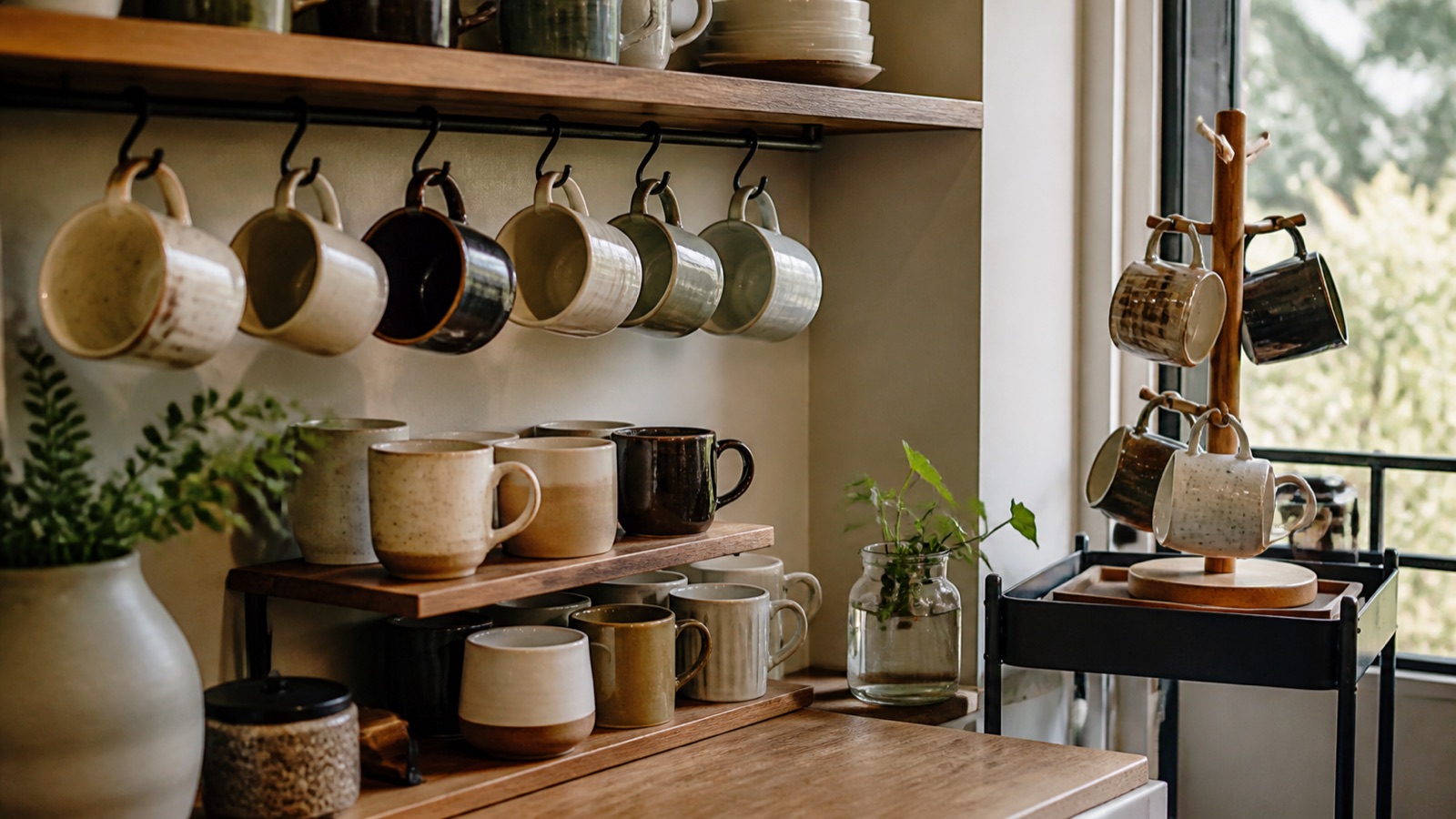
If your mugs have spread onto the counter, the top of the fridge, and the windowsill, you are not disorganized. You are out of vertical space. A standard upper cabinet shelf is about 12 inches tall and 11 to 12 inches deep, and a single row of 4-inch mugs uses only a third of that height while claiming the whole footprint.
Most mug storage roundups answer that problem with a gallery of hook walls and pegboards. Those assume you have a blank wall, that you are allowed to drill into it, and that you want 20 mugs on display next to the stove. Plenty of small kitchens have none of those things, which is why this piece sits inside our what goes where guide to storing everything in a small kitchen and works from the cabinet outward.
Below are six ways to store mugs, ordered roughly by how much cabinet space you still have. Each one comes with the conditions where it works and the ones where home cooks consistently report it failing.
Cull the collection before you buy anything
The most common complaint in mug organizer reviews is that the rack was full on the day it arrived. That is a collection problem, not a hardware problem. A workable rule for a small kitchen is two mugs per person in the household plus four for guests, which puts a two-person apartment at eight mugs total.
Box the rest and put the box in a closet for 30 days. If you do not go looking for a specific mug in that time, donate the box. The kitchen declutter checklist walks through the same test for the rest of the cabinet, and it is worth doing before you measure for any organizer, because the right one depends on how many mugs are left.
Under-shelf cup hooks inside the cabinet
Screw-in cup hooks are the cheapest fix and the one that recovers the most space. A pack of 10 to 20 brass or vinyl-coated hooks usually runs under $10. Screw them into the underside of a cabinet shelf, and hang mugs by their handles in the dead air above the plates or glasses on the shelf below.
Space the hooks 4 to 5 inches apart so the mugs do not clink. That gives you five or six mugs per 24-inch shelf, and the shelf itself stays free for something else. Stagger two rows front and back if the shelf is 11 inches or deeper.
This works when the shelf is solid wood, plywood, or MDF at least half an inch thick. It does not work with glass shelves, with thin particleboard that crumbles around the screw, or with wire shelving. Renters usually find that a few small holes inside a cabinet are not a deposit issue, but check your lease. If you would rather not screw anything, clip-on under-shelf mug hangers hook over the front edge of the shelf and hold two to four mugs each with no tools.
A shelf riser to get a second row
If your mugs are 4.5 inches tall or shorter, a 5- to 6-inch shelf riser turns one row into two inside a standard 12-inch shelf. Mugs go underneath, and a second set goes on top. Wire risers with a flat top are the sturdiest; bamboo looks better but is often taller, so check the listing for current dimensions against your shelf clearance.
The limits are height and weight. Tall latte mugs and travel tumblers at 5 to 6 inches will not fit under a riser in a 12-inch shelf, and expandable risers sag in the middle when loaded with a dozen stoneware mugs, which together weigh 10 to 12 pounds. Measure the shelf depth too, since most risers need 10 to 11 inches to sit flat. Our roundup of the best shelf risers and cabinet shelves sorts them by clearance and load so you can match one to your mugs.
Tension rod with S-hooks (no drill)
A tension rod with a handful of S-hooks gives you a hanging rail without a single screw. Run it under an upper cabinet, across the inside of a cabinet opening, or in the gap between the end of a cabinet and the wall. A rod rated for around 12 pounds holds six to eight mugs, and S-hooks come in packs of 10 to 20 for a few dollars.
This works when you have two parallel surfaces 18 to 36 inches apart and the mugs are hanging, not swinging. It does not work across an open room, above a stove where steam and grease build up, or on painted drywall without rubber end caps, which otherwise leave dents. If you go this route, our guide to tension rod shelves for renters covers the rated loads and the end caps that hold on slick surfaces.
Mug tree or a coffee station on a cart
A rotating mug tree holds six mugs in a 7- to 8-inch footprint and costs under $20. It only earns its counter space if you already keep a coffee corner, because otherwise it is one more thing sitting where you need to chop. The countertop organization guide has a short test for whether an item deserves to live on the counter at all.
If the coffee maker, filters, and mugs are all fighting for counter space, moving the whole setup to a three-tier rolling cart is often the cleaner fix. Mugs hang from S-hooks on the side rail, the coffee maker sits on top, and the cart tucks against a wall or beside the fridge. Our picks for the best rolling carts for small kitchens note which ones have side rails sturdy enough for hanging mugs.
Wall rail or rack (when you can drill)
If you own your place or have permission, a 16- to 24-inch wall rail with sliding hooks holds 8 to 12 mugs at eye level. Mount it into studs or with drywall anchors rated for at least 25 pounds, since a dozen ceramic mugs plus the rail can pass 15 pounds. Leave 5 inches of clearance below the rail so the mugs do not scrape the backsplash.
Adhesive hooks are the renter version, and they are the one solution that draws consistent warnings in reviews. Limit each hook to a single mug, stay away from the sink and stove, and expect them to let go if the wall gets humid or greasy. Do not hang anything you would be sad to see shatter.
Which one to pick
If you still have a cabinet, start with cup hooks under the shelf and a riser above them, which together roughly triple what one shelf holds. If the cabinets are full, a tension rod under the upper cabinet is the fastest no-drill rail. If you are down to counter and floor, a rolling coffee cart keeps mugs, machine, and supplies in one movable spot.
Whichever you choose, measure the shelf height, depth, and your tallest mug first. Then use the shelf riser roundup or the tension rod guide to pick a size that actually fits.