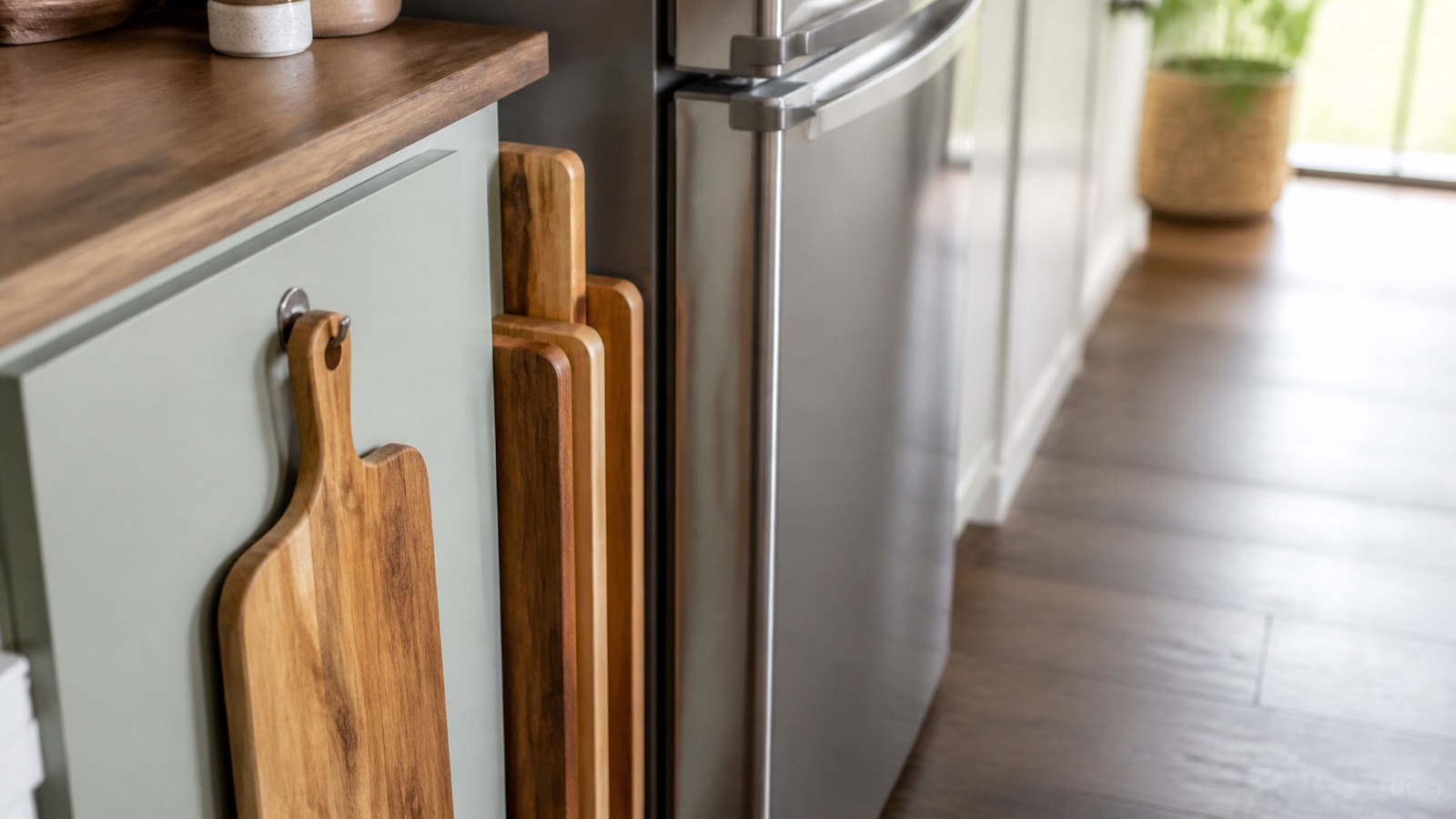
You have three cutting boards, one of them a heavy wooden one, and they lean against the backsplash because that is the only place they fit. The wet one never quite dries, and the plastic ones slide down behind the toaster. Search "cutting board storage ideas" and you get photos of built-in slots in custom cabinetry, which does not help in a rental with four cabinets. This page is one of the item guides in our what-goes-where guide to small kitchen storage, and each option below is sorted by what it needs from your kitchen, plus whether a wet board can dry in it.
That drying question matters more for boards than for anything else you store. A wood board stored wet against a wall warps and can grow mold on the hidden side, and plastic boards hold water in the knife scores. Whatever you choose, a board needs airflow on both faces for a few hours after washing, which rules out any slot that seals it against a wall or another board.
Stand them in a countertop rack
A bamboo or steel countertop rack with three or four slots holds boards on edge in a footprint of roughly 6 by 10 inches, and many hold a couple of pot lids or a sheet pan too. Under $20 buys one, and the open design lets boards dry. It goes against the backsplash at the end of the counter run, which is where boards usually end up anyway, just stacked.
It costs counter space, which is the scarcest thing in a small kitchen, so it only earns its place if boards were already living on the counter. Slots are typically sized for boards up to about 1.5 inches thick, so a heavy end-grain block does not fit and tips the rack when leaned in. Check the listing for slot width before buying one for a thick board.
Slot them into a cabinet with a rack or tension rods
Inside a cabinet, boards share the vertical rack you use for baking sheets, standing on edge in slots 1 to 2 inches apart. If you would rather not buy a rack, two short tension rods mounted vertically from the cabinet floor to the shelf make the same slots for under $15 with no screws. A cabinet at least 13 inches tall inside fits most boards on their long edge.
Slots inside a cabinet are the one place a wet board should not go, so this is for boards that are already dry or for the boards you use less. Tension rods slip on slick laminate under a heavy board, and a rack with narrow wire slots lets thin flexible mats slump. Our roundup of the best tension rod shelves and rods covers which end caps grip laminate, and our guide to baking sheet storage shows how to share one rack between boards, sheets, and cooling racks.
Hang them on the cabinet door or over the door
A wire rack that hooks over a cabinet door holds two or three boards in the 3 inches behind the door, and an over-the-door rack on a pantry door holds larger boards and the flexible mats. Neither needs tools, both cost $10 to $25, and boards hanging on a door get air on both sides. This is the usual choice when neither the counter nor a cabinet has room.
Weight and thickness are the limits. A hook-over rack holds boards up to about 1 inch thick, so the butcher block stays out, and a door with more than about 5 pounds hanging on it starts to sag on its hinges. Over-the-door racks add 2 to 3 inches to the door, so the shelf behind needs clearance. The best over-the-door organizers for small kitchens compare which ones fit standard cabinet doors versus full-size pantry doors.
Hook them on the wall by the handle
Boards with a handle or a hole hang from a single hook on the wall or the side of a cabinet, which uses no counter, no cabinet, and gives the board full airflow. A wall rail with S-hooks holds two or three boards in about 12 inches. Adhesive hooks rated for 5 pounds handle a plastic or thin wood board for a renter; a wooden board over about 3 pounds should go on a screw-in hook.
Only boards with a hole or handle work, and a hanging board on the wall near the stove collects grease. It also has to be somewhere you will not bump it, since a 2-pound board swinging on a hook near a doorway is a bruise waiting to happen. For rails, hooks, and where to mount them, see our guide to vertical and wall storage for small kitchens.
Slide them into the gap beside the fridge or stove
The 2- to 4-inch gap between the fridge and the wall or cabinet fits a thin board on edge, and a slim rolling cart in a 5- to 8-inch gap holds several boards plus the sheet pans. Slim carts, $25 to $50, roll out for access and hide the whole collection. Our roundup of the best rolling carts includes the narrow models that fit these gaps.
The gap beside the stove is hot when the oven is on, and a wood board stored there for a year dries out and cracks. The gap beside the fridge is safer but airless, so only dry boards go there. Measure the gap with the appliance pulled to its normal position, since a fridge that rocks forward a half inch turns a fit into a jam.
Lean them against the backsplash, done right
Leaning boards on the counter is what most people do, and it is fine for a single board if it can dry. Stand it on a short edge on a folded dish towel or a silicone trivet, leaning at an angle so both faces get air, and move it once a day. A wet board flat against tile never dries on the back, which is where mold starts.
This does not scale past one or two boards, and it uses the same counter inches as a rack without the stability. Plastic boards slide off a wet counter, and a heavy board leaning on a toaster is a nuisance. If you have more than two boards leaning, it is time for one of the racks above.
Keep fewer boards
The cook with one large wood board and one small plastic board for raw meat usually has no storage problem at all. Boards are among the first things a minimalist kitchen essentials list trims, and flexible cutting mats, which roll up and stand in a mug, replace the middle sizes for most tasks. Sell or donate the boards you have not used in a month.
Store the survivors where they can dry: a countertop rack or a door rack for the daily board, a cabinet slot or the fridge gap for the backups. If you are buying one thing, an over-the-door organizer solves this for most small kitchens without touching the counter, and a pair of tension rods handles the cabinet for under $15.